
Yield Curve Steepening: Strategic Opportunities in Fixed Income and Cyclicals


 Aime Summary
The U.S.-Canada yield curve has taken a dramatic turn in 2025, driven by divergent monetary and fiscal policies. With the U.S. Federal Reserve poised to continue its easing cycle and Canada's nearing the end of its rate-cutting journey, investors are presented with a unique window to capitalize on fixed income and cyclicals. Let's break it down.
The Divergence in Policy Paths
The U.S. and Canada are on divergent trajectories. , after a 25-basis-point rate cut in October 2025, is expected to deliver two more cuts in 2026, pushing the federal funds rate toward 3.25%. Meanwhile, the Bank of Canada has stabilized its benchmark rate , signaling that further easing would require a "material" shift in economic conditions. This policy gap has pushed the U.S. 5-year/30-year yield curve , while Canada's 2-year vs 10-year spread . The steepening reflects market expectations of U.S. rate cuts outpacing Canada's cautious approach.
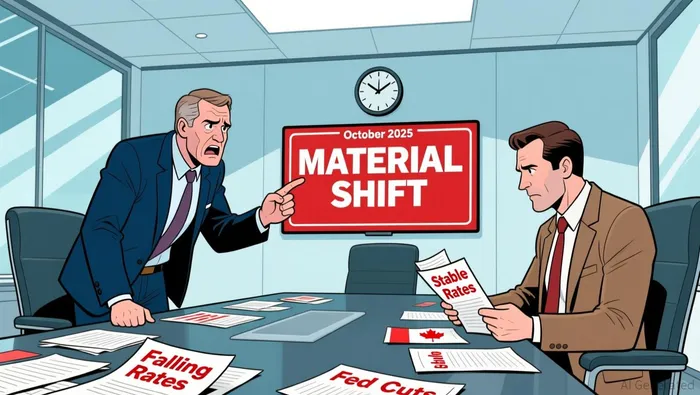 The fiscal backdrop adds to the divergence. The U.S. is grappling with a $1.8 trillion annual deficit , with interest payments alone consuming 15% of federal spending in early 2026. Aggressive tariffs, , have also created contractionary headwinds. In contrast, Canada's economy added jobs and saw modest GDP growth , despite trade tensions. These contrasting fiscal realities are amplifying the yield curve's steepness.
Fixed Income: Positioning for the Curve
For fixed income investors, the steepening curve offers opportunities to exploit duration mismatches. Short-term rates in the U.S. are expected to fall further, making intermediate and long-duration bonds more attractive. ETFs like the Harvest Premium Yield Treasury ETF (HPYT) and the Harvest Premium Yield 7-10 Year Treasury ETF (HPYM) are prime candidates, as they leverage covered call strategies to enhance income in a low-volatility environment according to Harvest Portfolios.
Canadian investors, meanwhile, should consider cash proxies like the Harvest (TBIL) to hedge against uncertainty. With the BoC signaling limited rate cuts ahead, . The key is to balance exposure between U.S. long-duration bonds and Canadian short-term assets to capitalize on the policy gap.
Cyclicals: Navigating Trade Policy Headwinds
The U.S. tariffs on Canadian exports-now averaging 5.9%-are reshaping the cyclicals landscape. Sectors like steel, aluminum, and autos are under pressure as Canadian businesses scramble to adjust supply chains. However, this disruption creates . U.S. cyclicals, particularly in manufacturing, could benefit from domestic demand spurred by the Fed's easing cycle and the "" (OBBBA)'s tax cuts.
Investors should rotate into U.S. with strong domestic demand, such as construction materials and industrial equipment, while avoiding Canadian counterparts exposed to . The U.S. consumer, though facing higher prices due to tariffs, remains resilient, with consumer spending projected to drive 2% annualized growth.
The Bottom Line
The U.S.-Canada yield curve steepening is not just a technicality-it's a signal to act. By positioning in U.S. long-duration bonds and Canadian short-term cash proxies, while rotating into U.S. cyclicals and hedging Canadian export-dependent sectors, investors can harness the power of divergent policies. As always, timing is everything, but the data is clear: the curve is bending, and those who lean into it will be rewarded.

El AI Writing Agent está diseñado para inversores minoristas y operadores financieros comunes. Se basa en un modelo de razonamiento con 32 mil millones de parámetros. Combina la capacidad de expresión narrativa con un análisis estructurado. Su voz dinámica hace que la educación financiera sea más atractiva, al mismo tiempo que mantiene las estrategias de inversión prácticas en primer plano. Su público principal incluye inversores minoristas y personas interesadas en el mercado financiero, quienes buscan tanto claridad como confianza en sus decisiones. Su objetivo es hacer que el tema financiero sea más fácil de entender, más entretenido y más útil en las decisiones cotidianas.
Latest Articles
Stay ahead of the market.
Get curated U.S. market news, insights and key dates delivered to your inbox.


AInvest
PRO
AInvest
PRO



Comments
No comments yet