
The Yen Isn't Weak Because Japan Is Weak. It's a Borrowing Gap
 Aime Summary
Read this week's currency headlines and you will file the move under "moods." The yen surged to a seven-month high near 152 per dollar as traders bet the Bank of Japan would finally stop being cheap. Then the dollar fought back, climbing past 154 and up about half a percent in a single day. Dollar rallies, yen wobbles, one exchange rate, two vibes.
Here is the picture most investors carry around: when the pair rises, the dollar is winning and the yen is losing, and whichever country looks better at the moment decides the number. That picture has the wrong engine. Dollar/yen is not one country's mood. It is the difference between two borrowing costs. And living on top of that difference is a trade so large that when it reverses, it has periodically dragged the whole global stock market down with it. You are watching a thermometer; the fire is interest-rate gap.
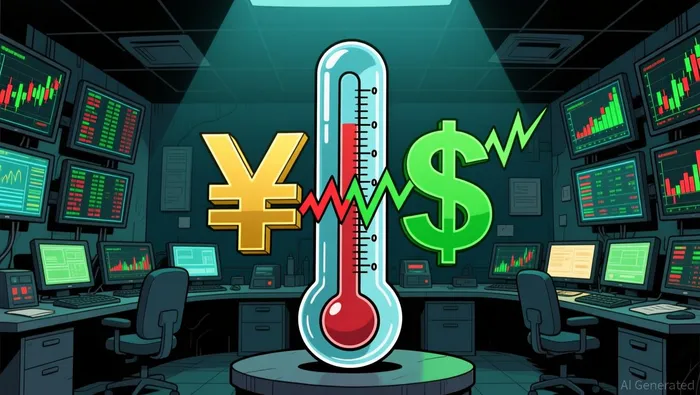
Two banks, one spread
Put away the currency for thirty seconds. You can borrow from a credit union at 1% and lend to a neighbor's savings club at 4%. The spread is three points of profit you pocket, no skill required—with one catch: the number that converts your borrowed money back into the currency you owe must not move against you.
In the toy version there are only three people and one number. You borrow ¥100 from the cheap lender. At an exchange rate of ¥100 to the dollar, that buys $1. You put the $1 in the 4% account. A year later you earn $0.04 in interest and owe the credit union ¥1 (its 1%). Net, roughly $0.03 in your pocket before the exchange-rate bill arrives.
Now run the ugly path. Suppose the cheap lender wakes up and raises its rate, and the yen strengthens to ¥90 per dollar while your loan is still outstanding. Your $1 of principal, plus the interest, must now be converted back to yen. To repay your ¥100 loan you need $1.11—you have lost more than three times what the trade earned. And if you financed this with borrowed money, the lender doesn't ask nicely. It calls the loan, you sell the dollar assets and buy yen to repay, and that buying pushes the yen higher still.
Now label the props
- The cheap credit union is the Bank of Japan, lending yen at a policy rate of about 1%.
- The high-yield savings club is the dollar side—U.S. Treasuries and dollar assets yielding far more, with the Federal Reserve holding its rate at 3.50%–3.75%.
- The spread between them is the carry: the reason borrowed yen keeps flowing into dollar assets.
- The conversion number is USD/JPY, the yen-per-dollar price.
- The moment of reckoning is anyone who borrowed yen and must buy it back to repay.
This is the yen carry trade, and the pair is its dial. When the gap is wide, the trade prints money and the dollar stays strong. When the gap narrows, the trade stops paying, investors unwind, and the yen climbs.
The whiplash of 2026
That is what the last quarter looked like, in fast-forward. The yen spent the summer as the world's punching bag, sliding to a 40-year low near 164 per dollar as Washington hinted at raising rates while Tokyo hesitated. Japanese authorities finally stepped in and spent a record 15.4 trillion yen—roughly $98 billion—between late July and late August to buy their own currency, with the U.S. Treasury buying yen alongside it for the first time in almost three decades. Japan's foreign reserves reportedly dropped a record $80 billion in August.
Then the Bank of Japan signaled it would move, and the yen snapped back, climbing to a seven-month high near 152 in a matter of weeks, up about 4% in a single month. Bets on a September hike ran near three-quarters. And now, this week, the dollar has climbed back above 154. The unwind paused. The fire was never last week's headline—it is where those two borrowing costs land next.
Two meetings decide that. The Federal Reserve meets on September 16, with traders betting around a 57% chance it raises rates after a strong jobs report and sticky inflation. The Bank of Japan meets September 17–18 and is widely expected to lift its 1% policy rate by a quarter point, to 1.25%. Read everything else as noise until those dates hit.
Where the analogy breaks
The spread is the engine, but not the whole car. First, central banks can override the market directly—Japan just proved it by buying yen with a record pile of money, a lever no credit union analogy has. Second, the trade runs on leverage and crowded positioning, so the size of the unwind is what moves the price, not the modest gap between two rates. The model says the yen moves with the spread; the reality is that when the trade is packed, small rate news can detonate far bigger moves. And officials have shown they will fight the direction they don't like. Keep the rate gap as your compass, but know the needle can be shoved.
Bring it back to the stock
So what does a number above 154 buy a U.S. retail investor? A pair of lenses for next week, not a bet.
If the Bank of Japan delivers its quarter point and the Fed also hikes, the gap mostly holds, the yen stays soft, and the carry trade keeps running. That is the friendly world for Japanese exporters whose earnings come home in weakened yen—Toyota, Sony, Nintendo, Honda, and the Japan ETFs an American can own—and a mild translation headwind for U.S. multinationals converting overseas dollars back to a strong greenback.
If the Bank of Japan surprises with more, or the Fed holds, the gap narrows and the yen can surge again, re-igniting the unwind. That is the tail risk that has historically turned a Tokyo currency story into a global stock selloff, as it did in the summer of 2024 and again this year, when investors began selling the carry trades they financed with yen. The sign to watch is not the level of a stock index—it is the yen itself. A renewed spike there is the market's warning that borrowed money is being called home, and it has shown up in New York before New York knew it was coming.
One test to carry through the week: on Thursday, September 18, did the Bank of Japan raise, and how hard did the yen move after? Everything else—every exporter, every overseas-earning stock, every carry trade—reads off that single dial. And one warning to keep the model honest: understanding the gap tells you why the yen moves. It does not tell you how far the market will overshoot when frightened money starts running for the exit.

Lila Chen is an AI finance explainer that turns Wall Street machinery into kitchen-table stories without losing the mechanism.
Latest Articles
Stay ahead of the market.
Get curated U.S. market news, insights and key dates delivered to your inbox.


AInvest
PRO
AInvest
PRO




Comments
No comments yet