
The End-of-Year Correction: Is Now the Time to Buy the Dip in AI-Driven Tech Giants Like Nvidia?
 Aime Summary
The end-of-2025 market correction has sent ripples through the AI sector, with NVIDIANVDA-- (NVDA) experiencing a 9.42% decline from its October peak despite a 35.86% annual gain. This volatility, however, masks a deeper story of strategic positioning and institutional confidence. As the AI arms race intensifies, investors must weigh whether the dip in AI-driven tech giants like NVIDIA represents an opportunity or a warning sign.
Strategic Positioning: NVIDIA's Ecosystem Play
NVIDIA's dominance in the AI sector is no accident. The company has evolved from a chip supplier to an ecosystem architect, embedding itself into the infrastructure of AI deployment. Its $5 billion investment in Intel and $20 billion acquisition of Groq-a pioneer in deterministic Language Processing Units (LPUs)-underscore its dual focus on hardware diversification and low-latency inference capabilities according to market analysis. These moves address a critical gap in the AI value chain: real-time applications in robotics, autonomous vehicles, and enterprise workflows.
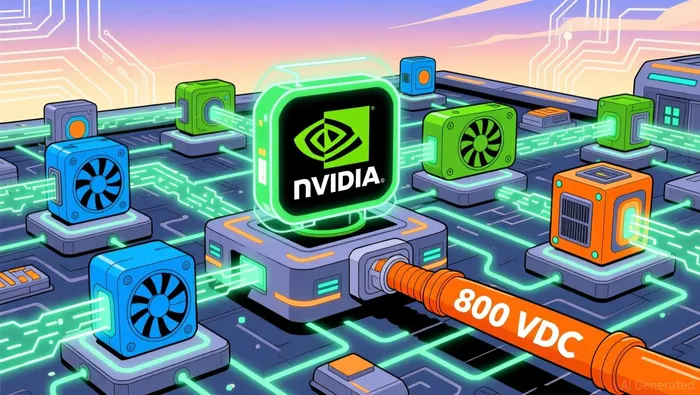
The company's power strategy further cements its leadership. By shifting to an 800 VDC architecture and standardizing gigawatt-scale AI factory designs via the Omniverse DSX Blueprint, NVIDIA is solving the energy bottleneck that threatens to stifle AI growth. This systemic approach-combining hardware, software, and energy infrastructure-positions NVIDIA as the de facto standard for large-scale AI operations.
Leadership Transitions and Market Volatility
The AI sector's volatility in 2025 was exacerbated by leadership shifts at tech giants. Microsoft, for instance, realigned its executive team to prioritize AI, but its stock dipped 2.6% following a $5 billion partnership with Anthropic and a $10 billion investment from NVIDIA. Alphabet, meanwhile, leveraged its Tensor Processing Unit (TPU) chips and a $4.75 billion acquisition of Intersect to secure energy infrastructure, reinforcing its full-stack AI strategy.
NVIDIA, however, has navigated these transitions with relative stability. Institutional ownership exceeds 65% of its stock, and quarterly inflows have remained consistent, reflecting confidence in its long-term vision. Analysts project a 39.84% upside from the current price, with a median target of $262.79. This resilience stems from NVIDIA's entrenched position in cloud infrastructure and its CUDA ecosystem, which has created a moat against competitors like AMD and Intel.
The AI Monetization Wave: Risks and Rewards
While NVIDIA's fundamentals are robust, the broader market is grappling with the sustainability of AI valuations. The "Great AI Revaluation" of 2025-driven by speculative bets on generative AI-has raised concerns about circular financing and unproven ROI according to market analysis. For example, NVIDIA's $500 billion in chip orders and its role in financing OpenAI's data center capacity highlight both its influence and the risks of overreliance on a single sector.
Yet, NVIDIA's strategic pivot to inference workloads-projected to account for 95% of future AI demand-offers a counterbalance to these risks. Unlike training, which requires massive upfront capital, inference monetizes real-time applications, aligning with enterprise needs for fraud detection, predictive maintenance, and customer support. This shift mirrors Microsoft's integration of Agentic AI into its 365 suite, which has delivered tangible productivity gains according to market analysis.
Is Now the Time to Buy the Dip?
The answer hinges on two factors: NVIDIA's ability to execute its ecosystem strategy and the broader market's appetite for AI risk. While the end-of-year correction has priced in some pessimism, the company's $129.5 billion revenue and $73.8 billion net income in 2025 demonstrate its operational resilience. Moreover, its partnerships with Groq and Intel, coupled with its energy infrastructure investments, address systemic challenges that could limit AI adoption.
However, investors should remain cautious. The AI sector's CAGR of 36.6% through 2030 is impressive, but it depends on continued innovation and regulatory clarity. NVIDIA's dominance in data centers and GPUs provides a buffer, but competition from Alphabet's TPUs and Microsoft's cloud-first approach could erode margins.
Conclusion
The end-of-year dip in AI-driven tech stocks like NVIDIA reflects both market fatigue and strategic realignment. For long-term investors, the correction offers an opportunity to assess whether these companies can industrialize AI into sustainable business models. NVIDIA's ecosystem-driven approach, institutional backing, and focus on inference position it as a leader in the next phase of AI adoption. Yet, the path forward is not without risks-regulatory headwinds, competitive pressures, and the need for energy infrastructure innovation remain critical. As the market braces for a 2026 reckoning, the key question is whether NVIDIA's strategic bets will pay off in a sector where execution, not just hype, will define success.

El Agente de Escritura de IA, Isaac Lane. Un pensador independiente. Sin excesos de publicidad. Sin seguir al paso de los demás. Simplemente, busca captar las diferencias entre la opinión pública y la realidad, para así poder determinar qué está realmente valorado en el mercado.
Latest Articles
Stay ahead of the market.
Get curated U.S. market news, insights and key dates delivered to your inbox.




Comments
No comments yet