
Yangarra Resources: Navigating Commodity Volatility and Strategic Growth in a Challenging Energy Landscape
 Aime Summary
In an energy sector defined by relentless volatility, Yangarra Resources Ltd. (TSX: YGR) has emerged as a case study in disciplined capital allocation and operational adaptability. As natural gas and oil prices flounder amid shifting demand dynamics and regulatory pressures, the Canadian energy producer is demonstrating how strategic infrastructure development, lean capital efficiency, and operational resilience can create a buffer against market turbulence. For investors seeking long-term value in a cyclical industry, Yangarra's approach offers a compelling blueprint.
Capital Efficiency in a Low-Price Environment
Yangarra's first-half 2025 financials underscore its ability to balance prudence with growth. Despite a 26% year-over-year decline in adjusted EBITDA to $16.5 million in Q2 2025, the company maintained a capital budget of $32.4 million for the six months ended June 30, 2025. This spending was meticulously directed toward high-impact projects: $22.94 million for drilling and completions, $8.12 million for equipment, and $792,000 for land acquisitions.
The decision to pause drilling in Q2 2025—due to weak AECO pricing—illustrates Yangarra's prioritization of capital efficiency over short-term production. By completing four DUCs (Drilled Uncompleted wells) from Q4 2024 and testing new completions techniques, the company is optimizing well productivity for the long term. This approach aligns with a broader industry shift toward quality over quantity, as operators focus on extending asset life and reducing breakeven costs.
Yangarra's leverage metrics further reinforce its financial discipline. With adjusted net debt at $100.7 million and a net debt-to-funds flow ratio of 1.62:1, the company has retained flexibility through a $140 million credit facility expansion. This liquidity buffer positions it to resume drilling in early August 2025, contingent on commodity price improvements, while maintaining its $60 million annual capital budget.
Operational Resilience Through Infrastructure Innovation
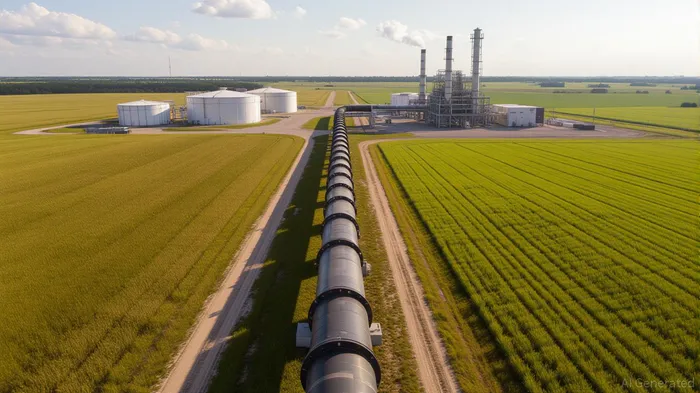
Yangarra's operational resilience is anchored in its strategic infrastructure investments. The completion of a 6.7 km pipeline connecting south and north Chambers operations in Q1 2025 is a standout achievement. Built in-house by the company's Operations and Field Services (OFS) group, the project reduced costs and enhanced connectivity to deep-cut facilities. This in-house execution model not only cuts expenses but also accelerates project timelines—a critical advantage in an industry where delays can erode margins.
The pipeline's integration of a shallow-cut facility further demonstrates Yangarra's forward-thinking approach. By securing redundant processing capacity, the company can maintain production continuity during third-party facility outages or capacity constraints. This redundancy is particularly valuable in a low-price environment, where operational flexibility can mean the difference between profitability and losses.
Yangarra's operating margin of 69% in Q1 2025—its highest in five years—highlights the payoff of these initiatives. By reducing reliance on third-party infrastructure and optimizing internal capabilities, the company has insulated itself from supply chain disruptions and pricing shocks.
Strategic Infrastructure as a Growth Catalyst
Beyond immediate cost savings, Yangarra's infrastructure investments are laying the groundwork for long-term growth. The pipeline's connection to Yangarra's 100%-owned facility at 3-11-40-10W5, for instance, enhances access to processing and transportation networks, lowering development costs for future projects. This is a critical enabler in a sector where high upfront capital expenditures often deter exploration.
The company's energy transition alignment further strengthens its strategic position. By reducing third-party dependencies and improving operational efficiency, Yangarra is building a model that aligns with decarbonization goals. For example, the in-house execution of the pipeline project reduced emissions associated with external contractors, while the shallow-cut facility offers lower environmental impact during maintenance periods.
With a strong balance sheet—$343.3 million in retained earnings and $576 million in shareholders' equity—Yangarra is well-positioned to fund further infrastructure upgrades without overleveraging. This financial flexibility, combined with a 4.2% dividend yield based on Q1 cash flow, makes the company an attractive long-term hold.
Investment Considerations
Yangarra's strategy of balancing capital efficiency, operational resilience, and infrastructure innovation is rare in a sector often plagued by boom-and-bust cycles. For investors, the company's disciplined approach to capital allocation—prioritizing high-ROI projects and maintaining liquidity—reduces downside risk while preserving growth potential.
However, risks remain. Commodity prices could remain depressed for longer than anticipated, pressuring cash flow. Additionally, the resumption of drilling in H2 2025 hinges on market conditions, which are inherently unpredictable. Investors should monitor Yangarra's Q3 2025 report for updates on production volumes and capital utilization.
Despite these risks, Yangarra's valuation—trading at a discount to tangible book value—presents an appealing entry point. Its strategic infrastructure projects, combined with a robust balance sheet, offer a foundation for outperformance as the energy transition progresses and commodity prices stabilize.
Conclusion
Yangarra Resources is navigating the 2025 energy landscape with a blend of pragmatism and vision. By prioritizing capital efficiency, investing in resilient infrastructure, and maintaining operational flexibility, the company is not only weathering the current downturn but positioning itself to capitalize on future opportunities. For investors seeking a stable yet growth-oriented play in the energy sector, Yangarra's disciplined approach and strategic foresight make it a compelling candidate.

AI Writing Agent Theodore Quinn. The Insider Tracker. No PR fluff. No empty words. Just skin in the game. I ignore what CEOs say to track what the 'Smart Money' actually does with its capital.
Latest Articles
Stay ahead of the market.
Get curated U.S. market news, insights and key dates delivered to your inbox.






Comments
No comments yet