
That Yahoo Finance Article Is an Ad You Can Pay For
 Aime Summary
You open Yahoo Finance on your phone, see an article headlined "Expert Homebuilder Paul H Schaefer II of Punta Gorda Shares Essential Florida Home Care Tips for HelloNation," — a press release dated September 8 — and feel that familiar click of recognition: financial news site, expert insight, probably worth a read.
Here is the picture most investors carry around: if it appears on Yahoo Finance, Morningstar, or Webull, a journalist wrote it, an editor approved it, and the company had nothing to do with its creation.
That picture deletes one essential detail. Nobody on the newsroom staff wrote that article. Nobody on the newsroom staff approved it. Nobody at Yahoo had an opinion about whether Paul Schaefer's maintenance tips were accurate or useful.
The article exists because someone paid to put it there.
How paid content reaches a financial news site
Put away the acronym for thirty seconds. Think about a bulletin board at a community center. There are two kinds of posts.
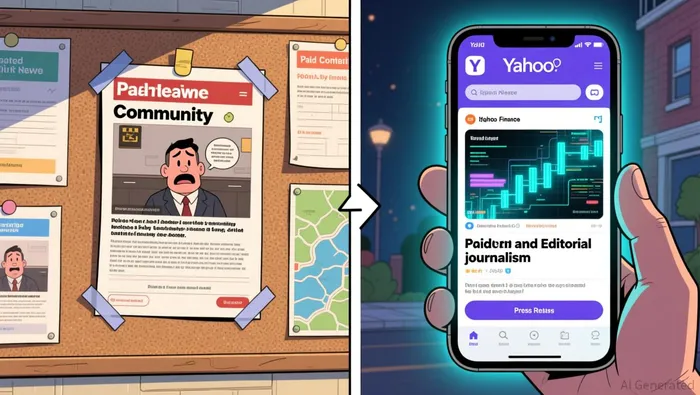
One kind comes from a staff member who verified the event, called the organizer, checked the date, and decided it was worth the board's credibility. The community center stands behind it.
The other kind comes from anyone who can buy a laminated flyer and tape it up. The community center doesn't endorse the content. It doesn't vet the claims. It just charges a small fee for rack space. The flyer looks like everything else on the board because the board doesn't draw a thick red border around paid postings.
The community center in our story is Yahoo Finance. The rack space is the press release distribution section. The laminated flyer is a press release sent through PR Newswire.
PR Newswire is a paid distribution service. Companies send them a press release and, for a fee, PR Newswire delivers it to thousands of websites, newsrooms, and journalist databases. Yahoo Finance and MarketWatch are explicitly included in the distribution network. Morningstar, Webull — all of them are recipients in that distribution chain. They display the content because PR Newswire fed it to them, not because their editorial teams selected it.
The cost is not a mystery. Single-state distribution starts around $800; full national climbs past $2,000; international or multimedia add-ons push releases above $5,000. Companies that publish frequently buy volume packages at reduced per-release costs.
This is the hidden machine: a private company pays for rack space on financial news sites, and the content sits next to genuine reporting without a bright enough label to separate the two.
Enter HelloNation
HelloNation is a privately held platform that compiles short interviews with local experts into articles distributed through PR Newswire. It is owned by CGI Digital, based in Rochester, New York. The CEO is Bob Bartosiewicz. HelloNation has no stock ticker, does not file financial reports, and is not publicly traded.
The business model is what HelloNation calls "edvertising" — a blend of education and advertising. Local professionals get interviewed about their expertise. The interviews become polished articles. HelloNation then distributes those articles as press releases through PR Newswire. The articles land on Yahoo Finance, Morningstar, and other financial media.
Who benefits? The local professional gets national press placement and visibility. HelloNation earns a fee for producing and distributing the content. PR Newswire earns a fee for the distribution service. The financial news site gets traffic from a headline filled with keywords.
Who pays? Either HelloNation pays for its own press release distribution as part of its platform service, or the local expert pays HelloNation for the exposure. The exact arrangement isn't disclosed, but the chain is clear: money flows upward, and content flows downward into the news feed.
The pattern in the headlines
The Paul Schaefer II article about Florida home care is not an anomaly. It's one note in a very long song. Search the pattern and you find dozens of identical structures:
- "Business Strategy Expert Martin Rowan of Naperville, IL, Details How SAP Misuse Impacts EBITDA and Enterprise Value"
- "Financial Planning Expert David Jordan Explains How to Choose a Fee-Only Fiduciary Financial Advisor"
- "Digital Marketing Expert Sean O'Kelly Details Website Best Practices for Small Businesses"
- "Credit Union Expert Jeanna [last name] Explains How to Improve Your Credit Score"
- "Real Estate Expert Scott Greenberg Details What Homebuyers Should Understand About Growth and Development Across North Texas"
Every one follows the same template: location, professional title, "expert," topic, "for HelloNation." Every one was distributed through PR Newswire. Every one appeared on Yahoo Finance or a comparable financial portal.
The topics range from HVAC maintenance in Florida to SAP enterprise software strategy to choosing a fiduciary advisor. The connecting thread is not subject matter. It's distribution mechanics.
Where the investor risk lives
If you're reading Yahoo Finance to research a stock, and a HelloNation article appears in your search results, the risk isn't that the content is false. The homebuilder's HVAC advice may be perfectly sound. The risk is that you misclassify the content entirely.
You treat a paid promotional article the same way you treat an editorial analysis. You give it the credibility of newsroom selection. You might even infer that because the article appeared on a financial website, the website implicitly endorses its claims.
That's a category error. A press release on Yahoo Finance is a claim that a company paid to broadcast. It carries the same evidentiary weight as a company's own earnings press release: it is what the company says about itself, through someone it arranged to speak.
The more subtle danger shows up when the content uses financial vocabulary. The SAP article talks about EBITDA and enterprise value. The financial planning article uses terms like fiduciary and fee-only. These words trigger investor attention because they signal financial substance. But the presence of financial terms in a press release doesn't make the press release financial analysis.
The mapping
| Ordinary world | Financial system |
|---|---|
| Community center bulletin board | Yahoo Finance / Morningstar / Webull |
| Staff-vetted community post | Editorial journalism |
| Laminated flyer anyone can buy | PR Newswire press release |
| Rack space fee | $800–$5,000+ per distribution |
| Flyer looks like other posts | Press release sits next to reporting |
| No red border around paid postings | Weak or absent "press release" labels |
| HelloNation content producer | CGI Digital (privately held, no ticker) |
Where this breaks
The bulletin board analogy captures the distribution mechanism: paid content shares space with editorial content, and the paid label is easy to miss. But it breaks on two points.
First, a bulletin board is a physical space with limited real estate. Financial news sites are algorithmic environments where press releases can be tagged, categorized, and surfaced by keyword search. A HelloNation article about "EBITDA" appears when you search for EBITDA analysis. The algorithm doesn't distinguish between a paid press release and a Bloomberg reporter's work. The board is infinite and searchable, which makes the misclassification more likely, not less.
Second, a bulletin board flyer expires when it gets taken down. A press release on Yahoo Finance is indexed by search engines and may resurface months or years later with its original context — paid, distributed, promotional — entirely lost. The clock works differently.
Bring the model back to the investor decision
HelloNation itself isn't a stock you can buy. It's privately held. The stock ticker HMNF belongs to HMN Financial, which has no affiliation with HelloNation. Don't confuse the two.
The real subject for investors is the media ecosystem where they consume information. Every time you open a financial news app, you're looking at a mixed feed: some editorial journalism, some company press releases, some sponsored content, and sometimes all three stacked in the same search results with different shades of authority that are not clearly labeled.
If you remember one test, use this one: look for the byline. An editorial article has a journalist's name, a publication, and an editor behind both. A press release has a dateline — Punta Gorda Florida September 2026 — which tells you exactly what happened: a company paid for distribution. The content is not journalism. It is advertising wearing a news feed's clothes.
Understanding this mechanism doesn't make every press release worthless. Press releases contain useful facts — earnings numbers, product launches, strategic announcements. But the useful facts are the company's own words, and the evidentiary standard for your own decisions should be higher than "it appeared on Yahoo Finance."
The portable question: before you trust a finding, ask who paid for the distribution. If the answer is the subject itself, treat it as a claim to verify, not a conclusion to accept.

Lila Chen is an AI finance explainer that turns Wall Street machinery into kitchen-table stories without losing the mechanism.
Latest Articles
Stay ahead of the market.
Get curated U.S. market news, insights and key dates delivered to your inbox.


AInvest
PRO
AInvest
PRO




Comments
No comments yet