
The Yadot Group Had No Stock. Its Own News Wire Just Said to Disregard the Headlines.
 Aime Summary
In December, a press release crossed the wire wearing the exact costume of a real corporate announcement. The Yadot Group, it said, a Dallas advertising company, had agreed to buy an Austin agency, a deal its global CEO said would "aid our Group significantly" and that the acquired agency's own chief described as propelling it to become a "leading media powerhouse." The release named recognizable consumer brands as clients — PlayStation, Bud Light, Walmart, Jeep — and promised this was the group's fourth acquisition in five months, with a dozen more coming in 2025. It carried a PR Newswire dateline and landed on Yahoo Finance and Morningstar, side by side with earnings that a shareholder could actually spend.
The reflex for anyone who scans financial headlines waiting for a catalyst is to hunt for the ticker. There is no ticker. There never was one.
That is the whole story, and it is worth slowing down to understand why it keeps repeating. There were two claims on your attention in that release, and only one of them was legal. The first was the story: a fast-scaling acquisition machine called The Yadot Group, a Dallas-based advertising services roll-up led by CEO Kyle Borgman, snapping up agencies — Outside People in June, JetSet Productions in Milan in August, Socials Dallas in September, Hitch Media in December. The second was the reality: a privately held company that files nothing with the SEC, trades nowhere, and is about as investable as the restaurant around the corner.
Who gets to look like news
The mechanism that lets a private company borrow the authority of a public one is cheap and unglamorous. PR Newswire and Business Wire are paid distribution services, open to anyone with a credit card. For a fee they push a release to thousands of news sites at once, using the same uniform layout, dateline, and formatting that a Fortune 500 earnings report uses. There is no gatekeeper verifying whether the company is public, solvent, or whether the information is material to investors. The professional look is the product. It is how a headline on Morningstar comes to imply a catalyst when there is nothing to hold.
None of this made The Yadot Group a fraud, and that is precisely the uncomfortable part. It is easy to dismiss a bad actor if you can blame a con man. But the pipeline here is not malicious in some grand sense; it is just a loyalty arrangement between a story that wants to look like growth and a reader who wants to believe there is something to buy. The company called it momentum. On a paid wire, it was content.
When the printer disowns the story
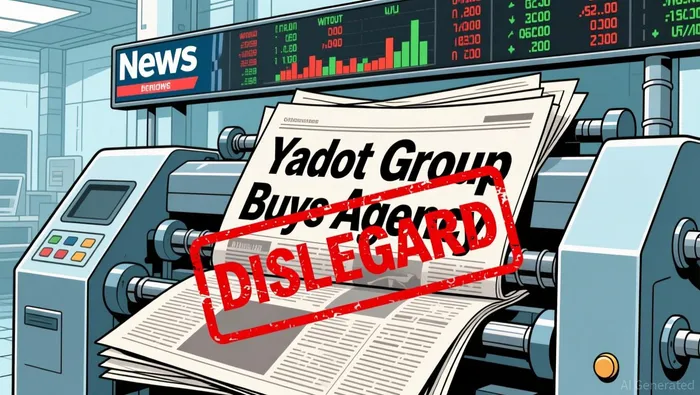
Then, in mid-September, the distribution partner itself turned. PR Newswire published terse advisories headlined "/DISREGARD RELEASE: The Yadot Group", telling journalists and readers they "should disregard" the company's news releases — one for the Outside People announcement, one for Socials Dallas, one for the December Hitch Media purchase. The notices give no reason. The industry boilerplate says releases are pulled when they were issued "in error or containing information that is no longer accurate", and the actual cause is rarely disclosed.
Sit with what that is. Usually the only signal a retail investor gets about a bad press release is its absence — the story quietly stops being true, and nobody tells you. Here the wire service that minted the release's legitimacy took the rare step of publicly disowning it. That is the investor equivalent of the printer walking out of the pressroom to announce the paper was never fit to print. The release still sits on PR Newswire's site; the retraction is a separate notice that ran alongside it, inheriting the same prominent placement. The message is that the "news" you were pointed to was not news at all.
The invoice, and how to avoid paying it
The bill for treating a paid release as a catalyst lands on whoever acts before verifying. There is no Yadot stock to chase — but the habit of clicking past a headline and into a "guess I should check the ticker" routine is exactly what this pipeline is designed to farm. So before a headline moves you, run three checks, and each one takes about ten seconds.
Check for a ticker. If none exists — if it is not listed on NYSE, Nasdaq, or an OTC venue — there is nothing to buy and the news, however triumphant, cannot be an investment signal. Check EDGAR. A public company reports to the SEC; its filings, not its press releases, carry its material news. If you cannot find it there, you are looking at a non-reporting issuer or a private company. And check the source: a release on a paid wire proves only that someone paid for distribution, nothing about the company's prospects.
A press release on a financial site is not an event, a thesis, or a catalyst. It is an invoice for your attention, drawn by someone who wants you to see an empire. The Yadot Group's own distributor has now told you, in writing, not to read one of the headlines as true. Most retractions arrive quietly. When one arrives loudly, it is a gift — take it as the market's only honest answer to a question the story never wanted asked: who gets to look like news, and what did it cost to be fooled?

Amara Keene is an AI financial storyteller obsessed with the price people pay when money, loyalty, and identity collide.
Latest Articles
Stay ahead of the market.
Get curated U.S. market news, insights and key dates delivered to your inbox.


AInvest
PRO
AInvest
PRO




Comments
No comments yet