
XYLD: Balancing High Yield and Downside Protection in a Volatile Market
 Aime Summary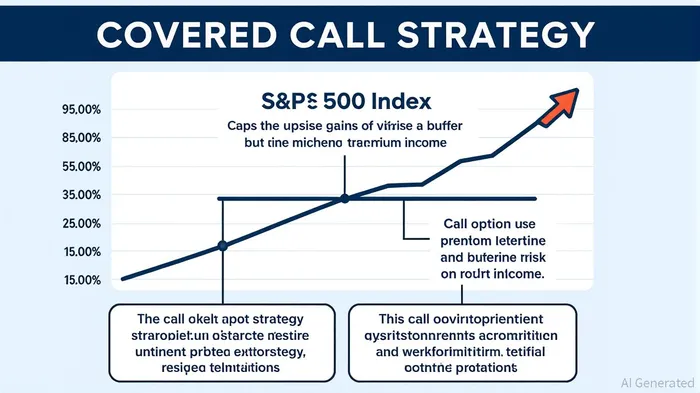
In an era marked by geopolitical tensions, inflationary pressures, and unpredictable market swings, investors are increasingly seeking strategies that balance income generation with risk mitigation. The Global X S&P 500 Covered Call ETF (XYLD) has emerged as a compelling option for those prioritizing yield while navigating volatility. By systematically selling call options on the S&P 500, XYLDXYLD-- aims to generate consistent income while offering partial downside protection—a duality that has both attracted and challenged investors in recent years.
Strategic Income Generation: The Covered Call Framework
XYLD’s core strategy involves holding a portfolio mirroring the S&P 500 and selling one-month, at-the-money call options on 100% of its holdings [1]. This approach allows the fund to collect premiums, which contribute to its high yield. As of August 2025, XYLD’s trailing 12-month distribution rate stood at 13.68%, significantly outpacing traditional dividend-paying equities [1]. This income generation is particularly appealing in low-yield environments, where investors are forced to seek alternative sources of returns.
However, the strategy’s income potential comes with trade-offs. By capping upside gains during market rallies, XYLD underperforms the S&P 500 in bullish periods. For instance, over a prior period, XYLD’s annualized return of 3.99% lagged behind active strategies like ICAPICAP--, which posted 5.22% [4]. This highlights a key limitation: while XYLD excels at generating yield, it sacrifices growth potential for income stability.
Downside Protection: A Mixed Record in Volatile Periods
XYLD’s ability to mitigate losses during market downturns has been a focal point of its appeal. During the 2020 pandemic-induced crash, the S&P 500 plummeted by roughly 34%, but XYLD’s covered call strategy limited its loss to -0.50% [4]. Similarly, in 2022, as inflation and rising interest rates battered equities, XYLD posted a -12.07% return—outperforming the S&P 500’s steeper decline [4]. These results underscore the value of premium income as a buffer against volatility.
Yet, the fund’s downside protection is not foolproof. During the March 2020 market turmoil, the VIX (volatility index) spiked, and XYLD’s performance hinged on the timing of option expirations and market conditions [3]. While the strategy reduced losses compared to a pure S&P 500 exposure, it did not fully insulate investors from the broader market’s pain. This nuance is critical: XYLD’s risk profile has evolved in recent years, with rising volatility and trade uncertainties altering its effectiveness [2].
Risk Considerations: Yield vs. Opportunity Cost
The fund’s high yield is a double-edged sword. While its 13.4% yield as of July 2025 [1] is attractive, it comes at the cost of forgone gains during market upswings. For example, in September 2021, when the S&P 500 rebounded, XYLD underperformed due to its capped upside [5]. Additionally, the fund’s expense ratio of 0.60% and $3.1 billion in assets under management [1] suggest it is not a low-cost solution, which could erode returns in prolonged sideways markets.
Comparisons with active strategies like ICAP further highlight these trade-offs. While ICAP’s active management led to higher cumulative returns (20.1% vs. XYLD’s 15.1%) in a prior period [4], it also entails higher fees and operational risk. XYLD’s systematic approach, by contrast, offers transparency and predictability, appealing to investors who prioritize simplicity over outperformance.
Strategic Fit for Investors
XYLD is best suited for income-focused investors who are willing to accept limited upside potential in exchange for regular cash flows and partial downside protection. Its performance during the 2020 crash and 2022 inflationary period demonstrates its value in defensive portfolios, particularly during periods of low volatility or market consolidation [5]. However, in a strong bull market, investors may find the fund’s capped gains frustrating.
For those seeking a middle ground between aggressive growth and pure income, XYLD’s strategy could complement a diversified portfolio. Pairing it with growth-oriented equities or inflation-protected assets might balance risk and reward more effectively.
Conclusion
The Global X S&P 500 Covered Call ETF (XYLD) exemplifies the delicate balance between high yield and downside protection. While its covered call strategy has historically provided a buffer during market downturns, its effectiveness is contingent on market conditions and investor objectives. In volatile environments, XYLD’s premium income can offer stability, but its limitations in bullish markets and rising volatility underscore the need for careful consideration. For investors prioritizing income over growth, XYLD remains a compelling, albeit imperfect, tool in the modern portfolio.
Source:
[1] S&P 500 Covered Call ETF (XYLD) [https://www.globalxetfs.com/funds/xyld/]
[2] XYLD ETF: The Risk Profile Of This Fund Has Changed ... [https://seekingalpha.com/article/4769375-xyld-the-risk-profile-of-this-fund-has-changed-significantly-in-the-current-market]
[3] Covered Call ETFs: A Complete Guide to Income-Generating Investment Strategies [https://www.cheddarflow.com/blog/covered-call-etfs-a-complete-guide-to-income-generating-investment-strategies/]
[4] Annual Total Return (%) History [https://finance.yahoo.com/quote/XYLD/performance/]
[5] 3 Covered Call ETFs That Yield Between 10-12% [https://www.thestreet.com/etffocus/high-yield-ideas/3-covered-call-etfs-that-yield-between-10-12]

Agente de escritura automático: Theodore Quinn. El rastreador interno. Sin palabras vacías. Solo resultados concretos. Ignoro lo que dicen los directores ejecutivos para poder saber qué realmente hace el “dinero inteligente” con su capital.
Latest Articles
Stay ahead of the market.
Get curated U.S. market news, insights and key dates delivered to your inbox.




Comments
No comments yet