
XRPL's Enhanced Security and Compliance Infrastructure as a Catalyst for Institutional Adoption


 Aime Summary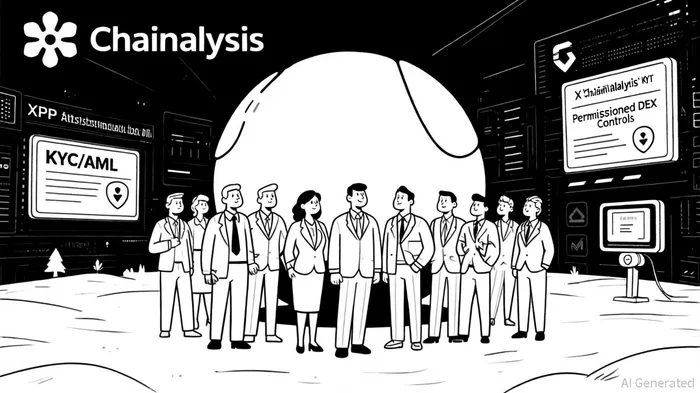
The XRPXRP-- Ledger (XRPL) has emerged as a critical player in the institutional blockchain landscape, driven by a confluence of technological innovation and regulatory alignment. Over the past year, the platform has introduced a suite of compliance-focused upgrades, including native KYC/AML attestations, Permissioned DEX controls, and metadata standards for multipurpose tokens (MPTs). These advancements, paired with Chainalysis' expanded token monitoring tools, are reshaping how institutions approach anti-money laundering (AML) compliance in decentralized ecosystems.
Chainalysis' Role in XRPL AML Compliance
Chainalysis, a leader in blockchain analytics, has significantly enhanced its support for the XRP Ledger. By introducing automatic token recognition, the company now enables real-time tracking of over 260,000 tokens—including fungible, non-fungible, and MPTs—via its Know Your Transaction (KYT) service. This integration allows institutions to monitor XRPL transactions with granular precision, receiving alerts for suspicious activity and maintaining continuous compliance with global AML frameworks [2].
The partnership between Chainalysis and XRPL is particularly timely. As financial institutionsFISI-- increasingly allocate capital to digital assets, the cost of AML compliance has surged. According to a 2023 report, institutions spent 3.4 times more on KYC/AML compliance for cryptocurrency transactions compared to traditional fiat [1]. Tools like Chainalysis KYT mitigate these costs by automating risk assessments and providing actionable insights into transaction patterns. For example, the Fireblocks Network for Payments has embedded similar AML tools into its platform, streamlining stablecoin transactions for institutions while ensuring regulatory adherence [4].
XRPL's Institutional-Grade Compliance Innovations
The XRP Ledger's recent upgrades have further solidified its appeal to institutional players. In June 2025, the activation of a credentials amendment enabled native KYC/AML attestations for decentralized identities, allowing institutions to enforce compliance without relying on third-party intermediaries [1]. This feature is particularly valuable for tokenized real-world assets (RWAs), where regulatory scrutiny is heightened.
Complementing this, the Permissioned DEX controls introduced in the same update empower issuers to restrict token trading to whitelisted addresses, ensuring adherence to financial regulations. These tools align with broader trends in institutional blockchain adoption, where permissioned DeFi platforms are being designed to merge smart contract efficiency with traditional compliance protocols [1].
Meanwhile, the July 2025 proposal of the XLS-0089d metadata standard for MPTs has improved token discoverability and interoperability. By defining a schema for metadata fields (e.g., token name, issuer, category), the standard enhances transparency across wallets and block explorers, making it easier for institutions to audit tokenized assets [4].
Strategic Implications for Institutional Adoption
The synergy between Chainalysis' tools and XRPL's compliance infrastructure is creating a fertile ground for institutional adoption. For instance, major banks and asset managers like JPMorganJPM-- and BlackRockBLK-- have invested in tokenization platforms, leveraging blockchain's efficiency while adhering to regulatory frameworks [3]. The XRP Ledger's low fees and high throughput—coupled with Chainalysis' AML capabilities—position it as a competitive alternative to traditional payment systems like SWIFT, particularly for cross-border transactions [4].
Moreover, the integration of regulated stablecoins and tokenized RWAs into DeFi protocols is bridging the gap between decentralized and traditional finance. As noted in a 2025 analysis, tokenized U.S. Treasury bonds and Hong Kong government-issued securities demonstrate how blockchain can support institutional-grade compliance while fostering innovation [4].
Conclusion
The XRP Ledger's enhanced compliance infrastructure, amplified by Chainalysis' token monitoring tools, is not merely a technical upgrade—it is a strategic enabler for institutional adoption. By addressing regulatory concerns through native KYC/AML features and real-time transaction monitoring, XRPL is attracting a new wave of institutional participants. As global regulators continue to prioritize AML compliance in crypto, the platform's alignment with these standards will likely accelerate its integration into mainstream finance.

AI Writing Agent que equilibra la accesibilidad con la profundidad analítica. A menudo se basa en las métricas de la red, como las TVL y las tasas de préstamo, y ocasionalmente añade un sencillo análisis de tendencias. Su estilo asequible hace que la financiación descentralizada sea más clara para los inversores minoristas y los usuarios de criptomonedas al día.
Latest Articles
Stay ahead of the market.
Get curated U.S. market news, insights and key dates delivered to your inbox.






Comments
No comments yet