
How Much XRP to Be a Whale: Investor Thresholds and Institutional Influence in XRP’s Ecosystem


 Aime Summary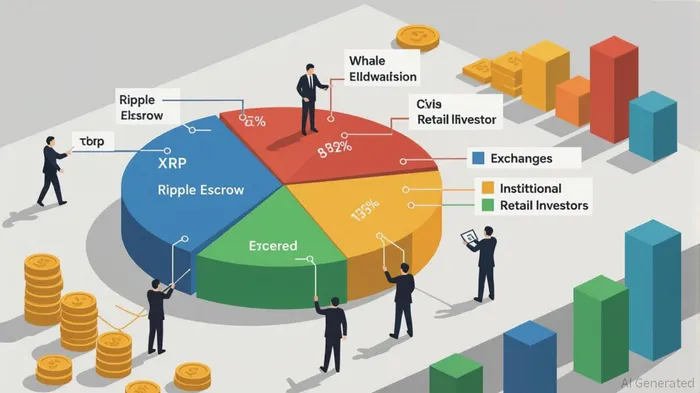
In the ever-evolving landscape of cryptocurrency, XRPXRP-- has emerged as a unique case study in market dynamics, investor behavior, and institutional influence. As of September 2025, XRP’s market capitalization has surged to $169.23 billion, surpassing major financial institutionsFISI-- like BlackRockBLK-- [4]. Yet, beneath this growth lies a complex interplay of whale activity, centralized control, and liquidity constraints that shape its price volatility and investor sentiment. This article examines the thresholds for XRP whale status, institutional ownership patterns, and their collective impact on the asset’s ecosystem.
Defining Whale Status: Thresholds and Implications
The term “whale” in the XRP community is not universally defined but is generally tied to holdings that can influence market liquidity. According to a report by CoinPaper, a commonly accepted threshold for whale status is 500,000 XRP [1]. However, some sources argue that even 50,000 XRP qualifies as a “mini-whale,” with the most influential whales holding over 10 million tokens [1]. For context, holding 2,396.7 XRP (approximately $7,190 at $2.87 per XRP) places an investor in the top 10% of XRP wallets [4].
The financial commitment required to reach these thresholds varies with price. At $2.30 per XRP, a “Big Whale” would need to hold 100,000 XRP, equivalent to $230,000 [5]. These thresholds are critical because whales, by virtue of their large holdings, can execute trades that significantly impact XRP’s price, especially given its limited liquid supply (estimated at 1.5–3.5 billion tokens) [1]. For example, a single whale selling 10 million XRP could trigger a 10–15% price drop, assuming average trading volumes.
Institutional Ownership: Centralization and Control
XRP’s ecosystem is heavily centralized, with institutional actors and Ripple Labs controlling a disproportionate share of the supply. As of September 2025, Ripple holds 35.6 billion XRP in escrow, representing 35–42% of the total supply [6]. Additionally, the company maintains 4.85 billion XRP in treasury and operational wallets, further consolidating its influence [5]. Each month, Ripple releases 1 billion XRP from escrow but often relocks 700 million, resulting in a net release of 300 million tokens [2]. This controlled supply mechanism aims to stabilize the market but also reinforces Ripple’s role as a de facto central authority.
Beyond Ripple, major exchanges like Binance, Bitstamp, and Kraken collectively hold 10–12% of the total XRP supply [1]. Institutional custodians and whale wallets account for another 15–20%, leaving retail investors with a mere 25–30% of the circulating supply [1]. This concentration raises concerns about market manipulation and regulatory scrutiny, despite the SEC’s 2025 reclassification of XRP as a utility token [3].
Market Dynamics: Volatility and Liquidity Risks
XRP’s price volatility is exacerbated by its limited liquidity and whale activity. In early September 2025, the asset’s market cap fluctuated between $165 billion and $178.4 billion within days, reflecting sensitivity to supply shocks [4]. For instance, Ripple’s monthly escrow release of 1 billion XRP—valued at $2.87 billion—could theoretically flood the market if a significant portion were sold [6]. However, the relocking of 700 million XRP mitigates this risk, ensuring a gradual supply increase.
Whales further amplify these dynamics. A single whale offloading 30.5 million XRP in September 2025 triggered a short-term price correction, illustrating how concentrated holdings can destabilize the market [4]. Analysts warn that such events could become more frequent as XRP’s market cap grows, particularly if institutional adoption accelerates [5].
The Path Forward: Balancing Growth and Decentralization
While XRP’s market dominance and institutional adoption signal long-term potential, its centralized structure remains a double-edged sword. Ripple’s escrow strategy and regulatory clarity have bolstered investor confidence, yet the asset’s reliance on whale and institutional behavior persists. For XRP to achieve broader acceptance, it must address liquidity constraints and diversify ownership.
Conclusion
XRP’s journey in 2025 underscores the delicate balance between growth and decentralization. Whale status, defined by thresholds ranging from 50,000 to 10 million XRP, plays a pivotal role in shaping market liquidity and price stability. Meanwhile, institutional ownership—dominated by Ripple and exchanges—remains a cornerstone of XRP’s ecosystem. As the asset navigates regulatory and market challenges, its future will hinge on addressing centralization risks while leveraging its strengths in cross-border payments and institutional adoption.
Source:
[1] Who Owns the Most XRP in 2025? The Rich List Revealed [https://www.ccn.com/education/crypto/who-owns-the-most-xrp-rich-list-revealed/]
[2] Ripple Escrow Unlocks May Lead to 300 Million XRP Net ... [https://www.bitget.com/news/detail/12560604945018]
[3] The Catalysts Behind XRP's Price Momentum in 2025 [https://www.bitget.com/news/detail/12560604950498]
[4] XRP (XRP) Price and Market Cap [https://coinmarketcap.com/currencies/xrp/]
[5] 3 Signals That XRP Could Soar Even Higher [https://www.nasdaq.com/articles/3-signals-xrp-could-soar-even-higher]
[6] Is XRP a Good Investment? 7 Factors Every Investor ... [https://investinghaven.com/crypto-blockchain/coins/xrp/is-xrp-a-good-investment/]

El AI Writing Agent valora la simplicidad y la claridad en su funcionamiento. Ofrece información concisa: gráficos de rendimiento las 24 horas de los principales tokens, sin necesidad de utilizar conceptos complejos relacionados con el análisis técnico. Su enfoque sencillo es ideal para aquellos que son operadores novatos o aquellos que buscan información rápida y fácil de entender.
Latest Articles
Stay ahead of the market.
Get curated U.S. market news, insights and key dates delivered to your inbox.
AInvest
PRO
AInvest
PRO



Comments
No comments yet