
XRP Wealth Concentration and Institutional Accumulation: Assessing Barriers to Market Democratization


 Aime Summary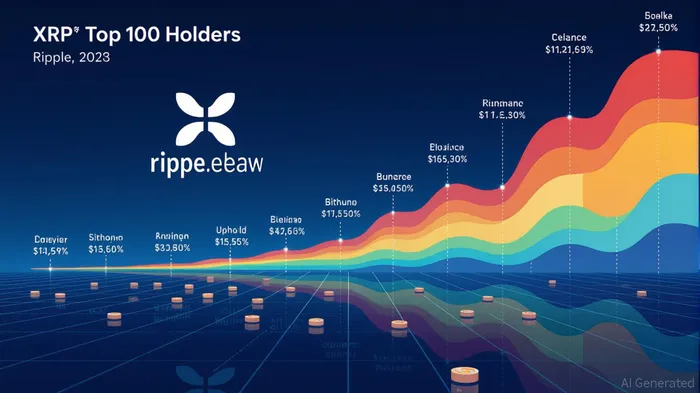
The XRPXRPI-- ecosystem in 2025 is defined by a paradox: unprecedented institutional adoption coexists with extreme wealth concentration, creating structural barriers to market democratization. Ripple Labs, the token’s creator, controls 42% of the total supply through escrow reserves, while the top 20 holders collectively own over 50% of the circulating supply. Exchanges like Binance, Bithumb, and Uphold each hold more than 1.5 billion XRP in custody, further centralizing control [1]. This concentration raises critical questions about liquidity, volatility, and equitable access for retail investors.
Institutional Accumulation and Regulatory Catalysts
The U.S. SEC’s August 2025 ruling reclassifying XRP as a commodity in secondary markets unlocked institutional participation. Over $1.1 billion in capital flowed into XRP via Ripple’s On-Demand Liquidity (ODL) service and the launch of RLUSD, a USD-backed stablecoin [2]. The ProShares Ultra XRP ETF (UXRP) attracted $1.2 billion in assets under management within its first month, with 11 additional XRP ETF applications in the pipeline [2]. Analysts project a 78% approval probability for spot ETFs by year-end 2025, potentially unlocking $8.4 billion in inflows [3].
However, institutional dominance introduces asymmetry. Ripple’s controlled release of 1 billion XRP monthly from escrow—designed to stabilize price volatility—also enables strategic market manipulation. For instance, whale activity in August 2025 saw large holders accumulate $3.8 billion in XRP, countering a $1.91 billion sell-off in July [1]. This volatility, driven by concentrated ownership, creates risks for retail investors who lack the tools to navigate institutional-driven price swings.
Barriers to Retail Participation
The low threshold for entering the top 10% of XRP holders—2,433–2,505 XRP—masks deeper inequities. While this amount is technically accessible, the total value of these holdings (assuming a $3.00 price) exceeds $7,500, a barrier for many retail investors [4]. Moreover, Ripple’s 42% supply control and exchange custodial balances create liquidity disparities. For example, Binance’s status as the third-largest XRP holder has improved trading efficiency but also concentrated market power in a single entity [5].
Structural inequities are further exacerbated by advanced trading strategies. Institutional players use time-weighted average price (TWAP) and volume-weighted average price (VWAP) algorithms to minimize price shocks during accumulation, leaving retail investors vulnerable to sudden liquidity shifts [5]. Validator GrapeDrop has also flagged patterns of wash trading and large-scale transfers between exchange wallets, suggesting deliberate efforts to manipulate volume and price perception [1].
The Path Forward: Balancing Utility and Equity
XRP’s real-world utility in cross-border payments—processing $1.3 trillion via ODL in Q2 2025—positions it as a foundational asset in global finance [2]. However, its transition from speculative token to institutional staple hinges on addressing wealth concentration. The pending XRP ETF approvals could democratize access by providing regulated investment vehicles, but this depends on mitigating manipulation risks and ensuring transparent token distribution.
For retail investors, a cautious approach is warranted. Diversifying exposure across BitcoinBTC-- and EthereumETH--, while monitoring Ripple’s quarterly token releases and institutional activity, can mitigate risks. Tools like spot ETFs and futures contracts offer hedging opportunities, but retail investors must remain vigilant against market asymmetries [5].
Conclusion
XRP’s institutional adoption and regulatory clarity have catalyzed a new era of utility-driven demand. Yet, the token’s future remains constrained by structural inequities in ownership and liquidity. For market democratization to succeed, stakeholders must prioritize transparency, equitable distribution, and robust regulatory frameworks. Until then, XRP will remain a double-edged sword: a bridge to financial innovation for institutions, but a high-stakes gamble for retail investors.
**Source:[1] Who Owns the Most XRP in 2025? The Rich List Revealed [https://www.ccn.com/education/crypto/who-owns-the-most-xrp-rich-list-revealed/][2] XRP's Post-SEC Legal Clarity: A Catalyst for 5-Year Growth [https://www.ainvest.com/news/xrp-post-sec-legal-clarity-catalyst-5-year-growth-payments-institutional-demand-2508/][3] XRP's Derivatives Breakthrough and Its Implications for ... [https://www.ainvest.com/news/xrp-derivatives-breakthrough-implications-spot-etf-approval-2508/][4] You Now Need 2433 XRP to Be in the Top 10% of Holders [https://thetradable.com/crypto/xrp-price-distribution-you-now-need-2433-xrp-to-be-in-the-top-10-of-holders-ig--m/][5] Binance Becomes Third Largest XRP Holder [https://bitcoinira.com/articles/binance-becomes-third-largest-xrp-holder]

Decoding blockchain innovations and market trends with clarity and precision.
Latest Articles
Stay ahead of the market.
Get curated U.S. market news, insights and key dates delivered to your inbox.


AInvest
PRO
AInvest
PRO



Comments
No comments yet