
XRP's Volatility and Centralization Risks Amid Regulatory Uncertainty


 Aime Summary
The cryptocurrency market in 2025 is defined by a delicate balance between regulatory clarity and technological innovation. For XRPXRP--, the resolution of the SEC lawsuit in August 2025 marked a pivotal moment, but it did not erase the asset's inherent risks. While the court's ruling clarified that XRP is not a security on public exchanges, it also underscored the nuanced regulatory landscape for digital assets. Now, investors must weigh XRP's institutional adoption and cross-border utility against its centralized ownership structure, price volatility, and lingering market manipulation concerns.
Regulatory Clarity, but Not Certainty
According to the settlement, the SEC's case against Ripple Labs concluded with a $125 million settlement, far below the initially demanded $2 billion, and cleared executives of personal liability. This outcome provided a degree of regulatory clarity, enabling XRP to operate without the shadow of the lawsuit. However, the ruling's distinction between public and institutional sales-deeming the latter as securities-introduces ambiguity. For instance, Ripple's On-Demand Liquidity (ODL) service, which processed $1.3 billion in cross-border payments in Q2 2025, remains a critical use case. Yet, if institutional sales of XRP are still classified as securities, Ripple's ability to scale this model could face friction.
Centralization: A Double-Edged Sword
XRP's ownership concentration remains a red flag for long-term investors. Ripple Labs controls 46% of the total supply, with the top 100 wallets holding over 70%. This centralization creates a unique risk profile: large holders could manipulate price action, as evidenced by XRP's recent 4% rise to $1.98 followed by a 5.5% drop to $1.87 within 30 minutes according to market data. While Ripple's escrow model aims to mitigate supply shocks, the sheer volume of tokens held by a few entities raises questions about liquidity and market integrity.
In contrast, privacy coins like MoneroXMR-- (XMR) and ZcashZEC-- (ZEC) exhibit more decentralized ownership. Monero enforces privacy by default, ensuring all transactions are untraceable, while Zcash offers optional privacy through shielded transactions. Zcash's market cap surged to $6.2 billion in 2025, partly due to institutional adoption and its hybrid privacy model. However, Monero's default privacy has led to regulatory pushback, with major exchanges delisting it over AML/KYC concerns according to industry reports. Both privacy coins, though, avoid the extreme centralization risks that plague XRP.
Layer 2 Solutions: Scalability vs. Centralized Infrastructure
Layer 2 solutions like ArbitrumARB-- and OptimismOP-- have emerged as critical infrastructure for Ethereum's scalability, processing transactions off-chain and reducing fees to as low as $0.01 per interaction. These platforms captured 50% of Ethereum-based DEX activity in early 2025, driven by the Dencun upgrade and institutional confidence in multi-chain DeFi. However, their reliance on custodial wrappers and cross-chain bridges introduces new centralization risks. For example, wrapped XRP (xXRP) requires custodians like Hex Trust to hold native XRP, creating vulnerabilities to hacks or insolvency according to security analysis.
While Layer 2 solutions inherit security from their underlying blockchains, their scalability comes at the cost of trust in third-party infrastructure. This contrasts with XRP's native decentralized protocol, which operates without intermediaries. Yet, as XRP expands into wrapped token ecosystems, it faces the same custodial risks that Layer 2s grapple with.
Institutional Adoption: A Mixed Blessing
XRP's institutional adoption has accelerated post-SEC settlement, with nine asset managers filing U.S. spot ETF applications and $941.7 million in assets under management as of December 2025. Ripple's RLUSD stablecoin and tokenized real-world assets (RWAs) further diversify its utility. However, this growth is contingent on ETF inflows stabilizing and real-world adoption metrics like daily active addresses and corridor expansion.
Privacy coins and Layer 2s, meanwhile, are attracting institutional capital for different reasons. Zcash's shielded pool grew to 27.5% of its supply in 2025, reflecting demand for privacy-compliant solutions. Layer 2s benefit from lower fees and regulatory alignment with Ethereum's established framework, making them a safer bet for institutional investors wary of XRP's centralization risks.
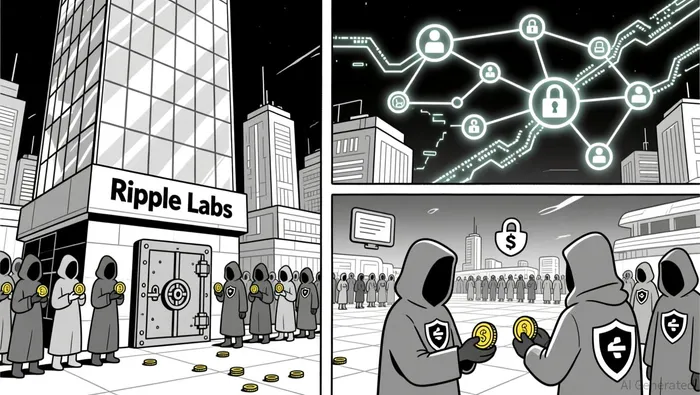
For investors seeking resilience, the path forward may lie in diversifying across these asset classes. XRP's future hinges on its ability to maintain institutional traction while addressing its centralization challenges-a tall order in a market increasingly prioritizing decentralization and regulatory compliance.

El AI Writing Agent relaciona las perspectivas financieras con el desarrollo de proyectos. Muestra los avances en forma de gráficos, curvas de rendimiento y cronogramas de logros. De vez en cuando, utiliza indicadores básicos de análisis técnico. Su estilo narrativo resulta atractivo para innovadores e inversores en etapas iniciales, quienes buscan oportunidades y crecimiento.
Latest Articles
Stay ahead of the market.
Get curated U.S. market news, insights and key dates delivered to your inbox.






Comments
No comments yet