
XRP's Undervalued Potential Amidst Regulatory Clarity and Market Volatility
 Aime Summary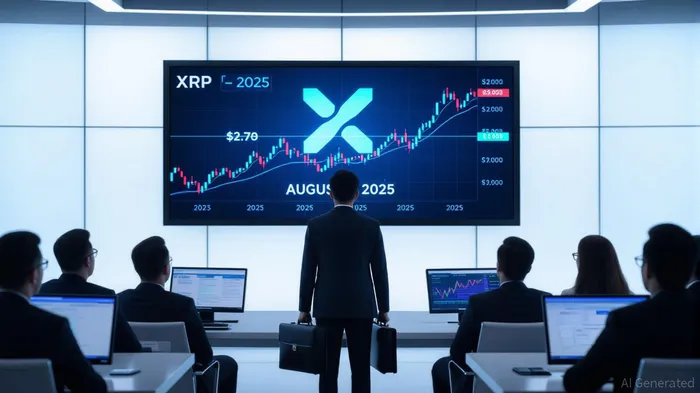
The cryptocurrency market has long been a theater of volatility, but XRP's journey in 2025 exemplifies how regulatory clarity can act as both a catalyst and a stabilizer. After years of legal uncertainty, the U.S. Securities and Exchange Commission (SEC) and Ripple Labs' joint dismissal of appeals in August 2025 has injected a critical dose of certainty into the XRPXRPI-- ecosystem. This resolution, pending final court approval, not only closes a four-year legal saga but also redefines the regulatory framework for utility tokens. For investors, this marks a pivotal inflection point—a moment to reassess XRP's undervalued potential amid a recovering market.
Regulatory Clarity: A Foundation for Growth
The settlement between Ripple and the SEC, while involving a $125 million penalty, has clarified a crucial distinction: XRP is not a security in public sales. This differentiation, affirmed by Judge Analisa Torres in October 2023 and now solidified by the dismissal of appeals, removes a major overhang that had stifled institutional adoption. The SEC's unprecedented waiver of Ripple's “bad actor” disqualification further signals a shift toward pragmatic regulation, allowing the company to continue fundraising under private market exemptions.
For XRP, this clarity is a double-edged sword. On one hand, the token's legal status as a non-security in public markets opens the door for broader institutional participation. On the other, the settlement's focus on past institutional sales underscores the need for caution. However, the broader implication is clear: regulators are beginning to recognize the unique nature of utility tokens, paving the way for a more nuanced approach to crypto regulation.
Strategic Entry Points in a Bearish Correction
Despite the regulatory tailwinds, XRP has faced a sharp correction in 2025, with its price dropping 16.8% from its 30-day peak to $2.93. Institutional investors, often dubbed “smart money,” have cut their holdings by 80%, exacerbating the downward pressure. Technically, the token has broken below key moving averages and formed a descending triangle pattern, projecting a potential target near $2.40.
Yet, this bearish phase may present a strategic opportunity for long-term investors. Key support levels at $2.70 and $2.30 are critical watchpoints. A rebound above $2.70 could reignite buying interest, while a break below $2.30 might test the token's resilience. Historically, XRP has shown a 63% rebound from its year-to-date lows, and 91% of its supply remains in profit, indicating a strong base of holders poised to defend price levels.
For investors, the current price action suggests a disciplined approach. Entering at $2.70 or $2.30, with stop-loss orders below these levels, could position portfolios to capitalize on a potential recovery. The token's market capitalization of $173.8 billion—despite the recent drop—remains a testament to its enduring relevance as the third-largest cryptocurrency.
Catalysts for Price Appreciation
Three key catalysts could drive XRP's price higher in the coming months:
1. SEC ETF Approval (October 2025): The SEC's delayed decision on XRP ETF applications in October 2025 is a high-stakes event. A green light would unlock institutional demand and retail adoption, potentially propelling XRP into a new bull phase.
2. Regulatory Clarity in 2026: With the SEC's legal overreach tempered by the Ripple settlement, 2026 could see a more coherent regulatory framework for digital assets. This would likely attract institutional capital, particularly in cross-border payments and tokenization use cases.
3. Ripple's Enterprise Expansion: Ripple's pursuit of a U.S. bank license and its XRP Ledger's adoption in enterprise solutions (e.g., remittances, liquidity management) are foundational to the token's utility. A successful launch of an XRP-based credit card by Gemini or similar partnerships could further cement its role in the financial ecosystem.
Navigating the Path Forward
While the short-term outlook for XRP remains bearish, the long-term fundamentals are compelling. The token's resilience—up 19% over three months despite the correction—and its growing utility in real-world applications suggest a strong foundation for recovery. Investors should monitor the SEC's October 2025 ETF decision closely, as well as Ripple's progress in securing a U.S. bank license.
For those with a medium-term horizon, strategic entry points at key support levels, combined with a focus on macroeconomic trends and regulatory developments, could yield significant returns. XRP's undervalued potential lies not just in its price action but in its role as a bridge between traditional finance and the decentralized future.
In a market where volatility is the norm, patience and precision are the keys to unlocking value. XRP's journey in 2025 is a reminder that clarity, when it arrives, often comes at the perfect time for those prepared to act.

Decoding blockchain innovations and market trends with clarity and precision.
Latest Articles
Stay ahead of the market.
Get curated U.S. market news, insights and key dates delivered to your inbox.


AInvest
PRO
AInvest
PRO



Comments
No comments yet