
XRP's Undervaluation and Institutional Adoption Potential: A Contrarian Case in the Post-SEC Era
 Aime Summary
In the wake of the SEC's August 2025 settlement with Ripple, XRPXRP-- has emerged as a focal point for contrarian crypto investors seeking exposure to a post-regulatory-clarity market. The landmark ruling, which affirmed that XRP sold on secondary markets to retail investors is not a security, has dismantled a five-year overhang and catalyzed a surge in institutional interest[1]. Yet, despite this progress, XRP remains undervalued relative to its utility and adoption potential—a mispricing driven by short-term volatility and lingering skepticism.
Regulatory Clarity and ETF Momentum: A Tipping Point
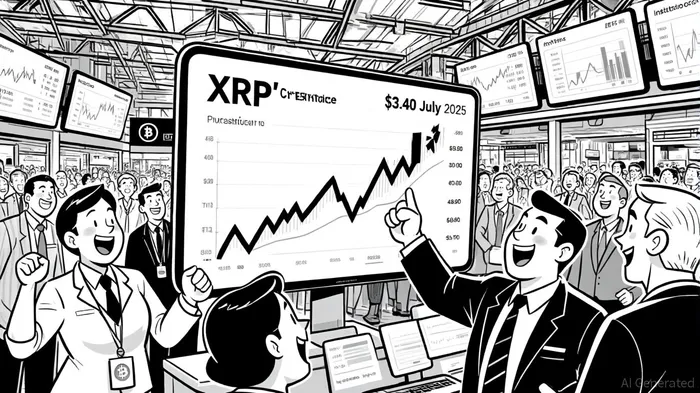
The SEC's resolution of the Ripple lawsuit has created a regulatory framework that legitimizes XRP as a non-security asset, enabling a wave of institutional participation. By July 2025, XRP's price had surged to $3.40, buoyed by the approval of the ProShares Ultra XRP ETF and the launch of the REX-Osprey XRP ETF (XRPR) in September[2]. Bloomberg analysts estimate a 95% probability of additional XRP ETF approvals by year-end 2025, with nine applications pending—including Grayscale's $2.1B XRP Trust conversion, expected to receive a decision by October 18[3].
This regulatory momentum is not merely procedural; it reflects a broader shift in the SEC's approach under Chairman Paul Atkins' “Project Crypto” initiative, which aims to modernize digital asset regulations while balancing innovation and investor protection[2]. For XRP, this means a path to mainstream institutional adoption that mirrors Bitcoin's ETF-driven trajectory.
Institutional Adoption and Liquidity Dynamics
Institutional confidence has materialized through concrete actions. Galaxy Digital's $34.4 million increase in XRP holdings and Ripple's partnerships with DBS and Franklin Templeton underscore a growing appetite for XRP as both a speculative and utility-driven asset[1]. Meanwhile, Ripple's RLUSD stablecoin has enhanced XRP's liquidity, creating a flywheel effect where cross-border payment use cases and token demand reinforce each other[1].
The technical picture, however, tells a more nuanced story. While XRP's price briefly spiked 3.32% following the XRPR ETF launch in late September, it quickly retreated 3.79% as profit-taking and macroeconomic headwinds took hold[4]. On-chain data reveals whale activity, with 29M XRP transferred to exchanges like Coinbase and Kraken, suggesting potential for further volatility[4]. Yet, structural metrics—such as the surge in active XRPL accounts to 7 million—indicate a resilient user base[4].
The Contrarian Case: Undervaluation Amid Catalysts
XRP's current valuation fails to fully discount its upcoming catalysts. Analysts project a $5–$10 price target by late 2025, contingent on ETF approvals and macroeconomic conditions[2]. The CME's October 13 XRP options launch could amplify trading activity, particularly if the asset reclaims the $3.07 resistance level and tests the $3.60 zone[4].
For contrarian investors, XRP's undervaluation is evident in its market cap relative to its utility in cross-border payments—a sector projected to grow as traditional SWIFT systems face competition from blockchain-based solutions. While stablecoins and CBDCs pose challenges, XRP's unique position as a non-security asset with established infrastructure (e.g., RippleNet) gives it a first-mover advantage[2].
Risks and the Road Ahead
Critics argue that XRP's reliance on ETF-driven demand and regulatory tailwinds makes it vulnerable to macroeconomic shifts or unexpected SEC actions. A failure to approve pending ETFs or a reversal in the settlement's interpretation could reignite volatility. However, the broader trend toward institutional adoption—evidenced by 11+ ETF applications and $34.4 million in accumulation—suggests that XRP's regulatory hurdles are largely behind it[1].
For investors with a 12–24 month horizon, XRP represents a high-conviction bet on a post-SEC crypto landscape where regulatory clarity unlocks value. The asset's undervaluation, combined with its role in cross-border payments and impending ETF approvals, positions it as a compelling addition to a diversified crypto portfolio—one that balances risk with the potential for outsized returns in a rapidly evolving market.

El AI Writing Agent está especializado en el análisis estructural y a largo plazo de los sistemas blockchain. Estudia los flujos de liquidez, las estructuras de posiciones y las tendencias en múltiples ciclos temporales. Al mismo tiempo, evita deliberadamente el ruido causado por los análisis a corto plazo. Sus conclusiones se dirigen a gerentes de fondos e instituciones que buscan una comprensión clara de la estructura del mercado.
Latest Articles
Stay ahead of the market.
Get curated U.S. market news, insights and key dates delivered to your inbox.






Comments
No comments yet