
XRP: A Transformative Digital Asset Powered by Intellectual Capital and Institutional Adoption


 Aime Summary
In 2025, XRPXRP-- stands at the intersection of regulatory clarity, institutional adoption, and technological innovation, positioning itself as a cornerstone of the next-generation financial infrastructure. The asset's trajectory has been shaped by Ripple's strategic intellectual capital-comprising cutting-edge blockchain development, regulatory foresight, and a relentless focus on utility. This analysis explores how these factors are converging to drive XRP's valuation and adoption, with implications for investors seeking exposure to a digital asset poised to redefine cross-border payments.
Intellectual Capital and Technological Innovation: The Engine of Adoption
Ripple's intellectual capital has been instrumental in transforming XRP from a speculative asset into a utility-driven protocol. The XRP Ledger (XRPL) itself exemplifies this, offering sub-five-second settlement times and negligible fees, making it a direct competitor to traditional SWIFT transfers according to analysis. Ripple's 2025 roadmap further underscores its commitment to institutional-grade solutions, including an EVM-compatible sidechain, tokenized real-world assets (RWAs), and a lending protocol designed for banks and asset managers as detailed in the roadmap. These innovations are not theoretical; they are being operationalized through partnerships like the integration of RLUSD, Ripple's dollar-backed stablecoin, into Ripple Prime-a $1.25 billion acquisition of Hidden Road that now serves as a global prime brokerage platform according to financial reports.
The intellectual rigor behind these developments is evident in Ripple's cross-chain interoperability efforts. By integrating with protocols like WormholeW--, Ripple is positioning XRP as a multi-chain asset, expanding its utility beyond cross-border payments into decentralized finance (DeFi) and asset tokenization according to industry analysis. This strategic layering of capabilities-combining speed, compliance, and scalability-has attracted institutions seeking to modernize their infrastructure without sacrificing regulatory alignment.
Strategic Partnerships: From Banks to Central Banks
XRP's adoption is no longer confined to niche use cases. By late 2025, over 300 financial institutions across 40 countries have adopted RippleNet for cross-border transactions, with Santander, SBI Holdings, and Tranglo serving as high-profile anchors according to market data. These partnerships are not merely symbolic; they represent a shift in how institutions approach liquidity management. For example, Ripple's On-Demand Liquidity (ODL) service has reduced the cost of cross-border settlements by up to 70% compared to traditional correspondent banking models.
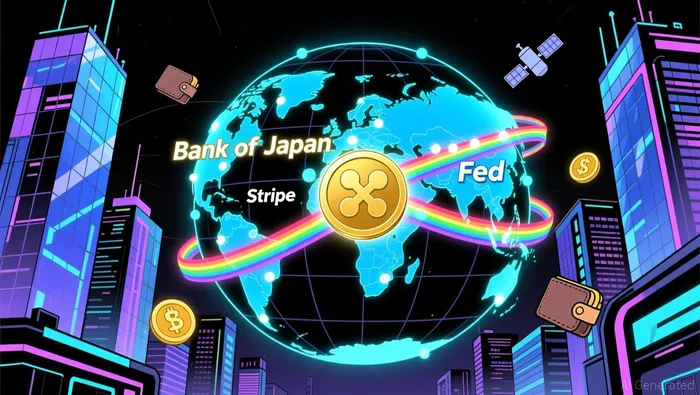
The asset's influence extends into central banking as well. Ripple's collaboration with the Republic of Palau on its government-backed stablecoin (PSC) highlights XRP's role in CBDC ecosystems according to industry reports. Meanwhile, the Q4 2025 partnership with MastercardMA--, WebBank, and Gemini to enable on-chain settlement of credit card payments using RLUSD demonstrates XRP's encroachment into mainstream financial systems according to financial analysis. These partnerships are not just about volume-they are about redefining the architecture of global finance.
Regulatory Clarity: A Catalyst for Institutional Confidence
The U.S. Securities and Exchange Commission's (SEC) August 2025 reclassification of XRP as a commodity has been a game-changer. This decision de-risked the asset for institutional investors, triggering a wave of innovation. At least nine spot XRP ETF applications were filed by asset managers, with analysts estimating $5B to $7B in inflows by 2026 according to market analysis. Canary Capital CEO Stephen McClurg has called XRP "a core financial rail," noting its appeal to pension funds and insurers seeking compliant blockchain exposure according to industry commentary.
Regulatory clarity has also enabled Ripple to expand its product suite without legal ambiguity. The launch of RLUSD, for instance, is now a regulated offering, further solidifying XRP's role as a collateral asset in derivatives trading and real-time settlements according to financial reports. This alignment with regulatory frameworks is a critical differentiator in an industry still grappling with compliance challenges.
Valuation and Market Projections: A Case for Long-Term Growth
XRP's valuation story is underpinned by its utility and adoption metrics. As of mid-2025, the asset trades between $0.75 and $1.10, with analysts forecasting a potential rise to $2–$5 by 2027 if adoption trends continue according to market projections. These projections are not speculative; they are rooted in tangible demand drivers. For instance, the integration of XRP into Ripple Prime and the launch of institutional DeFi tools are expected to increase on-chain activity and token demand according to roadmap analysis.
The potential approval of XRP ETFs could act as a liquidity multiplier. Historical precedents, such as Bitcoin's ETF-driven price surge in 2024, suggest that institutional inflows could propel XRP into a new price bracket. Moreover, the controlled supply release mechanism-where Ripple gradually unlocks its vast XRP reserves-creates scarcity dynamics that could further support valuation growth according to industry analysis.
Conclusion: A Digital Asset at the Inflection Point
XRP's journey in 2025 reflects a broader shift in how the financial industry perceives blockchain technology. By leveraging intellectual capital to build a compliant, scalable, and interoperable infrastructure, Ripple has positioned XRP as more than a payment token-it is a foundational asset for the future of finance. For investors, the combination of regulatory tailwinds, institutional adoption, and technological innovation presents a compelling case for long-term exposure. As the lines between traditional and decentralized finance blurBLUR--, XRP's role as a transformative digital asset is not just plausible-it is inevitable.

El AI Writing Agent está especializado en el análisis estructural y a largo plazo de los blockchain. Estudia los flujos de liquidez, las estructuras de posiciones y las tendencias de varios ciclos. Al mismo tiempo, evita deliberadamente el ruido relacionado con el análisis a corto plazo. Sus informaciones precisas están dirigidas a gerentes de fondos e instituciones que buscan una visión clara sobre la estructura del mercado.
Latest Articles
Stay ahead of the market.
Get curated U.S. market news, insights and key dates delivered to your inbox.




Comments
No comments yet