
XRP's Surging Momentum to $1.88: A Breakthrough or a Bubble?
 Aime Summary
Regulatory Resolution: A Mixed Blessing
The 2025 settlement between Ripple and the SEC marked a pivotal moment. Ripple agreed to a $50 million penalty, with the injunction against future violations lifted, effectively resolving a four-year legal battle. This outcome clarified XRP's status as a non-security in most public exchange sales, creating a precedent that could redefine token classification standards. However, the settlement's ambiguity-particularly around private sales-leaves room for regulatory uncertainty. While this resolution reduced legal headwinds, it did not eliminate them entirely, leaving XRP vulnerable to future enforcement actions in jurisdictions with divergent interpretations.
Market Catalysts: ETFs, Partnerships, and Real-World Utility
The surge to $1.88 coincided with several key market catalysts. First, the launch of the BlackRock XRP ETF and other institutional products injected over $1.25 billion in assets under management, signaling growing institutional confidence. Second, Ripple's strategic acquisitions, including Hidden Road and GTreasury, expanded its footprint in financial infrastructure, enhancing XRP's utility beyond speculative trading. Third, the development of RLUSD in Japan-backed by SBI-positioned the XRP Ledger as a compliant stablecoin platform for cross-border payments, a use case with tangible economic value.
On-chain metrics further support XRP's utility-driven narrative. Over four billion transactions processed on the XRP Ledger underscore its role in real-world applications, particularly in cross-border remittances. Institutional partnerships with firms like Guggenheim and Franklin Templeton have also driven infrastructure adoption, increasing XRP's exposure to traditional financial systems.
Volatility and the "ETF Paradox"
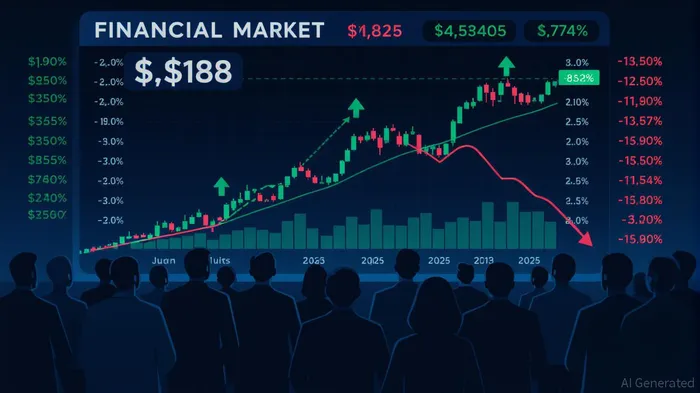
Despite these positives, XRP's price action remains puzzling. While ETF inflows hit record levels, the token's price stagnated around $1.88, failing to capitalize on the $3.65 peak seen in July 2025. Analysts attribute this to liquidity constraints and broader macroeconomic caution. A Monte Carlo simulation of 10,000 price paths suggests XRP could reach $1.88 by late 2026, but 60% of scenarios project a range between $1.04 and $3.40, highlighting significant uncertainty.
The disconnect between ETF assets and price performance raises questions about market depth. According to a report by Interactive Crypto, institutional capital inflows have not translated into meaningful price appreciation due to limited retail participation and hedging strategies by large holders. This "ETF paradox" underscores the challenges of scaling adoption in a market still grappling with regulatory skepticism.
Macro Risks and the Road Ahead
Looking ahead, XRP's trajectory hinges on two critical factors: regulatory clarity and macroeconomic stability. The March 2026 FOMC meeting will provide clarity on interest rate trends, which could influence capital flows into risk assets like crypto. Meanwhile, the potential approval of additional XRP ETFs-particularly in Europe-could further institutionalize the asset.
However, risks persist. Ripple's recent 48% price drop from its July high highlights the fragility of market sentiment. If macroeconomic conditions deteriorate or regulatory scrutiny intensifies, XRP could face renewed selling pressure. Conversely, sustained adoption in cross-border payments and stablecoin infrastructure could anchor its value proposition beyond speculative cycles.
Conclusion: Balancing OptimismOP-- and Caution
XRP's surge to $1.88 reflects a confluence of regulatory progress and market-driven innovation. The SEC settlement and institutional ETFs have laid the groundwork for broader adoption, while on-chain utility in payments and stablecoins offers a defensible value proposition. Yet, the token's volatility and the "ETF paradox" reveal structural weaknesses in liquidity and investor psychology.
For investors, the key lies in balancing optimism with caution. XRP's potential as a breakthrough asset is real, but its path forward remains contingent on macroeconomic stability, regulatory consistency, and the ability to convert utility into sustained demand. As the crypto market matures, XRP's journey will serve as a case study in navigating the delicate interplay between innovation and institutional trust.

Blending traditional trading wisdom with cutting-edge cryptocurrency insights.
Latest Articles
Stay ahead of the market.
Get curated U.S. market news, insights and key dates delivered to your inbox.




Comments
No comments yet