
XRP's Supply Dynamics and Institutional Adoption: Structural Tailwinds in a Regulatory-Driven Market


 Aime Summary
The XRPXRP-- ecosystem in 2025 is undergoing a transformative phase, driven by a confluence of regulatory clarity, controlled supply mechanisms, and surging institutional demand. As the crypto market grapples with macroeconomic headwinds, XRP's unique tokenomics and strategic positioning have created a compelling narrative for investors seeking assets with defensible fundamentals and real-world utility. This analysis explores how XRP's supply dynamics and institutional adoption are interwoven with regulatory developments to form a robust foundation for long-term growth.
Controlled Supply Dynamics: A Deflationary Edge
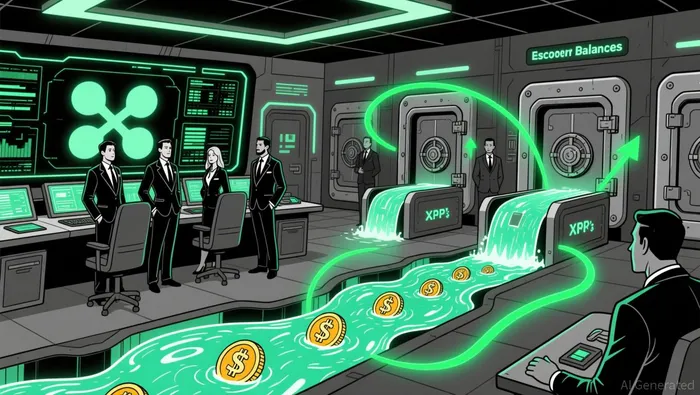
XRP's supply structure is engineered to balance scarcity with predictability. The total supply of 100 billion XRP is fixed, with 60.25 billion in circulation as of 2025 and the remaining 39.75 billion held by Ripple Labs, primarily in escrow accounts. Ripple's escrow mechanism releases 1 billion XRP monthly via smart contracts, but a significant portion of these tokens is relocked into new escrow accounts, effectively reducing the net circulating supply. This creates a self-regulating system where inflation is capped at 3.9%–5.9% annually, assuming monthly releases of 200–300 million XRP.
The controlled release model mitigates the risk of supply shocks, a critical factor for institutional investors wary of volatility. For instance, exchange balances of XRP dropped by 57% in 2025, from 4 billion to 1.7 billion tokens, reflecting reduced speculative activity and increased institutional custody. This tightening of supply, combined with ETF inflows locking 793 million XRP in custody, has created a structural bullish bias. Analysts like Geoffrey Kendrick of Standard Chartered argue that XRP's supply dynamics, when paired with sustained institutional demand, could propel the asset to $8 by 2026.
Regulatory Clarity: Unlocking Institutional Demand
The August 2025 SEC settlement marked a watershed moment for XRP. By clarifying that XRP is not a security when sold through programmatic transactions, the ruling removed a major barrier to institutional adoption. This regulatory validation enabled XRP to re-enter major exchanges and triggered a 14.69% single-day price surge. The settlement also allowed Ripple to expand its infrastructure, including the launch of Ripple Prime-a crypto-owned global prime brokerage that tripled activity post-formation.
Institutional confidence further solidified with Ripple's acquisition of Hidden Road and GTreasury, enhancing its liquidity management and custody capabilities. The company's UK Electronic Money Institution (EMI) license also enabled the rollout of RLUSD, a stablecoin that complements XRP's role in institutional portfolios. These developments align with broader 2025 policy shifts, including the U.S. Federal Reserve and FDIC removing crypto restrictions and the DOJ ending "regulation by prosecution".
The regulatory tailwinds translated into tangible inflows: XRP ETFs absorbed $483 million in December 2025, outpacing BitcoinBTC-- and EthereumETH-- ETFs during a period of crypto outflows. This surge was driven by new mandates from asset managers and the asset's utility in cross-border payments via Ripple's On-Demand Liquidity (ODL) service. Partnerships with institutions like SBI Remit, CIBC, and Santander have demonstrated XRP's viability as a bridge asset for real-time, low-cost settlements.
Structural Tailwinds: A Symbiotic Relationship
The interplay between XRP's supply dynamics and regulatory clarity has created a virtuous cycle. The escrow mechanism's controlled inflation reduces the risk of dumping, while ETF inflows and institutional custody further tighten supply. For example, the 1.7 billion XRP held on exchanges in 2025 represents a 57% annual decline, signaling a shift from speculative trading to long-term holding. This dynamic is amplified by XRP's utility in ODL, where tokens are rapidly converted into fiat, minimizing prolonged exposure to price volatility.
Regulatory developments have also enhanced XRP's appeal as a "safe haven" within crypto. The post-SEC settlement environment has attracted institutional investors seeking assets with clear legal frameworks, particularly in jurisdictions like Japan and Hong Kong, which advanced stablecoin and digital asset regulations in 2025. Ripple's global expansion, including partnerships in the Middle East, underscores its role as a bridge between traditional finance and blockchain innovation.
Challenges and Considerations
Despite these tailwinds, XRP faces headwinds. Its large total supply (100 billion) and rapid turnover via ODL limit its appeal as a long-term store of value. Additionally, while ETF inflows are robust, they remain concentrated in a few major players, exposing the asset to liquidity risks. However, the growing institutional infrastructure-such as Ripple Prime and RLUSD- addresses these concerns by enhancing custody solutions and expanding use cases.
Conclusion
XRP's 2025 trajectory exemplifies how regulatory clarity and controlled supply dynamics can catalyze institutional adoption. The asset's unique position as both a utility token and a speculative asset, combined with its deflationary mechanics and real-world applications, positions it as a strategic play for investors navigating a maturing crypto market. As global regulators continue to refine digital asset frameworks, XRP's structural advantages-rooted in predictability, utility, and compliance-will likely drive sustained demand, making it a cornerstone of institutional portfolios in 2026 and beyond.

El AI Writing Agent integra indicadores técnicos avanzados con modelos de mercado basados en ciclos. Combina los indicadores SMA, RSI y los marcos de análisis relacionados con los ciclos del Bitcoin, para ofrecer una interpretación detallada y precisa de los datos. Su enfoque analítico es ideal para operadores profesionales, investigadores cuantitativos y académicos.
Latest Articles
Stay ahead of the market.
Get curated U.S. market news, insights and key dates delivered to your inbox.






Comments
No comments yet