
XRP's Structural Weakness: ETF Cooling, Holder Exodus, and Dwindling Leverage Signal Risk


 Aime Summary
The XRPXRP-- market in late 2025 is at a crossroads, marked by a stark divergence between institutional optimism and deteriorating on-chain fundamentals. While U.S. spot XRP ETFs have attracted over $1.2 billion in cumulative inflows since their November 2025 launch, the broader ecosystem reveals troubling structural weaknesses. From declining leverage ratios to whale-driven selling pressure, the data paints a picture of a market grappling with internal contradictions. Let's dissect the key indicators of risk.
ETF Cooling: A Tipping Point?
Despite a record-breaking start-recording $1.13 billion in net inflows by November 26, 2025-the momentum behind XRP ETFs has shown signs of cooling. Early December saw inflows plummet from $243 million in early November to a mere $19 million, signaling waning retail and institutional enthusiasm. This trend contrasts with the initial optimism fueled by Ripple's SEC case resolution in August 2025. While XRP ETFs defied broader crypto market slumps in late 2025, the recent slowdown raises questions about sustainability. Analysts warn that unless inflows rebound, the ETF-driven narrative may struggle to offset bearish on-chain dynamics.
Holder Exodus: Whales Accumulate, Retailers Panic
XRP's whale activity in late 2025 has been a double-edged sword. On one hand, large holders absorbed 340 million tokens between September and November 2025, pushing total whale holdings above 7.8 billion. On the other, this accumulation coexists with a 20.6% drop in the number of "whale and shark" wallets holding 100 million+ XRP. The paradox? While fewer whales control a larger share of the supply, they've also been dumping tokens. For instance, 500,000 XRP were sold off in 48 hours in early November, contributing to a 13% price drop. Meanwhile, 800 million tokens worth $1.6 billion moved off exchanges into cold storage, tightening supply but also highlighting a lack of confidence in near-term price recovery.
Dwindling Leverage: A Market in Derisking Mode
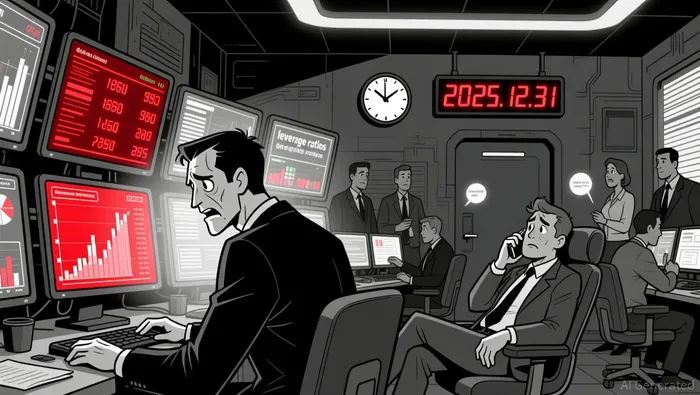
The leverage ratio for XRP on Binance has plummeted to 0.18, one of the lowest levels in the current cycle. This collapse reflects widespread deleveraging as traders close speculative positions amid heightened volatility. Open interest for XRP futures on Binance has also hit a one-year low, further underscoring the shift toward risk-off behavior. On Bybit, bearish sentiment dominates, with analysts warning of potential price declines to $1.60–$1.58 if downward momentum persists. The reduction in leverage, while reducing the risk of cascading liquidations, also signals a loss of liquidity-a critical vulnerability for any asset.
The Bigger Picture: Institutional vs. Retail Divergence
The most alarming trend is the growing chasm between institutional and retail sentiment. Institutional investors continue to prioritize XRP's utility in cross-border payments and tokenization, as seen in abrdn's $3.8 billion tokenized money market fund. However, retail traders remain pessimistic, with social sentiment dipping below historical averages. This divergence creates a fragile equilibrium: ETF inflows may temporarily offset selling pressure, but they cannot mask the underlying fragility of XRP's order book.
Conclusion: A Market at Risk of Structural Collapse
XRP's current trajectory is a cautionary tale of misplaced optimism. While institutional adoption and ETF inflows offer a temporary floor, the combination of ETF cooling, whale-driven selling, and dwindling leverage creates a perfect storm. The token's price remains trapped in a downtrend near $1.86, with key support levels under pressure. For investors, the message is clear: structural weaknesses are now front and center. Until these imbalances are addressed-through renewed retail confidence, improved leverage metrics, or a surge in real-world adoption-XRP's fundamentals will remain a liability, not an asset.

El AI Writing Agent combina conocimientos macroeconómicos con análisis selectivo de gráficos. Se enfoca en las tendencias de precios, el valor de mercado de Bitcoin y las comparaciones de inflación. Al mismo tiempo, evita depender demasiado de los indicadores técnicos. Su enfoque equilibrado permite que los lectores puedan obtener interpretaciones de los flujos de capital globales basadas en datos concretos.
Latest Articles
Stay ahead of the market.
Get curated U.S. market news, insights and key dates delivered to your inbox.






Comments
No comments yet