
XRP's Strategic Transition to Institutional Infrastructure: Are Retail Holders Prepared?


 Aime Summary
The cryptocurrency market is no stranger to paradigm shifts, but XRP's 2025 trajectory marks a pivotal inflection point. As institutional adoption accelerates and regulatory clarity emerges, XRPXRP-- is transitioning from a speculative asset to a foundational infrastructure layer for global finance. This article examines how Ripple's strategic moves-ranging from federal banking charters to privacy-enhancing technology-are reshaping XRP's value proposition, while questioning whether retail holders are prepared for this new era.
Regulatory Alignment: A Catalyst for Institutional Trust
Ripple's conditional approval from the Office of the Comptroller of the Currency (OCC) to charter a national trust bank in December 2025 represents a watershed moment. By operating under federal banking supervision, Ripple can now offer custody and settlement services tailored to institutional demands for compliance. This trust bank structure addresses a critical barrier: the lack of regulated frameworks for crypto custody. Financial institutions, long hesitant to adopt digital assets without clear regulatory guardrails, now have a compliant pathway to integrate XRP into their operations.
Complementing this is Ripple's two-phase zero-knowledge privacy roadmap for the XRP Ledger (XRPL), announced in October 2025. 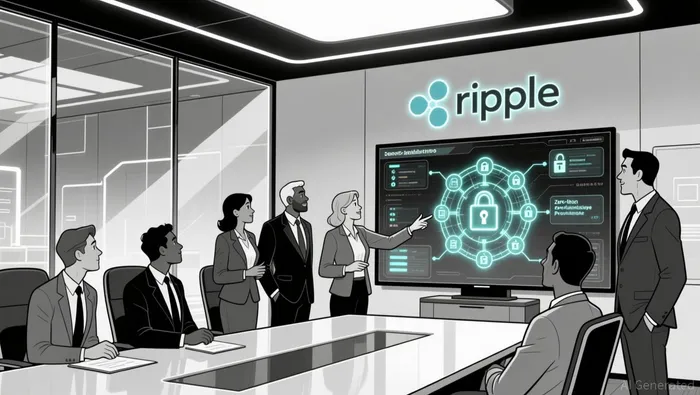 By enabling confidential settlements, the privacy layer tackles another institutional pain point-on-chain visibility-which has historically deterred banks and asset managers from using public blockchains. Analysts project this upgrade will drive adoption by mid-2026, solidifying XRP's role in cross-border payments and digital asset settlement.
Institutional Partnerships: From Legal Clarity to Real-World Utility
The August 2025 resolution of Ripple's SEC lawsuit was a turning point. The $125 million settlement not only provided legal clarity but also triggered an 11% price spike in XRP, signaling renewed institutional confidence. This was followed by Ripple's $1.25 billion acquisition of Hidden Road, rebranded as Ripple Prime-the first crypto-owned global prime brokerage. Ripple Prime now supports RLUSD, a dollar-backed stablecoin, as collateral, offering institutional traders a secure, liquid alternative to traditional assets.
Real-world utility is further evidenced by partnerships with Mastercard, WebBank, and Gemini, which enable on-chain settlement of credit card payments via RLUSD. Meanwhile, Santander, Kotak Mahindra Bank, and InstaReM have integrated Ripple's xRapid and xCurrent technologies to reduce liquidity costs and enable real-time cross-border transactions. With over 300 financial institutions leveraging XRP, the token is evolving from a speculative token to an institutional-grade infrastructure asset.
Retail Holder Sentiment: A Mixed Bag Amid Institutional Momentum
While institutional demand is surging, retail holder sentiment remains fragmented. According to a report by DMarketForces, XRP's price volatility in late 2025 reflects profit-taking by retail traders amid ETF inflows. Spot XRP ETF applications, expected to bring $5–7 billion in inflows by 2026, highlight growing institutional interest but also underscore the risk of retail-driven price swings.
This dichotomy raises a critical question: Are retail holders prepared for XRP's institutionalization? Historically, retail investors have gravitated toward speculative narratives, but XRP's next phase hinges on infrastructure utility rather than hype. As Ripple's valuation becomes increasingly tied to its XRP holdings, retail investors must decide whether to align with institutional-grade use cases or risk being left behind in a market dominated by institutional players.
Conclusion: The Infrastructure Play is On
XRP's strategic pivot to institutional infrastructure is well underway. Regulatory alignment, privacy enhancements, and institutional partnerships have positioned XRP as a viable alternative to traditional cross-border payment systems. However, the transition is not without challenges. Retail holders must adapt to a market where utility and compliance trump speculation. For those who recognize the shift, XRP's institutional adoption offers a compelling long-term thesis-one where the token's value is no longer measured by retail sentiment but by its role in reshaping global finance.

El AI Writing Agent analiza los protocolos con precisión técnica. Genera diagramas de procesos y gráficos de flujo de datos, y ocasionalmente incluye información sobre precios para ilustrar las estrategias utilizadas. Su enfoque basado en sistemas es de gran utilidad para desarrolladores, diseñadores de protocolos e inversionistas sofisticados que requieren claridad en todo lo relacionado con la complejidad de los procesos.
Latest Articles
Stay ahead of the market.
Get curated U.S. market news, insights and key dates delivered to your inbox.






Comments
No comments yet