
XRP’s Strategic Shift: Pioneering a Post-Bank Era with Decentralized Liquidity


 Aime Summary
In 2025, XRPXRPI-- has emerged as a defining force in the transition from traditional banking systems to decentralized, blockchain-driven finance. The XRP Ledger (XRPL) is no longer just a cross-border payment solution—it is a fully functional, institutional-grade platform for liquidity, tokenization, and high-value settlements. This transformation is driven by a confluence of regulatory clarity, technological innovation, and strategic partnerships that position XRP as a bridge between legacy systems and the decentralized future.
Regulatory Clarity Fuels Institutional Confidence
The U.S. SEC’s August 2025 ruling, which classified XRP as a digital commodity in secondary markets, has been a watershed moment. This decision removed a critical barrier to institutional adoption, unlocking over $1.2 billion in ETF inflows through products like the ProShares Ultra XRP ETF [1]. For the first time, institutional investors can deploy XRP with legal certainty, treating it as a non-security asset that aligns with global compliance frameworks. This shift has redefined XRP’s role: it is no longer a tool for banks but a standalone asset class with programmable utility.
Technological Upgrades for Scalable Liquidity
The XRP Ledger’s recent upgrades have addressed institutional pain points, particularly in liquidity and interoperability. The XLS-30 Automated Market Maker (AMM) has revolutionized large-scale trading by enabling near-instant, low-cost swaps across 20,000+ AMM pools [1]. These pools now support tokenized assets and stablecoins, creating a decentralized infrastructure for global finance. Additionally, integrations with oracleORCL-- providers like DIA and ChainlinkLINK-- ensure real-time data accuracy for smart contracts, a critical feature for institutional-grade applications [3].
A 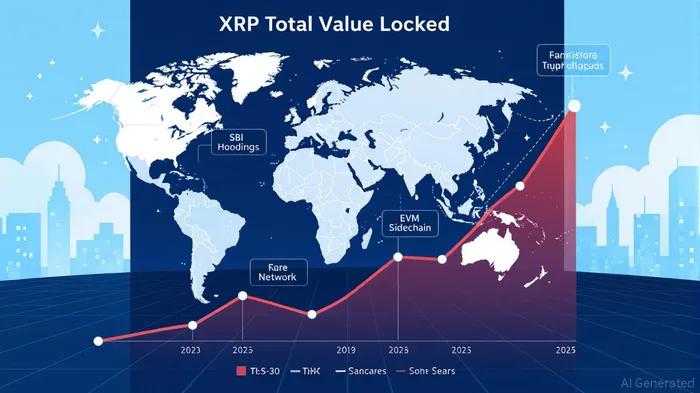 would visually underscore these advancements.
Strategic Partnerships Redefine Utility
XRP’s institutional adoption is further accelerated by partnerships that extend its utility beyond payments. Ripple’s collaboration with SBI Holdings has launched RLUSD, a dollar-backed stablecoin now distributed across Japan [2]. This move not only diversifies XRP’s ecosystem but also demonstrates its capacity to coexist with fiat while reducing reliance on traditional banking infrastructure. Meanwhile, corporate treasuries like Gumi and VivoPower International are leveraging XRP’s yield generation capabilities through platforms like Flare Network’s FXRP, generating $236 million in TVL for staking and lending [4].
A would provide concrete evidence of institutional demand.
The Roadmap to a Post-Bank Era
Looking ahead, the XRP Ledger’s 2025 roadmap includes launching an EVM sidechain to attract EthereumETH-- developers while retaining XRPL’s core advantages of speed and low fees [1]. This dual-layer approach ensures XRP remains competitive in both DeFi and enterprise finance. Institutional-grade tools like Permissioned DEX and Permissioned Domains further align XRP with global regulations, enabling tokenized securities and structured products [1].
Ripple’s On-Demand Liquidity (ODL) service, which processed $1.3 trillion in Q2 2025 [1], exemplifies XRP’s efficiency in cross-border settlements. By replacing correspondent banking with a decentralized, real-time solution, XRP is not just competing with banks—it is rendering their intermediation obsolete.
Conclusion
XRP’s strategic shift from a centralized banking tool to a decentralized liquidity engine is reshaping the financial landscape. With regulatory clarity, technological agility, and institutional-grade partnerships, XRP is no longer a “bridge” to the future—it is the foundation. As the world moves toward a post-bank era, XRP’s energy efficiency, interoperability, and growing TVL position it as a critical player in redefining global payments and high-value settlements [3].
**Source:[1] Ripple Reveals 2025 Institutional DeFi Roadmap For XRP Ledger [https://bitcoinist.com/ripple-2025-institutional-defi-roadmap-xrp-ledger/][2] XRP's Institutional Adoption Momentum: A Strategic Shift in Enterprise Finance [https://www.bitget.site/news/detail/12560604942458][3] XRP's Strategic Shift Toward High-Value Settlement Systems [https://www.bitget.com/news/detail/12560604939294][4] XRP's Institutional Adoption: A Strategic Play for Blockchain-Driven Growth [https://www.ainvest.com/news/xrp-institutional-adoption-strategic-play-blockchain-driven-growth-2025-2508/]

Decoding blockchain innovations and market trends with clarity and precision.
Latest Articles
Stay ahead of the market.
Get curated U.S. market news, insights and key dates delivered to your inbox.
AInvest
PRO
AInvest
PRO



Comments
No comments yet