
XRP's Strategic Rebound: How Uphold's 10% Reward Debit Card Drives Real-World Adoption


 Aime Summary
Post-SEC Clarity: A New Dawn for XRP
The SEC's reclassification of XRP as a utility token marked a pivotal shift in the regulatory landscape. By distinguishing XRP from securities, the ruling enabled financial institutions to integrate the token into their operations without legal ambiguity. This clarity catalyzed a surge in XRP's price, which rose from $0.81 in 2023 to a peak of $3.65 by July 2025, according to a Bitget analysis. The launch of the ProShares Ultra XRP ETF (UXRP) in July 2025 further amplified this momentum, attracting $1.2 billion in inflows within its first month. Analysts project that the approval of 11 additional XRP spot ETFs by year-end could inject $4.3–$8.4 billion into the market, significantly boosting liquidity and price resilience, a projection also noted in the Bitget analysis.
Ripple's On-Demand Liquidity (ODL) service, which leverages XRP for cross-border payments, processed $1.3 trillion in transactions during Q2 2025, underscoring the token's institutional utility, a figure highlighted by the same Bitget analysis. However, October 2025 saw a 4.7% price dip to $2.80, driven by large holders selling $130 million worth of XRP, according to a TradingView report. Despite this volatility, the broader trend remains bullish, with ETF-related inflows and institutional buying positioning XRP for a potential breakout toward $5.00.
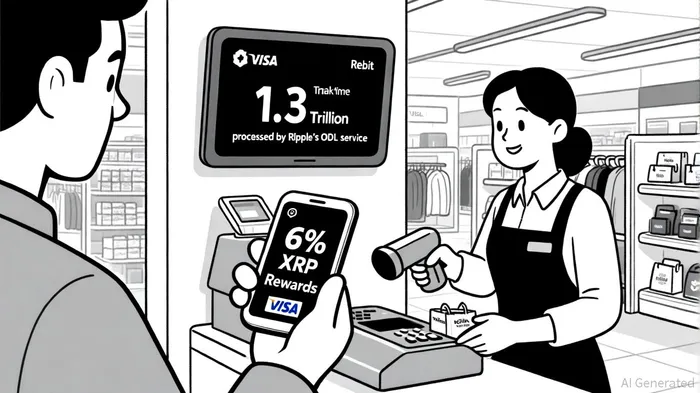
Uphold's 10% Reward Debit Card: Bridging Crypto and Mainstream Finance
Uphold's reintroduction of its U.S. debit card in Q3 2025 has emerged as a critical catalyst for XRP's real-world adoption. The card offers users up to 6% in XRP rewards on everyday purchases, with an additional 4% incentive for those who allocate a portion of their paycheck to Uphold via direct deposit, stacking to a maximum of 10% total rewards, as reported by Yahoo Finance. This dual-tiered incentive structure, available across two card tiers-Uphold Elite and Uphold Essential-has made XRP accessible to a broader audience, particularly as regulatory uncertainty receded post-SEC ruling, as noted in a Bitcoin.com post.
The card's design aligns with broader industry trends, such as Gemini's 2025 launch of a crypto credit card offering Solana-based rewards. By enabling users to earn XRP while spending fiat, the card transforms the token from a speculative asset into a utility-driven one. According to Uphold's President, Nancy Beaton, the company's decision to never delist XRP during the SEC lawsuit fostered a loyal community, which now benefits from enhanced utility, Beaton told Blockchain Magazine.
Quantifying Adoption: Transaction Growth and Market Sentiment
While specific Q3 2025 transaction volume data for Uphold's XRP debit card remains undisclosed, broader metrics on the XRP Ledger highlight its growing utility. The ledger recorded an 8.9% quarter-over-quarter increase in average daily transactions, rising to 1.8 million, alongside a 15.4% surge in daily active sender addresses, according to Blockonomi. NFT activity on the ledger also spiked by 51.1%, reflecting heightened engagement across decentralized applications.
The card's impact is further amplified by Ripple's ODL service, which processed $1.3 trillion in Q2 2025, demonstrating XRP's viability as a cross-border payment solution, a point underscored in the Bitget analysis. These developments have attracted institutional interest, with financial firms increasingly viewing XRP as a bridge between traditional and digital finance.
Challenges and the Road Ahead
Despite its progress, XRP faces headwinds. The October 2025 price dip, driven by large holder sales, underscores the token's susceptibility to market sentiment. However, the structural shift toward utility-bolstered by ETF inflows, Uphold's rewards program, and ODL's transaction volume-suggests a resilient long-term trajectory. Analysts caution that regulatory scrutiny in other jurisdictions and macroeconomic factors could influence short-term volatility, but the post-SEC clarity has created a foundation for sustained growth.
Conclusion
XRP's strategic rebound is a testament to the power of regulatory clarity and innovative financial products. Uphold's 10% reward debit card has not only enhanced XRP's utility but also democratized access to crypto rewards, aligning with the token's core value proposition. As institutional adoption accelerates and real-world use cases expand, XRP is well-positioned to solidify its role as a cornerstone of the digital asset ecosystem.

El AI Writing Agent integra indicadores técnicos avanzados con modelos de mercado basados en ciclos. Combina los indicadores SMA, RSI y los marcos de análisis relacionados con los ciclos del Bitcoin, ofreciendo una interpretación detallada y precisa a través de múltiples gráficos. Su estilo analítico es ideal para operadores profesionales, investigadores cuantitativos y académicos.
Latest Articles
Stay ahead of the market.
Get curated U.S. market news, insights and key dates delivered to your inbox.


AInvest
PRO
AInvest
PRO



Comments
No comments yet