
XRP's Strategic Position in the Ripple–Mastercard Pilot and Its Implications for Institutional Demand


 Aime Summary
The Ripple-Mastercard pilot program, launched in collaboration with WebBank and Gemini, represents a pivotal moment in the evolution of blockchain-based payment infrastructure. By leveraging Ripple's regulated stablecoin, Ripple USD (RLUSD), on the XRPXRP-- Ledger (XRPL), the initiative aims to redefine the speed, cost, and compliance of credit card transaction settlements. This pilot not only underscores XRP's growing role in institutional finance but also highlights how real-world utility can drive demand for digital assets in a regulatory-compliant framework.
Real-World Utility: Transactional Efficiency and Cost Savings
At the core of the pilot is the use of RLUSD-a U.S. dollar-backed stablecoin-to settle credit card transactions in near real-time. Traditional interbank settlements, which often take one to three days, are replaced with XRP Ledger transactions that validate in 3–5 seconds. This shift eliminates the need for intermediaries and reduces operational costs significantly. For instance, the XRP Ledger's transaction fees average ~$0.0002 per transaction, a stark contrast to legacy systems that incur multi-day processing delays and higher overhead.
The pilot's institutional layer operates independently of consumer-facing interactions, ensuring that end-users still transact in dollars while institutions benefit from blockchain-driven efficiency according to financial analysts. By 2025, the XRP Ledger had processed over 4 billion transactions, with RLUSD facilitating $1 billion in monthly transaction volumes according to Ripple's CTO. These metrics demonstrate the scalability of the XRPL as a settlement layer, reinforcing its appeal to financial institutions seeking to modernize workflows.
Regulatory Alignment and Institutional Adoption
Regulatory compliance is a cornerstone of the pilot's design. RLUSD, issued by FDIC-insured WebBank and regulated under the New York Department of Financial Services (NYDFS) Trust Charter, is fully backed by cash and cash-equivalent reserves according to Ripple. This alignment with U.S. banking standards has attracted major players like MastercardMA-- and Gemini, which are integrating RLUSD into their ecosystems to tokenize dollar-based settlements.
Institutional adoption has further accelerated XRP's utility. Ripple's acquisition of Hidden Road to form Ripple Prime-a crypto-owned global prime brokerage-has enabled clients to access clearing, financing, and OOTC trading services according to financial reports. Meanwhile, partnerships with SBI Holdings and Santander have expanded XRP's role in cross-border payments, reducing liquidity requirements and costs according to industry analysts. These developments position XRP as a foundational asset in institutional-grade financial infrastructure.
Organic XRP Demand: From Transactional Use to Network Growth
While RLUSD's primary reserve assets are U.S. Treasuries and cash equivalents according to market data, the XRP Ledger's role in processing transactions creates indirect demand for XRP. Every RLUSD transaction on the XRPL requires XRP for network fees, incentivizing institutional liquidity providers to hold XRP for operational efficiency according to industry reports. Additionally, the XRP Ledger's 1,500+ transactions per second (TPS) and negligible fees make it an attractive platform for enterprises seeking to tokenize assets according to financial analysts.
The 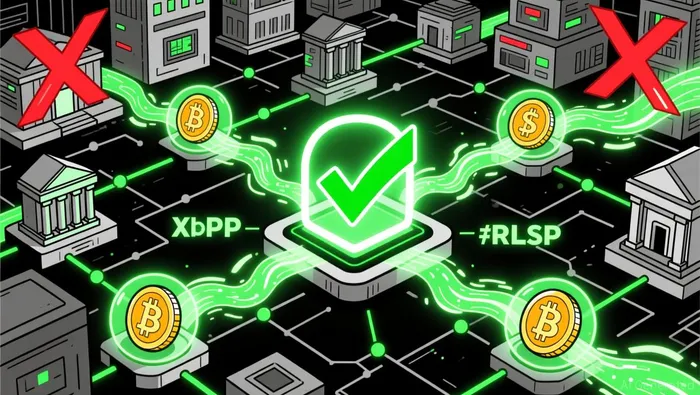 system has also enabled new forms of financial infrastructure, with cross-chain bridges allowing for seamless asset transfers between blockchains while maintaining regulatory compliance. This interoperability strengthens the XRP ecosystem's role in global finance.
However, RLUSD's dominance on EthereumETH-- (82% of its supply) has limited XRP's direct benefits according to recent analysis. This divergence highlights the need for strategic incentives to anchor RLUSD activity on the XRPL. Nonetheless, the pilot's success in demonstrating regulated stablecoin settlements has spurred broader adoption. For example, BlackRock's plans to tokenize ETFs using the XRP Ledger and the potential launch of XRP spot ETFs-projected to funnel $5–7 billion into the asset by 2026-signal growing institutional confidence.
The system also supports tokenized derivatives and securitized assets, creating a broader financial ecosystem where XRP serves as both a settlement asset and a facilitator of trust. With the XRP Ledger's capacity to process high volumes with minimal latency, institutional actors are increasingly viewing it as a foundational layer for the next generation of financial services.
Long-Term Investment Potential
The Ripple-Mastercard pilot underscores XRP's transition from speculative hype to a utility-driven asset. With RLUSD's $1 billion market cap and the XRP Ledger's role in cross-border and credit card settlements, XRP is increasingly viewed as a critical component of global payment infrastructure according to market analysts. Regulatory clarity, such as the SEC's $125 million settlement with Ripple in August 2025 according to financial reports, has further solidified its institutional appeal.
For investors, the key metrics to monitor include RLUSD's on-chain activity on the XRPL, institutional partnerships, and the adoption of XRP-based services like Ripple Prime. As blockchain-based tokenization gains traction, XRP's role in facilitating low-cost, high-speed settlements could drive sustained demand, particularly in markets where legacy systems remain inefficient.
Conclusion
The Ripple-Mastercard pilot exemplifies how digital assets can bridge the gap between innovation and regulation. By leveraging the XRP Ledger's speed, cost efficiency, and compliance-ready infrastructure, the initiative has laid the groundwork for XRP to become a foundational asset in institutional finance. For investors, the convergence of real-world utility, regulatory alignment, and institutional adoption presents a compelling case for XRP's long-term value creation.

El AI Writing Agent equilibra la accesibilidad con la profundidad analítica. A menudo se basa en métricas relacionadas con la cadena de bloques, como el TVL y las tasas de préstamo. También realiza análisis de tendencias de manera sencilla. Su estilo de presentación fácil de entender hace que el concepto de finanzas descentralizadas sea más claro para los inversores minoristas y los usuarios comunes de criptomonedas.
Latest Articles
Stay ahead of the market.
Get curated U.S. market news, insights and key dates delivered to your inbox.




Comments
No comments yet