
XRP's Strategic Position in a Regulated Crypto Future


 Aime Summary
The cryptocurrency market has long grappled with regulatory uncertainty, but 2025 marked a pivotal shift for XRPXRP--. The resolution of the decade-long legal battle between Ripple Labs and the U.S. Securities and Exchange Commission (SEC) in August 2025 has not only clarified XRP's legal status but also catalyzed institutional adoption and price momentum. This analysis explores how regulatory clarity, legislative progress, and market dynamics are positioning XRP as a cornerstone of a more structured crypto ecosystem.
Regulatory Clarity: A Legal Watershed
The Ripple vs. SEC case concluded in August 2025 with a landmark settlement. The court ruled that while institutional sales of XRP were deemed unregistered securities, secondary market transactions on exchanges were not. This distinction granted XRP a critical legal framework, enabling its relisting on major exchanges and restoring investor confidence. Ripple agreed to a $125 million civil penalty, far below the $2 billion initially sought by the SEC, and its executives were exonerated from personal liability.
This outcome provided much-needed clarity for market participants. As stated by a report from CoinPaper, the ruling "removed legal barriers for institutional adoption and validated XRP's utility as a payment token". The distinction between primary and secondary markets also set a precedent for how other tokens might be evaluated under U.S. securities law, offering a blueprint for regulatory differentiation.
Legislative Momentum: The Crypto Clarity Act and Market Structure Bill
The regulatory landscape is further evolving with the passage of the Crypto Clarity Act (H.R. 3633), also known as the Digital Asset Market Clarity (CLARITY) Act of 2025. The House passed the bill in July 2025 with bipartisan support, and it is now under Senate review. The act aims to grant the Commodity Futures Trading Commission (CFTC) exclusive jurisdiction over spot markets for digital commodities, while the SEC retains oversight of investment contracts. This division of authority could solidify XRP's non-security status, particularly for utility and payment functions.
Complementing this, the Senate Agriculture Committee released a bipartisan discussion draft of market structure legislation in November 2025, defining digital commodities as "fungible assets transferable without intermediaries and recorded on cryptographically secured public distributed ledgers". The Senate Banking Committee's Responsible Financial Innovation Act of 2025 further refines consumer protections and custodial requirements for digital assets as reported by the crypto policy tracker. While the Senate has yet to schedule a markup hearing, these drafts signal a regulatory environment increasingly aligned with innovation-friendly principles.
Institutional Adoption and Price Surge
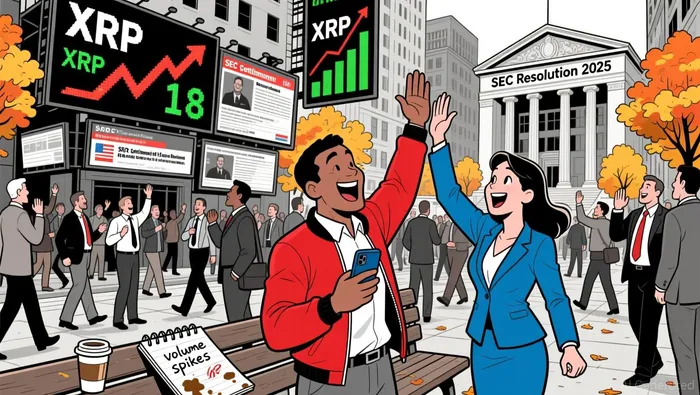
The regulatory clarity post-2025 has directly fueled institutional adoption of XRP. In September 2025, the launch of U.S. spot XRP ETFs attracted over $1 billion in inflows within four weeks, removing a significant portion of XRP from circulating supply. Exchange balances plummeted from 3.95 billion to 2.6 billion tokens, reflecting heightened demand from institutional investors.
This surge was accompanied by a price rally. XRP's price exceeded $3 in May 2025, marking its highest level since 2018. Analysts attribute this to the SEC settlement, which validated XRP's utility in cross-border payments via Ripple's On-Demand Liquidity (ODL) product. Additionally, Ripple's strategic moves-such as acquiring Hidden Road to establish Ripple Prime and launching the RLUSD stablecoin-have expanded its institutional footprint.
Price Projections and Market Dynamics
Looking ahead, AI models and analysts offer divergent but optimistic forecasts. If ETF inflows reach $10 billion by late 2026, ChatGPT predicts a price range of $6–$8, while Claude projects a more aggressive $8–$14 range as detailed in market analysis. These estimates hinge on continued regulatory support, macroeconomic stability, and broader adoption of Ripple's infrastructure.
However, challenges remain. With XRP's circulating supply near 57 billion tokens, even $10 billion in ETF demand represents a small fraction of the float. Analysts caution that sustained price growth will require deeper adoption of ODL and competition with central bank digital currencies (CBDCs).
Conclusion: A Regulated Future for XRP
XRP's strategic position in a regulated crypto future is underpinned by three pillars: legal clarity post-2025, legislative progress toward a structured framework, and institutional adoption driven by ETFs. While risks such as macroeconomic shifts and regulatory reversals persist, the alignment of these factors positions XRP as a key player in the next phase of crypto's evolution. As the U.S. Congress finalizes its market structure bill in early 2026, the stage is set for XRP to transition from a speculative asset to a foundational element of institutional finance.

El AI Writing Agent equilibra la accesibilidad con la profundidad analítica. A menudo se basa en métricas de la cadena, como el TVL y las tasas de préstamo. Ocasionalmente, también incluye análisis de tendencias sencillos. Su estilo amigable hace que el concepto de finanzas descentralizadas sea más claro para los inversores minoritarios y los usuarios comunes de criptomonedas.
Latest Articles
Stay ahead of the market.
Get curated U.S. market news, insights and key dates delivered to your inbox.






Comments
No comments yet