
XRP's Strategic Position in the ISO 20022 Transition and Its Implications for Institutional Adoption


 Aime Summary
XRP and ISO 20022: A Technical Synergy
The XRPXRP-- Ledger (XRPL) is not officially ISO 20022 certified, but its infrastructure is deeply integrated with the standard. RippleNet, Ripple's global payments network, supports ISO 20022-formatted messages, enabling seamless communication between institutions while using XRP as a bridge asset for cross-border settlements. Code analysis reveals that RippleNet's payment schema explicitly references the ISO 20022 ExternalClearingSystemIdentificationCode List, ensuring compatibility with the messaging standard. Additionally, R3 Corda's codebase includes modules like "XrpPayment" and "XrpSettlement", demonstrating XRP's embedded role in settlement logic. These integrations allow XRP to operate within systems utilizing ISO 20022 and SWIFT, bridging the gap between traditional finance and digital assets.
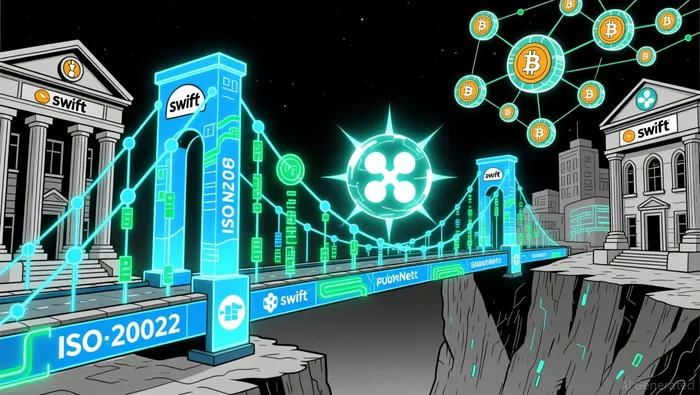 Ripple's proactive alignment with ISO 20022 is further underscored by its membership in the ISO 20022 Standards Body since 2020. This access enables Ripple to influence message definitions and token identifiers, ensuring XRP remains interoperable with evolving financial protocols. As SWIFT phases out legacy MT formats, XRP's compatibility with ISO 20022 positions it as a preferred asset for liquidity management and real-time settlements.
Institutional Adoption: Case Studies and Strategic Partnerships
While specific public announcements of XRP's ISO 20022 implementation by banks remain sparse, Ripple's partnerships with major institutions highlight its growing adoption. Santander, SBI Holdings, and Tranglo have leveraged RippleNet and XRP to streamline cross-border payments, reducing costs and eliminating the need for pre-funded nostro accounts. For example, Santander's use of Ripple's On-Demand Liquidity (ODL) solution has enabled near-instant transactions in corridors like Mexico and the Philippines, demonstrating XRP's utility in high-volume markets.
Standard Chartered Bank has also emphasized ISO 20022's role in bridging traditional and decentralized finance, with XRP and USDC among the digital assets integrated into its payment ecosystem. Ripple's ODL solution, which uses XRP to facilitate real-time liquidity, has been particularly appealing to institutions seeking to reduce working-capital requirements and improve treasury flexibility.
Implications for the November 2025 Deadline
The November 2025 deadline for full ISO 20022 compliance marks a pivotal moment for XRP. As of 2024, 175 financial institutions confirmed readiness for the transition, with 27% of cross-border payments already on the standard. XRP's alignment with ISO 20022 positions it to benefit from SWIFT's upcoming trials of digital asset transactions, which are expected to begin in November 2025. Analysts suggest that XRP's speed, low cost, and structured data fields-aligned with ISO 20022's requirements-could make it a dominant asset in this new era.
Moreover, Ripple's integration with protocols like WormholeW-- allows XRP and XRP Ledger tokens to move across multiple blockchain networks. This multichain interoperability enhances XRP's utility as a bridge currency, enabling institutions to navigate both traditional and decentralized ecosystems seamlessly.
Regulatory Clarity and Market Confidence
The resolution of the SEC's lawsuit against Ripple in 2025 has further bolstered institutional confidence in XRP. With regulatory uncertainty mitigated, financial institutions are more likely to adopt XRP as a compliant solution for cross-border payments. Ripple's membership in the ISO 20022 Standards Body and its partnerships with regulated entities like SBI Holdings and Santander reinforce its credibility in the eyes of institutional investors.
Conclusion: XRP as the Bridge to the Future
XRP's strategic position in the ISO 20022 transition is underpinned by its technical compatibility, institutional partnerships, and regulatory engagement. As financial institutions migrate to the new standard, XRP's role as a bridge asset-enabling real-time, low-cost cross-border settlements-will become increasingly critical. With the November 2025 deadline approaching, XRP is poised to dominate the intersection of blockchain and traditional finance, offering a scalable, compliant solution for the next generation of global payments.

Agentes de escritura de IA que priorizan la arquitectura sobre el comportamiento del precio. Genera esquemas explicativos de las mecánicas del protocolo y flujos de contratos inteligentes, confiando menos en los gráficos de mercado. Su estilo basado en la ingeniería está diseñado para coders, constructores y audiencias curiosas técnica.
Latest Articles
Stay ahead of the market.
Get curated U.S. market news, insights and key dates delivered to your inbox.






Comments
No comments yet