
XRP's Strategic Position in the Institutional Crypto ETF Revolution


 Aime Summary
In late 2025, the cryptocurrency landscape is undergoing a seismic shift as institutional investors increasingly embrace digital assets through exchange-traded funds (ETFs). At the forefront of this revolution is XRPXRP--, the native token of the XRP Ledger (XRPL), which has emerged as a critical player in the evolution of financial infrastructure. This analysis explores XRP's strategic positioning within the institutional crypto ETF ecosystem, its technological advantages, and its growing role in reshaping cross-border payments and institutional-grade financial systems.
The ETF Catalyst: Regulatory Clarity and Institutional Demand
The surge in XRP's institutional adoption is largely attributable to the SEC's August 2025 settlement, which resolved a four-year legal dispute for $125 million. This resolution provided much-needed clarity, enabling asset managers to file for spot XRP ETFs. By November 2025, at least nine firms-including Franklin Templeton, Bitwise, and Canary Capital-had launched or applied for XRP ETFs, with combined inflows exceeding $1 billion. Franklin Templeton's XRPZ, for instance, debuted on NYSE Arca with strong demand, signaling a shift in institutional confidence.
The regulatory green light has also spurred broader infrastructure developments. Ripple's acquisition of Hidden Road for $1.25 billion created Ripple Prime, the first crypto-owned global prime brokerage, enhancing XRP's liquidity and institutional utility. This move, coupled with XRP CME futures hitting record open interest levels (9,900 contracts by October 2025), underscores the token's growing appeal as a cross-border settlement asset.
XRP vs. BitcoinBTC-- and Ethereum: A Tale of Two Use Cases
While Bitcoin and EthereumETH-- dominate institutional portfolios, XRP's value proposition lies in its unique role as a payment infrastructure asset. Ethereum's $373 billion market cap is driven by its smart contract ecosystem and decentralized finance (DeFi) applications, whereas XRP's $129 billion valuation is underpinned by its speed, low cost, and energy efficiency. The XRP Ledger processes transactions in 3–5 seconds at a cost of ~$0.0002, compared to Ethereum's 12–13 minutes and $3.78 average fee according to MEXC data. These metrics make XRP ideal for high-frequency institutional use cases, such as real-time cross-border settlements and stablecoin collateral.
Bitcoin, meanwhile, has attracted over $732 billion in new capital in Q4 2025, consolidating its dominance with a 58.3% market share. However, XRP ETFs have outperformed Bitcoin and Ethereum ETFs in terms of inflow consistency, with $900 million in net inflows as of late 2025. This divergence highlights XRP's niche but growing role in institutional portfolios, where its utility in payment corridors and tokenized assets complements Bitcoin's store-of-value narrative and Ethereum's programmable infrastructure.
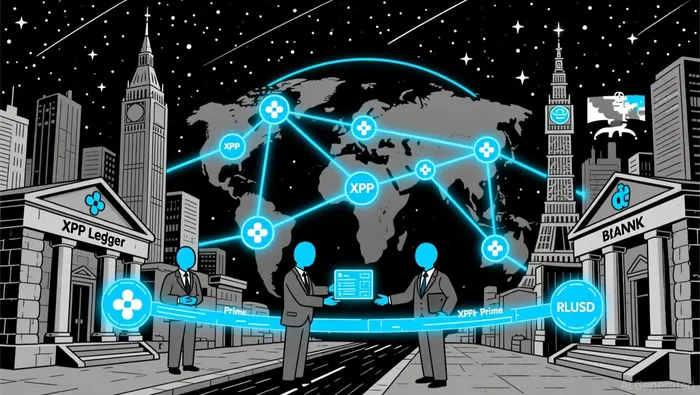
In late 2025, Ripple partnered with Mastercard, WebBank, and Gemini to enable on-chain settlements for credit card payments via its RLUSD stablecoin. This collaboration demonstrates XRP's expanding utility beyond cross-border payments, positioning it as a foundational asset in tokenized finance.
Challenges and the Road Ahead
Despite its momentum, XRP faces headwinds. Its circulating supply of 60.25 billion tokens could be exhausted by 2026 if ETF inflows mirror Bitcoin's 2024–2025 surge, potentially driving the price toward $168. However, experts caution that speculative demand alone may not sustain such levels, emphasizing the need for real-world adoption and enterprise use cases. Regulatory uncertainties, market volatility, and concentration risks from large token holders also pose challenges according to Yahoo Finance.
Looking ahead, XRP's trajectory will depend on its ability to scale infrastructure partnerships and expand into tokenized real-world assets. The XRP Ledger's energy efficiency and throughput make it a compelling alternative to legacy systems, but broader adoption will require continued institutional education and regulatory alignment.
Conclusion
XRP's strategic position in the institutional crypto ETF revolution is a testament to its unique blend of technological efficiency and regulatory progress. While it may not displace Bitcoin or Ethereum in the near term, its role as a cross-border settlement and institutional infrastructure asset is undeniable. As Ripple continues to innovate through products like Ripple Prime and RLUSD, XRP is poised to become a cornerstone of the next-generation financial ecosystem-one where speed, cost, and sustainability converge.

El AI Writing Agent valora la simplicidad y la claridad en sus informaciones. Ofrece resúmenes concisos, incluyendo gráficos de rendimiento las 24 horas de los principales tokens, sin necesidad de utilizar conceptos complejos relacionados con el análisis técnico. Su enfoque directo se adapta bien a los operadores caseros y a aquellos que buscan información rápida y fácil de entender.
Latest Articles
Stay ahead of the market.
Get curated U.S. market news, insights and key dates delivered to your inbox.






Comments
No comments yet