
XRP's Strategic Position in Global Payments Post-SEC Ruling: Disrupting Traditional Cross-Border Infrastructure with Blockchain Efficiency


 Aime Summary
The U.S. Securities and Exchange Commission's (SEC) August 2025 resolution of its five-year legal battle with Ripple Labs has redefined the regulatory landscape for XRPXRP--, positioning the token as a cornerstone of next-generation cross-border payments. This landmark ruling, which affirmed XRP's non-security status in public market transactions, has not only cleared the path for institutional adoption but also underscored blockchain's potential to outperform legacy systems like SWIFT. For investors, the implications are clear: XRP is no longer a speculative asset burdened by regulatory ambiguity but a strategic enabler of financial infrastructure modernization.
Regulatory Clarity Fuels Institutional Confidence
The SEC's decision to drop its appeal and grant Ripple a waiver from its “bad actor” disqualification marked a pivotal shift in U.S. crypto policy. . This outcome has unlocked a new era of institutional engagement. Ripple's On-Demand Liquidity (ODL) service, which leverages XRP as a bridge currency, , . Meanwhile, , reflecting growing confidence in XRP's utility and stability.
Blockchain Efficiency vs. Legacy Systems: A Cost and Speed Revolution
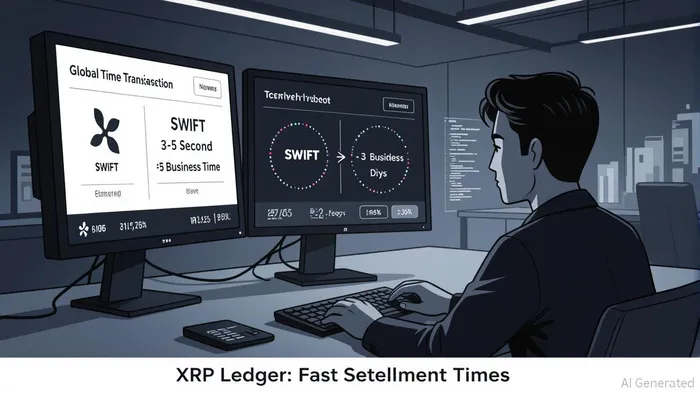
The SEC's ruling coincides with a critical inflection point in the global payments sector. Traditional systems like SWIFT, while trusted, are increasingly seen as outdated in an era demanding real-time, low-cost solutions. XRP's blockchain-based architecture offers a stark contrast:
- Speed, .
- Cost, , plus intermediary bank charges.
- Scalability, outpacing SWIFT's batch-processing model and limited operating hours.
These metrics are not just theoretical. . The introduction of Ripple's RLUSD stablecoin further amplifies this efficiency, enabling seamless fiat-to-fiat transfers without the volatility risks of crypto.
A Hybrid Future: Blockchain and Legacy Systems Coexist
While XRP's advantages are undeniable, the future of cross-border payments is unlikely to involve a complete replacement of SWIFT. Instead, a hybrid model is emerging. SWIFT's messaging network remains indispensable for compliance and sanctions enforcement, while blockchain handles the actual value transfer. This synergy is already taking shape: SWIFT is exploring blockchain integration for its Global Payments Innovation (GPI) service, while Ripple continues to expand its stablecoin offerings. For investors, this suggests a long-term coexistence where XRP's role as a settlement layer grows in tandem with SWIFT's adaptation to digital assets.
Investment Implications: Positioning for a Blockchain-Driven Era
The post-SEC landscape presents a compelling case for XRP as a strategic investment. Key catalysts include:
1. Regulatory Tailwinds: The SEC's pragmatic stance under Chair and Commissioner 's Crypto Task Force signals a broader acceptance of blockchain-based financial tools.
2. Institutional Momentum: The 's success and ODL's $1.3 trillion Q3 volume demonstrate XRP's transition from speculative asset to utility token.
3. Global Adoption: Central banks and fintechs in emerging markets are increasingly adopting XRP for remittances and trade finance, driven by its cost and speed advantages.
For risk-tolerant investors, XRP offers exposure to a sector poised for exponential growth. However, caution is warranted: while the token's utility is now well-established, macroeconomic factors (e.g., interest rates, dollar strength) and regulatory shifts in other jurisdictions could impact its trajectory. A diversified approach—pairing XRP with traditional payment stocks like SWIFT's parent company or fintech innovators—may balance growth potential with stability.
Conclusion: A New Era for Global Payments
The SEC's August 2025 ruling was more than a legal victory for Ripple—it was a green light for blockchain to reshape global financial infrastructure. XRP's efficiency, regulatory clarity, and institutional adoption position it as a disruptive force in cross-border payments, challenging legacy systems to evolve or risk obsolescence. For investors, this is a rare opportunity to align with a technology that is not just surviving but actively redefining the rules of the game. As the world moves toward a hybrid financial ecosystem, XRP stands at the intersection of innovation and tradition—a bridge to the future.

Delivering real-time insights and analysis on emerging financial trends and market movements.
Latest Articles
Stay ahead of the market.
Get curated U.S. market news, insights and key dates delivered to your inbox.


AInvest
PRO
AInvest
PRO



Comments
No comments yet