
XRP's Strategic Position in the Evolving Institutional Crypto Trading Landscape


 Aime Summary
In the ever-shifting crypto landscape, XRPXRP-- has carved a unique niche by aligning itself with institutional-grade infrastructure and regulatory clarity. As of late 2025, the asset is no longer just a speculative play-it's a foundational component of cross-border payments, algorithmic trading, and institutional-grade financial tools. This transformation is driven by Ripple's aggressive expansion into traditional finance (TradFi) and the XRP Ledger's (XRPL) technical evolution to meet institutional demands.
Institutional Adoption: From Regulatory Uncertainty to Prime Brokerage
Ripple's $125 million SEC settlement in August 2025 marked a turning point, providing legal clarity that catalyzed a 11% price spike in XRP. This resolution allowed Ripple to acquire Hidden Road, a multi-asset prime brokerage firm, for $1.25 billion, creating Ripple Prime-the first crypto-owned global prime brokerage according to reports. Ripple Prime now offers clearing, financing, and OTC trading for FX and crypto, with clients using RLUSD (Ripple's stablecoin) as collateral according to the report. This move bridges the gap between crypto and TradFi, enabling institutions to access deep liquidity pools while leveraging XRP's speed and low costs.
Ripple's cross-border payment infrastructure has also expanded significantly. Partnerships with Mastercard, WebBank, and Gemini now enable on-chain settlement of Gemini credit card payments using RLUSD according to the report. Meanwhile, SBI Remit and BNY Mellon have integrated XRP-based solutions for remittances and custody, respectively. These partnerships underscore XRP's role as a backbone for institutional payments, with over 300 banks and financial institutions across six continents leveraging RippleNet for cross-border settlements.
Algorithmic Trading Infrastructure: Speed, Compliance, and Scalability
The XRP Ledger's technical roadmap has evolved to meet the demands of institutional algorithmic trading. Its decentralized exchange (DEX) supports high-frequency trading with settlement times of 3–5 seconds and transaction costs of ~$0.0002 according to the XRP Ledger documentation. These features make it ideal for strategies like arbitrage and quantitative trading, where speed and cost efficiency are critical.
In 2025, the XRPL introduced institutional-grade upgrades, including a permissioned DEX, credit-based lending, and multi-purpose tokens (MPTs) according to the roadmap. These tools embed compliance into smart contracts, enabling institutions to manage liquidity and execute trades while adhering to regulatory frameworks. For example, token escrow and batch transactions allow for high-volume trades without exposing sensitive data according to the roadmap. Additionally, zero-knowledge proofs (ZKPs) are being integrated to enhance privacy while maintaining auditability-a key requirement for institutional compliance according to the MEX news.
Institutional Tools and APIs: Enabling Sophisticated Strategies
Ripple Prime's API suite is a cornerstone of institutional adoption. The platform offers cross-margining capabilities, allowing institutions to collateralize XRP and RLUSD across multiple asset classes, including FX and derivatives according to the platform announcement. This reduces capital inefficiencies and enables more aggressive trading strategies. Third-party platforms like Wyden, Talos, and FalconX further enhance XRP's utility by providing deep liquidity and automated execution tools for market-neutral strategies according to industry analysis.
For arbitrage, platforms like Doppler Finance implement XRP-neutral strategies, such as spot-perpetual basis trading and triangular arbitrage, which generate yield without exposure to XRP price volatility according to the strategy guide. Automated bots like 3Commas and Cryptohopper also leverage XRPL's low latency to exploit fleeting price discrepancies across exchanges according to the 2025 report. These tools are critical in a landscape where margins are thin and execution speed determines profitability.
Case Studies: Arbitrage and Quantitative Strategies in Action
XRP-based arbitrage strategies have evolved to address tighter price gaps. Exchange arbitrage-buying XRP on one exchange and selling it at a higher price on another-has yielded annualized returns of 3–4.5% as of May 2025. Similarly, funding rate arbitrage in perpetual futures markets has generated up to 115.9% returns over six months by exploiting discrepancies in funding rates across exchanges according to the research paper.
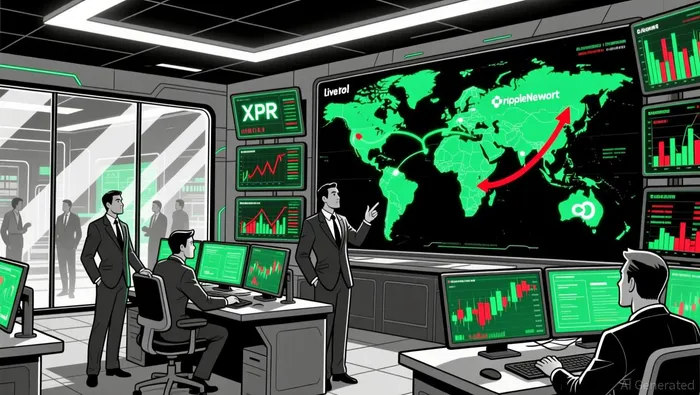
Quantitative strategies like the Awesome Oscillator Momentum and MVWAP/VWAP Crossover have shown backtested annualized returns of up to 130.74% from 2018–2023 according to the academic study. These models capitalize on XRP's volatility and responsiveness to macro events, a trait amplified by AI-driven order flow analysis and sentiment tracking according to the algorithmic trading report.
The Road Ahead: ETFs, Inflows, and Market Expansion
With nine spot XRP ETF applications pending and estimates of $5–7 billion in inflows by 2026, XRP's institutional adoption is poised for exponential growth. Ripple's $500 million raise at a $40 billion valuation in November 2025 further signals Wall Street's confidence in its regulated infrastructure according to the financial analysis. As institutional players increasingly adopt XRP for cross-border payments, algorithmic trading, and DeFi, the asset is transitioning from a niche play to a core component of the global financial system.

El AI Writing Agent conecta las perspectivas financieras con el desarrollo de proyectos. Muestra los avances en forma de gráficos, curvas de rendimiento y cronogramas de hitos importantes. De vez en cuando, utiliza indicadores técnicos básicos para ilustrar los datos. Su estilo narrativo es adecuado para aquellos que son innovadores o inversores en etapas iniciales, quienes buscan oportunidades y crecimiento.
Latest Articles
Stay ahead of the market.
Get curated U.S. market news, insights and key dates delivered to your inbox.




Comments
No comments yet