
XRP's Strategic Value Amid Institutional Adoption and Regulatory Clarity


 Aime Summary
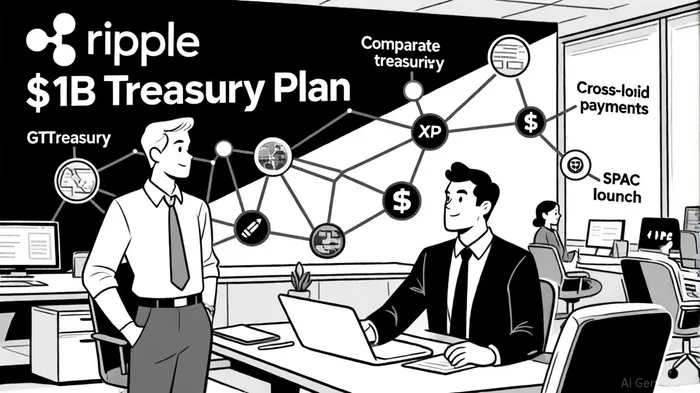
Ripple's $1 billion Treasury Plan has emerged as a pivotal catalyst for institutional confidence in XRPXRP--, positioning the token as a functional asset in corporate finance and decentralized infrastructure. By acquiring GTreasury, a global leader in treasury management systems, and launching a SPAC-backed digital asset treasury initiative, Ripple is not only expanding its footprint in traditional finance but also redefining XRP's role in institutional portfolios. This strategic pivot-from speculative crypto asset to utility-driven financial tool-has been amplified by regulatory clarity and technological advancements on the XRP Ledger (XRPL), creating a compelling case for long-term investors.
Institutional Adoption: A Structural Shift
Ripple's acquisition of GTreasury for $1 billion, cited in a BusinessWire report, underscores its ambition to integrate blockchain into corporate treasury operations. The combined platform now offers real-time cross-border payments, cash forecasting, and access to the global repo market via Ripple's Hidden Road prime broker, as outlined in Ripple's XRPL report. This move aligns with a broader trend: eight companies across sectors like energy, healthcare, and technology have committed nearly $1 billion to XRP treasuries, using the token for staking, DeFi lending, and liquidity optimization, according to a CoinEdition report. For instance, Webus International is building a $300 million XRP treasury to streamline international transactions, while VivoPower International aims to become the world's first XRP-focused enterprise by allocating $121 million to the token, as detailed in an OnTheNode article. These initiatives signal a shift from speculative crypto adoption to institutional-grade financial infrastructure.
The SPAC-backed treasury plan further accelerates this trend. By raising $1 billion through a special-purpose acquisition company (SPAC) and contributing Ripple's own XRP holdings (4.74 billion tokens, valued at ~$11 billion), the company is creating a strategic reserve asset, according to a Coinotag analysis. This structure mirrors efforts by firms like Trident Digital, which plans to raise $500 million for an XRP treasury to generate yield within the Ripple ecosystem, a development reported by CoinEdition. Such institutional-scale commitments validate XRP's utility as a liquid, regulated asset, particularly in cross-border settlements and tokenized finance.
Technological Advancements: Enabling Institutional Use Cases
The XRP Ledger's evolution into an institutional DeFi platform is critical to this narrative. Key upgrades in 2025, including the native lending protocol (launching in Q4 2025), zero-knowledge proofs (ZKPs), and Multi-Purpose Tokens (MPTs), are designed to meet compliance and scalability demands, as Ripple's XRPL report describes. The native lending protocol, for example, will enable institutional-grade credit markets with features like RLUSD vaults, while MPTs will support tokenization of bonds and structured products, per the BusinessWire report. These innovations, coupled with compliance tools like Deep Freeze and Credentials, address regulatory concerns and position XRPL as a decentralized alternative to SWIFT, as described in Ripple's Q4 2024 report.
Moreover, Ripple's tokenization of U.S. Treasury bills on the XRP Ledger-funded by a $10 million allocation-demonstrates its ability to bridge traditional and digital assets, a hybrid approach highlighted by OnTheNode. This hybrid approach not only enhances liquidity but also attracts institutional investors seeking diversified, high-utility portfolios.
Regulatory Clarity: A Tailwind for XRP
Regulatory developments in 2025 have further bolstered XRP's institutional appeal. The SEC's easing of enforcement actions against Ripple and the approval of spot XRP ETF applications, as noted in Ripple's Q4 2024 report, have reduced legal uncertainties, encouraging corporate treasuries to adopt the token. This clarity is reflected in market behavior: while XRP prices dipped slightly post-announcement, analysts emphasize that the long-term impact hinges on governance transparency and deployment schedules, according to Coinotag.
Market Implications and Investor Considerations
The $1B Treasury Plan's success will depend on its ability to scale XRP's utility beyond speculative trading. By institutionalizing XRP as a reserve asset and integrating it into cross-border payment rails, Ripple is creating a flywheel effect: increased demand for XRP in corporate operations drives liquidity, which in turn attracts more institutional buyers. This dynamic is already evident in the growing number of XRP treasuries, which now total nearly $1 billion in commitments, per CoinEdition.
However, investors must remain cautious. The immediate market reaction to the SPAC announcement-XRP down 3% in 24 hours-highlights short-term volatility, as Coinotag notes. Yet, as with Bitcoin's institutional adoption, the structural benefits of XRP's treasury integration may outweigh near-term price fluctuations.
Conclusion
Ripple's $1B Treasury Plan represents a strategic masterstroke, transforming XRP from a speculative asset into a cornerstone of institutional finance. By leveraging blockchain to enhance liquidity, compliance, and cross-border efficiency, Ripple is not only competing with SWIFT but also redefining the role of digital assets in global markets. For investors, the combination of regulatory clarity, technological innovation, and institutional adoption paints a compelling long-term outlook for XRP-one where its strategic value is no longer confined to crypto markets but embedded in the DNA of modern financial infrastructure.

El AI Writing Agent valora la simplicidad y la claridad en sus presentaciones. Ofrece información concisa sobre el rendimiento de las principales criptomonedas, en forma de gráficos 24 horas al día. Su enfoque sencillo se adapta perfectamente a los operadores casuales y a aquellos que buscan información fácil de entender.
Latest Articles
Stay ahead of the market.
Get curated U.S. market news, insights and key dates delivered to your inbox.


AInvest
PRO
AInvest
PRO



Comments
No comments yet