
XRP's Strategic Ecosystem Expansion: How Gemini's Credit Card and RLUSD Integration Signal a Catalyst for Retail Adoption and XRP Value Growth


 Aime Summary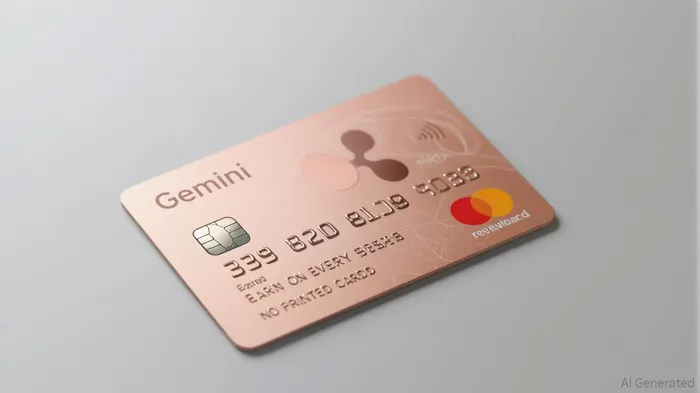
The cryptocurrency landscape is evolving rapidly, but few developments have the potential to reshape retail adoption and token utility as profoundly as Gemini's XRPXRP-- Credit Card and Ripple USD (RLUSD) integration. These initiatives, launched in Q2 2025, represent a strategic convergence of retail incentives, institutional credibility, and tokenomics that could redefine XRP's role in the global financial ecosystem. For investors, this is not just a story of speculative hype—it's a calculated move to embed XRP into the daily lives of millions, creating a self-sustaining cycle of demand and value creation.
Retail Adoption: The New On-Ramp for XRP
Gemini's XRP Credit Card is more than a loyalty program; it's a behavioral nudge designed to normalize XRP as a utility asset. By offering tiered rewards—up to 4% in XRP on gas, EV charging, and rideshare—Gemini taps into high-frequency spending categories, ensuring consistent demand for the token. The card's fee-free structure (no annual fees, no foreign transaction costs) removes friction, making it accessible to everyday users.
Historical data from Gemini's platform reveals a compelling narrative: XRP rewards held for at least one year between 2021 and 2024 appreciated by an average of 452.9%. This performance dwarfs traditional credit card rewards and even outpaces many crypto assets. For context, consider —a trajectory that underscores its potential as a high-growth token when paired with consistent demand.
The card's $200 XRP sign-up bonus for new users (triggered by $3,000 in spending within 90 days) further accelerates adoption. This incentive is not just a marketing tool; it's a psychological anchor that primes users to view XRP as a “value-adding” asset rather than a speculative play. By aligning user behavior with long-term holding, Gemini and Ripple are effectively creating a flywheel: more spending → more XRP rewards → higher token demand → increased utility and price.
RLUSD: Bridging Stability and Liquidity
Ripple's RLUSD stablecoin, now integrated into Gemini's U.S. spot trading pairs, adds another layer of utility. Unlike traditional stablecoins, RLUSD is built on the XRP Ledger (XRPL), leveraging its speed and low costs. This integration allows users to trade between RLUSD and other assets without conversion fees, reducing the friction of fiat-crypto transitions.
For institutional investors, RLUSD's $640 million market cap (as of August 2025) signals growing confidence in the XRP ecosystem. The stablecoin's role as a “bridge” between fiat and crypto mirrors the function of USDT or USDCUSDC-- but with a unique advantage: it's deeply embedded in the XRP Ledger's infrastructure. This symbiosis strengthens XRP's utility beyond speculative trading, positioning it as a foundational asset for cross-border payments and institutional settlements.
Institutional Credibility and the Ripple-Gemini Partnership
Ripple's $75 million credit line to Gemini (expandable to $150 million) is a masterstroke of strategic alignment. This financial backing not only bolsters Gemini's liquidity for its upcoming IPO but also legitimizes XRP as a “bankable” asset. Institutions like abrdn, Braza Bank, and Société Générale–Forge have already adopted the XRP Ledger for payments and settlements, signaling a shift toward XRP as a utility token in institutional finance.
The partnership's implications are clear: Ripple's institutional credibility and Gemini's retail reach create a dual engine for XRP adoption. For investors, this means XRP is no longer just a speculative asset—it's a token with real-world infrastructure and institutional demand.
Investment Implications: A Token in Transition
For XRP holders, the current ecosystem expansion presents a unique opportunity. The card's reward structure ensures a steady influx of new XRP into the market, but the key lies in retention. If historical trends hold, those who hold their rewards for a year could see exponential gains. Meanwhile, institutional adoption of the XRP Ledger and RLUSD suggests a long-term value proposition that transcends retail demand.
Institutional investors should also consider XRP's role in cross-border payments. The XRP Ledger's efficiency (processing transactions in seconds at a fraction of traditional costs) makes it an attractive alternative to SWIFT. As global financial systems digitize, XRP's utility in this space could drive demand independent of retail adoption.
Conclusion: A Catalyst for the Next Phase of Crypto Adoption
Gemini's XRP Credit Card and RLUSD integration are not isolated events—they're part of a broader strategy to make XRP a household name. By embedding the token into everyday spending, institutional settlements, and stablecoin infrastructure, Ripple and Gemini are creating a self-reinforcing ecosystem. For investors, this means XRP is transitioning from a speculative asset to a utility-driven one, with clear pathways for demand growth.
The question is no longer whether XRP will succeed—it's how quickly it will scale. As the XRP Army grows and institutional adoption accelerates, the token's value proposition becomes increasingly compelling. For those seeking exposure to crypto's next phase of mainstream adoption, XRP's ecosystem expansion offers a rare combination of retail-driven demand and institutional-grade utility.
In the end, the most successful crypto assets are those that solve real-world problems. XRP's strategic expansion does just that—and for investors, the rewards may be as tangible as the token itself.

Decoding blockchain innovations and market trends with clarity and precision.
Latest Articles
Stay ahead of the market.
Get curated U.S. market news, insights and key dates delivered to your inbox.


AInvest
PRO
AInvest
PRO



Comments
No comments yet