
XRP as a Strategic Corporate Treasury Asset: Why Gumi’s $17M Investment Signals a Shift in Institutional Crypto Adoption


 Aime Summary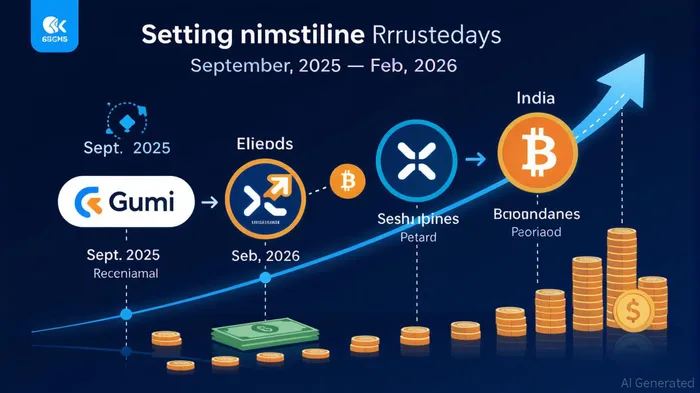
Japan-based gaming giant Gumi Inc.’s $17 million investment in XRPXRP-- marks a pivotal moment in institutional crypto adoption. By allocating 2.5 billion yen to Ripple’s native token over five months, Gumi is not merely diversifying its treasury but strategically positioning XRP as a functional asset for global financial operations. This move aligns with a broader trend of corporations leveraging blockchain technology to optimize liquidity, reduce costs, and navigate regulatory clarity—a shift that could redefine corporate treasury management in the digital age [1].
XRP’s Real-World Utility: Speed, Cost, and Scalability
XRP’s appeal lies in its technical advantages. Unlike BitcoinBTC--, which serves as a store of value, XRP is engineered for speed and efficiency. It settles transactions in 3–5 seconds with fees averaging $0.0002 per transfer, making it ideal for high-volume cross-border payments [4]. For corporations like Gumi, this translates to reduced reliance on traditional banking infrastructure, which often incurs delays and high pre-funding costs. Ripple’s On-Demand Liquidity (ODL) service, which uses XRP as a bridge currency, has already cut settlement times for remittances in the Philippines and India from days to minutes while slashing costs by up to 50% [6].
The token’s utility extends beyond remittances. Hyperscale Data, for instance, allocated $10 million to XRP to streamline its cross-border operations, citing XRP’s 1,500 transactions per second throughput and energy efficiency—99.99% lower than Bitcoin—as critical advantages [4]. These metrics position XRP as a scalable solution for institutions seeking to modernize working capital management and foreign exchange exposure.
Strategic Partnerships and Regulatory Clarity
Gumi’s investment is further bolstered by its partnership with SBI Holdings, a major shareholder with deep ties to Ripple. SBI’s advocacy for XRP in financial services and its collaboration on a multi-billion yen crypto fund underscore the token’s institutional credibility [3]. Additionally, Ripple’s March 2025 SEC resolution, which clarified XRP’s non-security status, has removed a key regulatory barrier, enabling broader adoption [4]. This clarity has spurred the launch of XRP-based ETFs like ProShares Ultra XRP (UXRP) and Purpose XRP (XRPP), providing institutional investors with familiar tools to access the asset [4].
The strategic rationale for XRP is also evident in corporate case studies. VivoPower’s $120 million XRP-focused treasury model combines direct holdings with staking via the Flare Network and an equity stake in Ripple Labs, generating passive returns while aligning with the ecosystem [5]. Similarly, Trident Digital’s $500 million XRP allocation leverages the token’s liquidity benefits to optimize capital efficiency [4]. These examples highlight XRP’s multifunctional role in institutional portfolios.
A New Era for Corporate Treasury Management
Gumi’s $17M investment reflects a paradigm shift: institutions are no longer viewing crypto as speculative but as infrastructure. By integrating XRP into its treasury, Gumi joins a growing cohort of companies—including Aplus, FOMO Pay, and Webus International—leveraging blockchain to reduce friction in global finance [1][4]. This trend is amplified by Ripple’s recent partnerships with Wormhole (for cross-chain interoperability) and EthereumETH-- Virtual Machine (EVM) sidechains, which expand XRP’s utility in DeFi and smart contract ecosystems [1].
For investors, the implications are clear. XRP’s real-world adoption, regulatory progress, and technical superiority position it as a cornerstone of institutional crypto strategies. As more corporations follow Gumi’s lead, XRP’s role in corporate treasuries will likely expand, reshaping the landscape of global finance.
Source:
[1] Japanese Gaming Giant Gumi Plans to Invest 2.5B Yen in XRP [https://thecryptobasic.com/2025/08/29/japanese-gaming-giant-gumi-plans-to-invest-2-5b-yen-in-xrp/]
[2] Japan-based Gumi commits $17M to XRP amid expansion into global payment networks [https://cryptoslate.com/japan-based-gumi-commits-17m-to-xrp-amid-expansion-into-global-payment-networks/]
[3] Gumi to Spend $17M on XRP - Altcoin News [https://cryptonews.com/news/japanese-corporate-altcoin-buying-spree-continues-with-gumi-to-spend-17m-on-xrp/]
[4] XRP in 2025: Trends, Technology and Future Outlook for Enterprise Adoption [https://www.linkedin.com/pulse/xrp-2025-trends-technology-future-outlook-enterprise-adoption-mishra-rluve]
[5] arowana funding the future xrp treasury [https://arowanaco.com/author/tedrarowanaco-com/]
[6] XRP Didn’t Replace SWIFT—But Here's What It Did Instead [https://www.ccn.com/education/crypto/ripple-xrp-odl-tokenization-real-world-utility-explained/]

Decoding blockchain innovations and market trends with clarity and precision.
Latest Articles
Stay ahead of the market.
Get curated U.S. market news, insights and key dates delivered to your inbox.


AInvest
PRO
AInvest
PRO



Comments
No comments yet