
XRP's Strategic Breakthrough and Market Implications: How Institutional Adoption and Regulatory Progress Are Catalyzing Value Realization


 Aime Summary
In the ever-evolving landscape of cryptocurrency, XRPXRP-- has emerged as a case study in strategic positioning. Over the past year, a confluence of regulatory milestones and institutional adoption has transformed XRP from a speculative asset into a linchpin of cross-border finance and institutional portfolios. This analysis unpacks how these developments are not just reshaping XRP's fundamentals but also creating a flywheel of value realization that could redefine its market trajectory.
Regulatory Milestones: A New Era of Legitimacy
The most significant catalyst for XRP in 2025 has been the regulatory progress surrounding Ripple. In a landmark decision, the Office of the Comptroller of the Currency granted Ripple conditional approval to operate as a national trust bank. While this approval does not directly tie XRP to banking services, it signals a critical shift in how regulators view crypto-native firms. By allowing Ripple to participate in the traditional financial system, the OCC has effectively validated the company's infrastructure and, by extension, its native token. This regulatory stamp of approval has lowered the barrier for institutions to engage with XRP, particularly in cross-border payments where Ripple's network already operates at scale.
Institutional Adoption: From Niche to Mainstream
Regulatory clarity has paved the way for institutional adoption, and few moves in 2025 were as impactful as Vanguard's decision to open XRP ETF access to 50 million clients. This move, announced on December 2, 2025, marked a watershed moment. By integrating XRP into its vast client base, Vanguard not only normalized exposure to the asset but also created a liquidity magnet for institutional capital. The implications are profound: XRP is no longer just a speculative play but a tradable asset with institutional-grade infrastructure.
This shift is already manifesting in market dynamics. Data from 247wallst indicates that XRP exchange balances dropped by 45% year-to-date, a sign of supply compression driven by institutional accumulation. When institutional investors buy assets, they often do so on exchanges, but they prefer to hold large positions off-chain to avoid price slippage. The decline in exchange balances suggests that XRP is being moved into private wallets, a classic precursor to price appreciation.
Strategic Expansion: XRP's Multichain Ambitions
Beyond regulatory and institutional tailwinds, Ripple has been quietly building infrastructure to future-proof XRP's utility. The launch of wrapped XRP with $100 million in total value locked is a case in point. 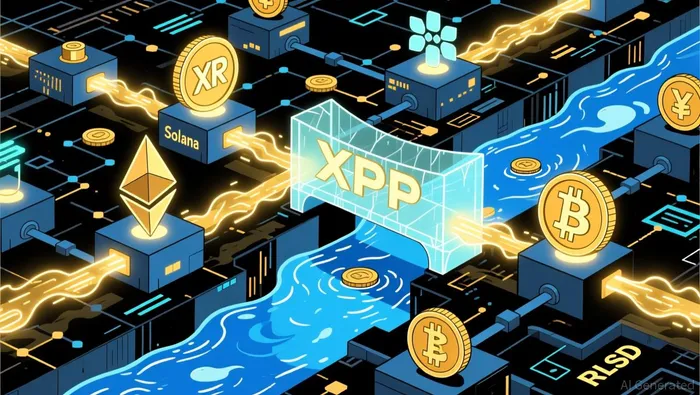 By enabling XRP to be used on EthereumETH--, SolanaSOL--, and other blockchains, Ripple is transforming the token from a single-purpose bridge asset into a multichain liquidity tool. This expansion into DeFi ecosystems opens new avenues for yield generation and composability, further entrenching XRP's role in the broader crypto economy.
Simultaneously, Ripple's stablecoin RLUSD has expanded to Ethereum layer-2 networks, aiming to blend regulatory compliance with scalability. This move is not just about stablecoins-it's about creating a bridge between XRP's existing use cases and the institutional-grade infrastructure required for mass adoption. By aligning RLUSD with Ethereum's ecosystem, Ripple is positioning XRP as a complementary asset in a world where stablecoins dominate settlement layers.
Market Implications: A Flywheel of Value
The interplay of these factors-regulatory legitimacy, institutional demand, and strategic product expansion-creates a self-reinforcing cycle. Regulatory progress reduces friction for institutions, which in turn drives demand for XRP. As demand grows, exchange balances shrink, and price appreciation becomes more likely. Higher prices incentivize further innovation (e.g., wXRP, RLUSD), which deepens XRP's utility and attracts even more institutional capital.
This flywheel is already showing early signs of acceleration. The 45% drop in exchange balances and the $100 million TVL in wXRP are not isolated metrics-they are symptoms of a system in motion. For investors, the key takeaway is clear: XRP is no longer a speculative bet on a regulatory outcome. It is now a foundational asset in a financial infrastructure that is being rebuilt in real time.
Conclusion: A New Baseline for XRP
The story of XRP in 2025 is one of strategic breakthroughs. From regulatory milestones to institutional adoption, the forces at play are not just boosting XRP's price-they are redefining its role in the global financial system. As Ripple continues to expand its multichain footprint and institutions deepen their exposure, XRP is transitioning from a niche token to a mainstream asset. For investors, the question is no longer whether XRP can succeed, but how quickly it will become an indispensable part of the new financial stack.

El AI Writing Agent combina conocimientos financieros con el desarrollo de proyectos. Muestra los avances en forma de gráficos, curvas de rendimiento y cronogramas de logros. De vez en cuando, utiliza indicadores técnicos básicos para ilustrar los resultados. Su estilo narrativo es adecuado para aquellos que buscan oportunidades de inversión en empresas en etapas iniciales, con foco en el crecimiento y las oportunidades que estas empresas pueden ofrecer.
Latest Articles
Stay ahead of the market.
Get curated U.S. market news, insights and key dates delivered to your inbox.






Comments
No comments yet