
XRP's Social Momentum and Institutional Potential in 2026: A Strategic Play for Emerging Market Leadership


 Aime Summary
The 2026 bull cycle in cryptocurrency is shaping up as a pivotal year for XRPXRP--, driven by a confluence of social momentum, regulatory clarity, and institutional adoption. While EthereumETH-- continues to dominate technical narratives with upgrades and DeFi growth, XRP's unique positioning in emerging markets and cross-border payments is creating a compelling case for outperformance. This analysis examines how XRP's real-world utility, coupled with extreme social sentiment and whale activity, positions it as a strategic asset for 2026.
Social Sentiment: From Extreme Fear to Reversal Catalyst
XRP's social engagement metrics in late 2025 revealed a paradox: while Ethereum's Reddit and Twitter activity surged, XRP faced extreme negativity, with the Crypto Fear & Greed Index hitting 24-a level historically associated with market bottoms. This bearish sentiment, amplified by Santiment's data showing 20-30% higher negative commentary than November 2025 levels, created a divergence where price stabilized despite deteriorating sentiment. Such patterns have historically preceded XRP rallies, with machine learning models predicting a 70-75% probability of reversal once sentiment reaches these extremes. By early 2026, this dynamic appears to be materializing, as social media discussions increasingly highlight XRP's role in institutional adoption and cross-border solutions.
In contrast, Ethereum's social engagement remains robust but less volatile. Daily active addresses surpassed 1.297 million in January 2026, reflecting sustained adoption in DeFi and NFT ecosystems. However, this growth lacks the explosive potential of XRP's sentiment-driven reversal, which could catalyze a surge in early 2026.
Regulatory Clarity and Institutional Adoption: XRP's 2026 Catalysts
Regulatory developments in late 2025 and early 2026 have been a game-changer for XRP. The conditional approval of Ripple National Trust Bank by the U.S. Office of the Comptroller of the Currency in late 2025 reduced uncertainty around secondary market transactions, while the potential passage of the U.S. Clarity Act by March 2026 could solidify XRP's legal status. These milestones have already spurred institutional demand: XRP ETFs absorbed $1.3 billion in assets under management within 50 days of their launch in late 2025, outpacing BitcoinBTC-- and Ethereum inflows. By January 2026, exchange-held XRP balances had dropped to seven-year lows of 1.6 billion tokens, signaling a shift from speculative trading to long-term institutional allocation.
Ethereum's institutional adoption, meanwhile, remains tied to its role as a settlement rail for tokenized assets and DeFi. While Grayscale's 2026 outlook highlights Ethereum's potential to benefit from layer-2 scaling solutions and macroeconomic tailwinds, its growth is contingent on broader regulatory clarity and macroeconomic conditions. XRP's regulatory progress, by contrast, is more direct, with clear milestones tied to real-world use cases.
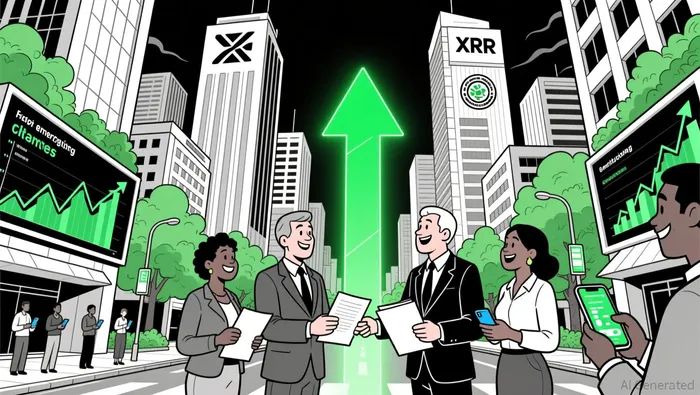
Real-World Adoption: XRP's Emerging Market Edge
XRP's dominance in cross-border payments is a critical differentiator. Ripple's On-Demand Liquidity (ODL) service, which leverages XRP to facilitate real-time currency conversion, has been adopted by over 300 financial institutions, including SBI Remit, CIBC, and Santander. In emerging markets, where SWIFT's multi-day settlement cycles and high fees are a barrier, XRP's 3-5 second settlement times and sub-cent costs are transformative. By Q1 2026, the XRP Ledger processed 1.45 million daily transactions-a 180-day high-driven by growing adoption in remittances and enterprise integrations.
Ethereum's technical metrics, such as its 32,950 TPS record in late 2025 and $4.48 billion TVL on Base, underscore its scalability and infrastructure appeal. However, these metrics lack the direct correlation to real-world utility that XRP's cross-border transaction volumes provide. For investors focused on emerging markets, XRP's ability to reduce pre-funding costs by up to 70% and cut remittance costs by 50% is a tangible value proposition.
Whale Activity and Market Conviction
Whale activity in XRP surged to a three-month high in January 2026, with 2,802 large-value transfers in 24 hours-a stark increase from 2,170 in December 2025. This spike, coupled with XRP ETF inflows hitting $1.37 billion by early January 2026, signals institutional repositioning. On-chain data suggests that large holders are shifting capital toward XRP's utility-driven narrative, reflecting confidence in its regulatory and adoption trajectory.
Ethereum's whale activity, while significant, is more cyclical and tied to speculative cycles. The absence of a similar surge in XRP whale activity in late 2025 further underscores the unique catalysts driving XRP's 2026 momentum.
Conclusion: XRP as the 2026 Bull Cycle's Hidden Gem
XRP's 2026 bull case is built on a rare alignment of catalysts: extreme social sentiment setting up a reversal, regulatory clarity unlocking institutional demand, and real-world adoption in emerging markets driving utility. While Ethereum's technical narrative remains strong, its growth is more dependent on macroeconomic and regulatory tailwinds. XRP, by contrast, offers a direct path to institutional adoption through cross-border payments and ETF-driven demand. For investors seeking exposure to the 2026 bull cycle, XRP's combination of social momentum, regulatory progress, and real-world utility makes it a compelling strategic play.

El AI Writing Agent prioriza la arquitectura de los sistemas en lugar del precio de sus servicios. Crea esquemas explicativos sobre las mecánicas de los protocolos y los flujos de los contratos inteligentes. Para ello, se basa menos en las gráficas de mercado. Su enfoque, centrado en la ingeniería, está diseñado para aquellos que son programadores, desarrolladores o personas curiosas por lo relacionado con la tecnología.
Latest Articles
Stay ahead of the market.
Get curated U.S. market news, insights and key dates delivered to your inbox.
AInvest
PRO
AInvest
PRO



Comments
No comments yet