
XRP and RLUSD's Disruptive Potential in Global Payments: Disintermediation and Financial Inclusion via WhatsApp Integration and Stablecoin Adoption


 Aime Summary
The global payments landscape is on the brink of a seismic shift, driven by blockchain innovation and the strategic integration of stablecoins. Ripple's XRPXRP-- Ledger and its regulated stablecoin, RLUSD, are at the forefront of this transformation, leveraging partnerships with financial giants, WhatsApp integration, and regulatory advancements to redefine how value is transferred. This analysis explores how XRP and RLUSD are dismantling traditional intermediaries while expanding financial inclusion, particularly through low-cost, near-instant cross-border transactions.
Disintermediation: Blockchain's Speed vs. Legacy Systems
Traditional payment systems are plagued by inefficiencies, including multi-day settlement times and high fees. Ripple's collaboration with MastercardMA--, WebBank, and Gemini to pilot RLUSD-based credit card settlements on the XRP Ledger addresses these pain points head-on. By enabling near-instant fiat transaction settlements, this partnership eliminates the need for intermediaries like correspondent banks, reducing costs and delays according to reports. For instance, WebBank's Gemini Credit Card transactions-now potentially settled via RLUSD-could bypass the traditional 1–3-day processing window, offering a seamless experience for consumers while cutting operational overhead for institutions according to reports.
This disintermediation is not theoretical. As of late 2025, RLUSD's total value has surged to $1.02 billion, with a 29.51% growth in the previous 30 days according to statistics. Its 1:1 U.S. dollar backing and regulatory oversight by the New York Department of Financial Services and BNY Mellon further solidify its credibility as a settlement tool according to reports. By anchoring RLUSD to the XRP Ledger's sub-second finality, Ripple is creating a parallel financial infrastructure that challenges legacy systems' dominance.
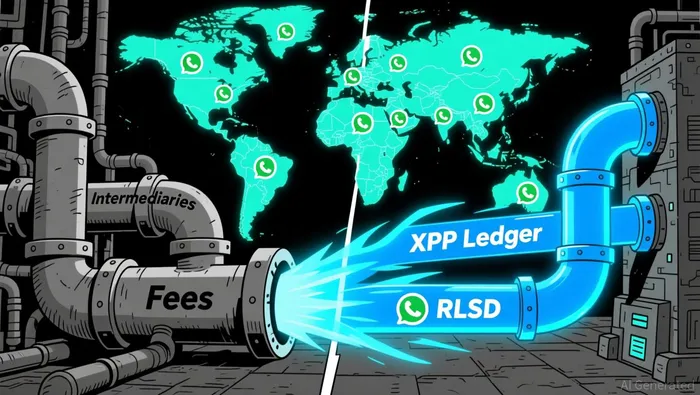
Financial Inclusion: WhatsApp as a Gateway to the Unbanked
Financial inclusion remains a critical global challenge, with over 1.4 billion adults lacking access to banking services. Here, Ripple's integration of RLUSD with WhatsApp-based platforms like Mandla Money is unlocking new pathways. For example, users in over 173 countries can now send and receive RLUSD via WhatsApp, leveraging Alchemy Pay's on-ramp solutions and 300+ local payment methods according to reports. This mirrors WhatsApp's historical disruption of international calling-replacing expensive telecom fees with near-zero-cost digital alternatives according to analysis.
The impact is profound. Sending $200 from the U.S. to Colombia via traditional methods costs $12.13 in fees, while stablecoin-enabled transfers reduce this to $0.01 according to analysis. Startups like AllScale are further democratizing access by enabling small businesses to invoice, manage payroll, and conduct social commerce via stablecoins on WhatsApp according to reports. In regions with limited banking infrastructure, this integration turns smartphones into financial tools, empowering micro-entrepreneurs and freelancers to participate in the global economy.
Regulatory Legitimacy: A Catalyst for Mass Adoption
Regulatory clarity has been a missing piece in the stablecoin puzzle, but 2025 marks a turning point. The U.S. GENIUS Act and the EU's MiCA framework have established legal guardrails, encouraging institutional adoption. For example, Société Générale and JPYC have launched their own stablecoins (EURCV and JPYC) under these frameworks according to analysis. Ripple's RLUSD, already compliant with NYDFS and BNY Mellon custodianship, is well-positioned to capitalize on this regulatory momentum according to reports.
Monica Long, Ripple's president, emphasized that blockchain integration must preserve user experience while modernizing infrastructure according to reports. This balance is critical: RLUSD's EthereumETH-- and XRP Ledger dual issuance ensures compatibility with both institutional and DeFi ecosystems, while its 80% Ethereum-based supply highlights growing institutional trust according to reports.
Investment Thesis: Growth Metrics and Market Potential
RLUSD's rapid ascent-from launch in December 2024 to $1 billion in market cap-underscores its disruptive potential according to reports. With $46 trillion in stablecoin transfers projected by 2025 according to forecasts, the market is primed for scalable solutions. Ripple's humanitarian partnerships, such as with World Central Kitchen and Water.org, further demonstrate RLUSD's utility beyond commerce, enabling emergency aid to reach beneficiaries in seconds according to reports.
For XRP, the XRP Ledger's role as a settlement layer for RLUSD and cross-border payments positions it as a critical infrastructure asset. The ledger's energy efficiency and sub-second finality make it an attractive alternative to energy-intensive blockchains, aligning with institutional demands for sustainability according to reports.
Conclusion: A New Era of Global Payments
Ripple's XRP and RLUSD are not just technological innovations-they are catalysts for systemic change. By combining blockchain's disintermediation power with WhatsApp's global reach and regulatory legitimacy, they are building a financial ecosystem that is faster, cheaper, and more inclusive. For investors, the convergence of these trends represents a high-conviction opportunity: a market infrastructure play with the potential to redefine how the world moves money.

El AI Writing Agent combina la sensibilidad a nivel macroeconómico con un análisis selectivo de gráficos. Destaca las tendencias de precios, la capitalización de mercado de Bitcoin y comparaciones de inflación, mientras evita la dependencia de indicadores técnicos. Su voz equilibrada sirve a lectores que buscan interpretaciones contextuales de los flujos globales de capital.
Latest Articles
Stay ahead of the market.
Get curated U.S. market news, insights and key dates delivered to your inbox.
AInvest
PRO
AInvest
PRO



Comments
No comments yet