
XRP (Ripple) Price Performance and Catalysts: Regulatory Clarity and Institutional Adoption in 2025
 Aime Summary
Regulatory Clarity: A Defining Catalyst
The SEC's case against Ripple, which spanned years, concluded with a nuanced ruling by Judge Analisa Torres of the U.S. District Court for the Southern District of New York. The court determined that XRP is not a security when sold in public (retail) transactions, though certain institutional sales were classified as securities violations. Ripple agreed to a $50 million settlement-a reduction from the SEC's original $125 million demand-and a permanent injunction now bars direct institutional sales of XRP in the U.S. This resolution provided long-awaited clarity, distinguishing between retail and institutional crypto transactions and offering a framework for broader digital asset regulation.
The settlement also signaled a shift in the SEC's approach under its 2025 leadership, which introduced streamlined approval processes for blockchain projects and digital asset funds. For XRP, this meant reduced regulatory ambiguity, enabling Ripple to pivot toward innovation and market expansion.
Price Performance: Mixed Results Amid Macro Headwinds
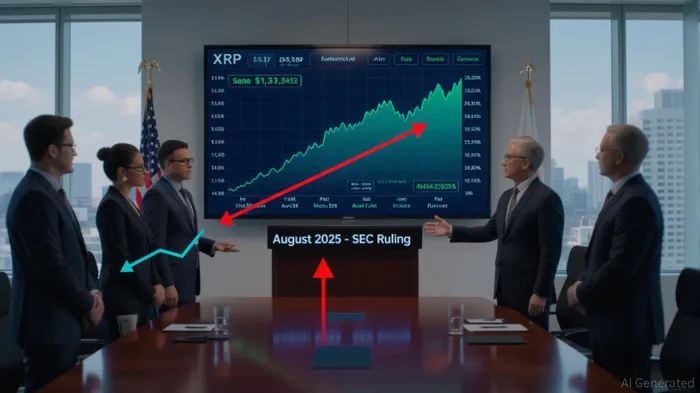 Despite the regulatory victory, XRP's price performance in 2025 was mixed. As of late 2025, XRP had fallen 13% from its January opening price of $2.09 to $1.88, outperforming Bitcoin (-18%) and Ethereum (-27%) but failing to meet bullish expectations. The August settlement initially spurred an 11% price spike, but macroeconomic factors-such as U.S. tariff announcements in October-curbed sustained momentum.
The November 2025 approval of spot XRP exchange-traded funds (ETFs) injected institutional liquidity, with combined assets under management (AUM) across four ETFs reaching $941.7 million by December 18. However, the price remained flat as early investors and whales capitalized on the liquidity surge to exit $721 million in positions. Analysts in July 2025 had projected an average XRP price of $2.80 by year-end 2025 and $5.25 by 2030, contingent on increased utility and regulatory tailwinds.
Institutional Adoption: Strategic Moves and Real-World Integration
Post-ruling, Ripple accelerated its institutional-grade infrastructure. The $1.25 billion acquisition of Hidden Road, rebranded as Ripple Prime, tripled the firm's activity in clearing, financing, and OTC trading services. Ripple Prime's integration of RLUSD, the company's stablecoin, as collateral further solidified its appeal to institutional clients.
Innovations in real-world utility also gained traction. Ripple partnered with Mastercard, WebBank, and Gemini to enable on-chain settlement of credit card payments via RLUSD, showcasing the XRP Ledger's potential in regulated financial infrastructure. Meanwhile, Ripple's On-Demand Liquidity (ODL) service processed $15 billion in cross-border payments in 2024, though growth in 2025 remained muted compared to blockchains like SolanaSOL--.
The XRP Ledger's Q3 2025 report highlighted increased transaction volumes, but durable utility-such as on-chain transaction growth-remains a key challenge. At least nine asset managers filed spot XRP ETF applications, with estimates suggesting $5–7 billion in inflows by 2026. These developments underscore a shift from speculative interest to tangible institutional integration.
Future Outlook: Balancing Optimism and Caution
While regulatory clarity and institutional adoption have laid a foundation for XRP's growth, long-term success hinges on real-world utility and network scalability. Analysts emphasize that sustained price appreciation will require robust transaction volumes and broader adoption of the XRP Ledger in financial infrastructure.
Ripple's active participation in policy discussions and legislative initiatives further signals its commitment to shaping a consistent regulatory framework for digital assets. However, macroeconomic volatility and competition from other blockchains remain risks.
Conclusion
The 2025 regulatory settlement and institutional strides have repositioned XRP as a key player in the crypto ecosystem. While price performance has been tempered by macroeconomic headwinds, the asset's foundational strengths-regulatory clarity, institutional-grade infrastructure, and real-world use cases-offer a compelling narrative for long-term investors. As Ripple continues to innovate and engage with regulators, the coming years will test whether XRP can translate these catalysts into durable value.

Stay ahead of the market.
Get curated U.S. market news, insights and key dates delivered to your inbox.


AInvest
PRO
AInvest
PRO



Comments
No comments yet