
XRP's Resurgence: From Legal Shackles to Global Finance Disruptor
In the volatile arena of cryptocurrencies, few assets have endured as much scrutiny and speculation as XRPXRP--. Once dismissed as a regulatory pariah, Ripple's native token is now scripting a comeback narrative that's captivating Wall Street and crypto enthusiasts alike. A viral forecast recently electrified social media, projecting XRP could skyrocket to $3,380—a leap that would transform a modest holding of 5,000 tokens into a $16.9 million fortune. While such predictions smack of moonshot optimism, they underscore a deeper shift: XRP is evolving from a speculative plaything into a potential cornerstone of tokenized finance. As regulatory clouds dissipate and adoption accelerates, investors are eyeing XRP not just for quickQUICK-- gains, but for its role in reshaping cross-border payments and asset tokenization.
Breaking Free from Regulatory Hurdles
The turning point arrived this summer with the long-awaited resolution of Ripple's bruising battle against the U.S. Securities and Exchange Commission. Initiated in late 2020, the lawsuit accused RippleXRP-- of violating investor protection laws through unregistered securities sales. After years of courtroom drama, the parties agreed to halt all appeals, with Ripple forking over a $125 million fine. The settlement, far lighter than the SEC's initial demands, injected a jolt of confidence into the market. XRP's price surged about 5% in the aftermath, climbing to $3.27—a modest bump, perhaps, but one that signals broader relief.
This isn't Ripple's first brush with regulators. Back in 2015, it paid a $700,000 penalty to the U.S. Treasury's Financial Crimes Enforcement Network for Bank Secrecy Act violations. A 2017 dispute with blockchain firm R3 ended in an out-of-court settlement. Yet the SEC case loomed largest, casting a shadow over institutional adoption. Now, with the slate wiped clean, Ripple is channeling $200 million into expansion initiatives. The precedent could ripple outward, encouraging other crypto firms—like those embroiled in similar SEC skirmishes—to opt for negotiation over protracted fights, much like the resolutions in cases involving Telegram and Kik. In a regulatory landscape that's thawing under pro-crypto sentiments, this clarity positions XRP as a safer bet for banks and enterprises wary of legal landmines.
The Utility-Driven Bull Case and Price Projections
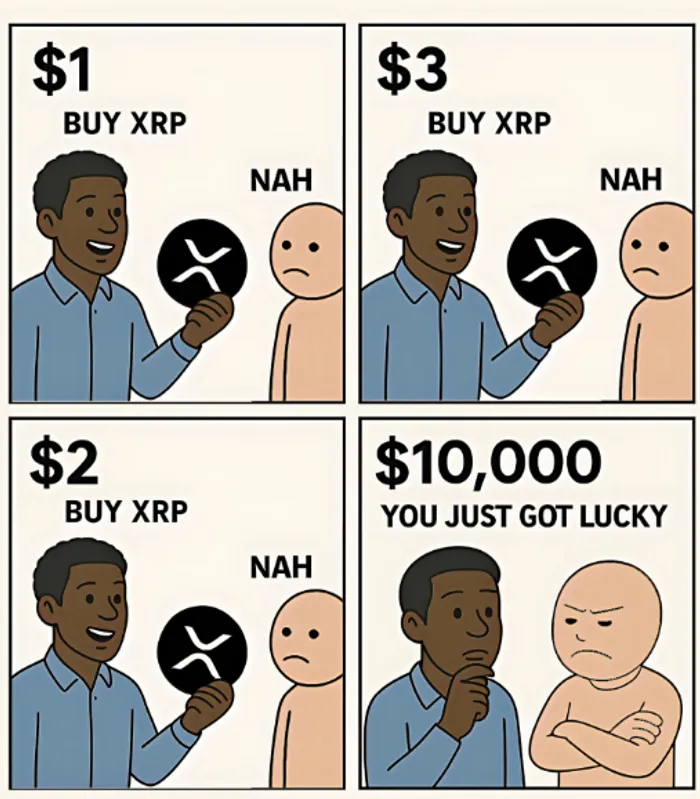
Beneath the hype, XRP's bullish case hinges on its utility in a world increasingly digitized. Proponents argue it's poised to capture slices of mammoth financial flows, from SWIFT's daily trillions to the derivatives market and the Depository Trust & Clearing Corporation (DTCC), which processes over $11 trillion in securities daily. Ripple's CEO has long touted XRP's potential to snag 14% of SWIFT's volume within five years, driving demand through real-world use rather than mere speculation. Models projecting that $3,380 target factor in variables like token supply, transaction velocity, and annual volumes potentially reaching $100 trillion—or even $2 quadrillion in a hyper-tokenized future. If XRP becomes the lubricant for these flows, its price would need to multiply 1,500-fold to accommodate the scale without friction.
Yet, as any seasoned analyst knows, velocity is the Achilles' heel in these equations. Optimistic forecasts assume a turnover rate of 10—meaning each XRP token facilitates 10 transactions annually. Critics counter that SWIFT achieves velocities up to 200, which could cap XRP's price at a more grounded $166 even under explosive adoption scenarios. Even AI-driven reviews, like those from rokROK--, temper the enthusiasm: $200 to $1,000 per token seems plausible if XRP cements itself in tokenized systems, but $3,000-plus would demand a seismic overhaul of global reserves, akin to dethroning the dollar's dominance.
Competition adds another layer of caution. Stellar's XLM mirrors XRP's cross-border prowess, while stablecoins like USDCUSDC-- offer stability without the volatility baggage. Ethereum-based projects, with their smart contract ecosystems, are vying for the same real-world asset (RWA) tokenization pie. If these rivals fragment the market, XRP's slice—and thus its price upside—shrinks.
Adoption Momentum and Strategic Expansions
Still, Ripple's ecosystem is gaining traction. Its On-Demand Liquidity (ODL) protocol, which leverages XRP as a bridge for instant fiat conversions, has secured partnerships with banks across South America, Europe, and Asia. Central banks in emerging markets are piloting digital currencies on Ripple's infrastructure, signaling a pivot from niche to mainstream.
Acquisitions are fueling this momentum. Ripple's 2023 purchase of custody specialist Metaco for $250 million bolstered its institutional-grade offerings, enabling secure handling of tokenized assets like real estate and carbon credits. This month, the $200 million acquisition of Rail further enhances enterprise tools for stablecoin issuance and asset management. These moves aren't mere window dressing; they're strategic bets on a tokenized economy where RWAs could unlock trillions in illiquid value. As Ripple announces more partnerships—expect a flurry through year's end—the narrative shifts from survival to dominance.
Macro Tailwinds, Predictions, and Inherent Risks
Macro tailwinds could supercharge this trajectory. With the Federal Reserve poised for rate cuts amid cooling inflation, liquidity is set to flood risk assets. Lower borrowing costs historically ignite crypto rallies, and utility-focused tokens like XRP stand to benefit as investors seek alternatives to yield-starved bonds. Then there's the ETF wildcard. Analysts like Zach Rector envision an XRP exchange-traded fund drawing $5 billion in institutional inflows, ballooning the market cap by $250 billion and propelling prices to $7-$20 in the near term. Armando Pantoja goes bolder, suggesting $1,000 is attainable under favorable conditions, potentially outpacing Bitcoin's climb to $1 million on a percentage basis.
XRP's performance underscores this potential. Up over 40% year-to-date in 2025, it builds on 2024's staggering 600% surge, defying skeptics who wrote it off during the SEC saga. Yet, for all the excitement, this remains a high-stakes wager. Market sentiment can swing wildly, influenced by geopolitical tensions, regulatory U-turns, or black swan events. Adoption, while promising, is uneven—concentrated in emerging markets rather than Wall Street titans. And while XRP's tech shines in speed and cost-efficiency, broader integration demands overcoming inertia in legacy systems.
Investors eyeing XRP before summer fades should weigh these catalysts against the risks. The viral forecasts may tantalize, but sustainable gains will stem from tangible milestones: ETF approvals, enterprise deals, and velocity-proven models. In a financial world hurtling toward tokenization, XRP isn't just riding the wave—it's engineering the tide. Whether it crests at $100, $1,000, or beyond, its journey reminds us that innovation often emerges from the crucible of adversity, reshaping fortunes in unexpected ways. As the back half of 2025 unfolds, XRP holders and watchers alike will be glued to the charts, betting on a future where crypto isn't fringe, but foundational.

Expert analysis on U.S. markets and macro trends, delivering clear perspectives behind major market moves.
Latest Articles
Stay ahead of the market.
Get curated U.S. market news, insights and key dates delivered to your inbox.


AInvest
PRO
AInvest
PRO



Comments
No comments yet