
XRP's Reinvention: How 2025's Regulatory Clarity and Institutional Adoption Are Reshaping the Digital Asset's Future


 Aime Summary
In the ever-shifting landscape of digital assets, few stories have been as pivotal—or as contentious—as that of XRPXRPI--. For years, the token languished under a cloud of legal uncertainty, its potential stifled by the protracted battle between Ripple Labs and the U.S. Securities and Exchange Commission. But 2025 has brought a dramatic turn. The resolution of that decade-long dispute, coupled with a surge in institutional adoption and infrastructure innovation, has redefined XRP's value proposition. For investors, the question is no longer whether XRP is a speculative asset but how it is becoming a cornerstone of the next phase of financial infrastructure.
Regulatory Clarity: A Watershed Moment
The August 2025 dismissal of the SEC's appeals in the Ripple case marked more than a legal victory—it signaled a paradigm shift in how regulators approach digital assets. By affirming that secondary trading of XRP does not constitute a securities violation, the court provided a critical green light for market participants. This clarity has been a catalyst, enabling institutional investors to engage with XRP without the existential risk of regulatory overreach.
The SEC's decision to waive Ripple's “bad actor” disqualification further underscores this shift. By allowing Ripple to raise capital under Regulation D, the agency has implicitly acknowledged that its earlier enforcement strategy—often criticized as opaque and punitive—was misaligned with the realities of digital asset innovation. This move aligns with the broader agenda of SEC Chair Paul Atkins, whose “Project Crypto” initiative prioritizes rulemaking over litigation. For XRP, this means a regulatory environment that is not only more predictable but also more conducive to growth.
Institutional Adoption: From Skepticism to Strategic Integration
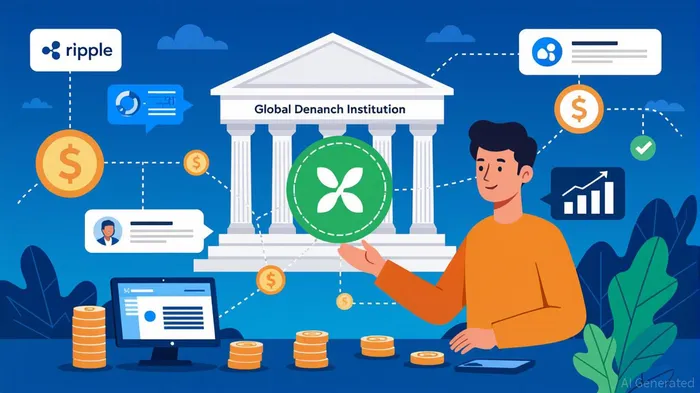
The legal fog that once shrouded XRP has given way to a wave of institutional confidence. Major banks, including SantanderSAN--, Standard Chartered, and SBI Holdings, are now leveraging Ripple's On-Demand Liquidity (ODL) service to streamline cross-border payments. These institutions are not merely experimenting—they are embedding XRP into their operational DNA. ODL's ability to settle transactions in seconds, at a fraction of traditional costs, has made it a strategic tool for reducing foreign exchange risks and improving working capital efficiency.
The institutional narrative is further amplified by the impending approval of XRP-based ETFs. With 11 applications pending and a 95% probability of approval by year-end, these products are poised to unlock billions in capital. Grayscale's XRP Trust, already a benchmark for institutional-grade exposure, has demonstrated the token's capacity to attract diversified portfolios. The ProShares Ultra XRP ETF's July 2025 debut—a first of its kind—has set a precedent, proving that XRP can coexist with traditional financial instruments.
Blockchain Infrastructure: The Unseen Engine of Growth
XRP's resurgence is not just about regulatory and institutional tailwinds—it is also about the maturation of its underlying technology. The XRP Ledger (XRPL), capable of processing 1,500 transactions per second with negligible fees, is increasingly being positioned as a scalable solution for global finance. Its interoperability with central bank digital currencies (CBDCs) and stablecoins like Ripple's upcoming RLUSD further cements its role as a bridge between traditional and digital systems.
Ripple's foray into tokenization and its alignment with CBDC initiatives are particularly noteworthy. By enabling real-time, secure transactions across borders, the XRP Ledger is addressing pain points that have long plagued legacy systems. For investors, this means XRP is no longer just a speculative token—it is a utility asset with tangible, enterprise-grade applications.
The Investment Case: Balancing Optimism and Caution
For investors, the interplay between regulatory clarity, institutional adoption, and infrastructure growth presents a compelling case. XRP's price surge in 2025—driven by ETF optimism and institutional buying—has already demonstrated its potential. However, the token's future depends on sustained regulatory alignment and the execution of Ripple's broader vision.
The approval of XRP ETFs could act as a liquidity multiplier, attracting capital from traditional asset managers and pension funds. Meanwhile, Ripple's pursuit of a national bank charter and its expansion into stablecoins and CBDCs could unlock new revenue streams. Yet, risks remain. The crypto market is still prone to volatility, and regulatory shifts—though currently favorable—could reverse under a new administration.
Conclusion: A New Era for XRP
The XRP of 2025 is unrecognizable from the token that faced existential threats just a few years ago. Regulatory clarity has transformed it from a legal liability into a regulated asset. Institutional adoption has turned it from a speculative curiosity into a strategic tool. And its blockchain infrastructure has evolved from a niche experiment into a scalable solution for global finance.
For investors, the lesson is clear: XRP is no longer a bet on the future—it is a participant in the present. As the financial system continues its digital transformation, XRP's role as a bridge between old and new will only grow. The question now is not whether XRP deserves a place in a diversified portfolio, but how much of it one should allocate to capitalize on this new era.

Blending traditional trading wisdom with cutting-edge cryptocurrency insights.
Latest Articles
Stay ahead of the market.
Get curated U.S. market news, insights and key dates delivered to your inbox.
AInvest
PRO
AInvest
PRO



Comments
No comments yet