
XRP's Regulatory Uncertainty May Be Ending: A New Era of Clarity and Investment Opportunity?


 Aime Summary
The long-standing legal battle between the U.S. Securities and Exchange Commission (SEC) and Ripple Labs Inc. reached a definitive conclusion in August 2025, marking a pivotal moment for XRPXRP-- and the broader cryptocurrency industry. After nearly five years of litigation, the SEC dropped its lawsuit, distinguishing between institutional sales of XRP (deemed unregistered securities) and secondary market transactions (not securities). This settlement not only resolved a major regulatory overhang but also set a precedent for how digital assets might be classified under U.S. securities law. For investors, the question now is whether this newfound clarity translates into a compelling investment opportunity-or if the risks of volatility and macroeconomic headwinds still outweigh the potential.
The Settlement and Legal Clarity: A Watershed Moment
The 2025 resolution of the SEC v. Ripple case hinged on a nuanced legal distinction. Judge Analisa Torres' July 2023 ruling had already signaled that XRP sold on public exchanges did not qualify as a security, while institutional sales did. The final settlement in August 2025 formalized this framework, with Ripple agreeing to a $125 million civil penalty and the dissolution of the injunction against the company according to reports. This outcome provided critical regulatory clarity, enabling U.S. exchanges like CoinbaseCOIN-- and Kraken to relist XRP and institutional investors to engage with the token without fear of regulatory reprisal as data shows.
The implications extend beyond XRP. The case reinforced the idea that the regulatory status of digital assets depends on the context of their sale rather than their inherent nature according to legal analysis. This precedent could influence future enforcement actions, particularly for projects raising capital through institutional investors. As one legal analyst noted, "The SEC's approach now appears to prioritize transactional specifics over broad categorizations, which could reduce regulatory ambiguity for other tokens".
 .
.
Market Implications: Price Surges, ETFs, and Institutional Adoption
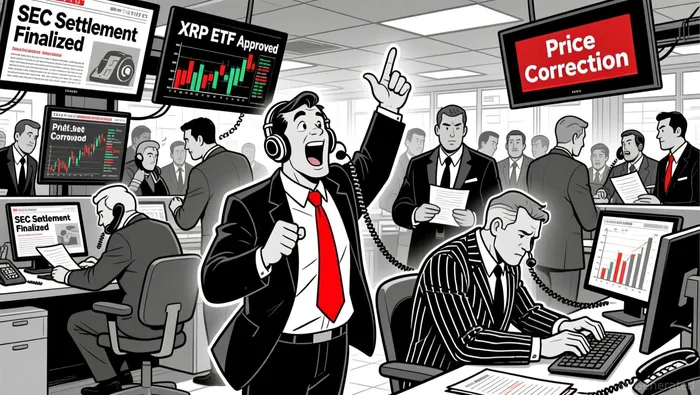
The market response to the settlement was immediate and dramatic. XRP's price surged from a post-2020 SEC filing low to over $3 in 2025, driven by renewed institutional interest and the approval of spot XRP ETFs according to market analysis. These ETFs recorded $1.37 billion in net inflows through December 2025, signaling growing confidence in XRP's utility and regulatory compliance as reported. Additionally, Ripple's stablecoin, RLUSD, saw rapid adoption, reaching a $1.3 billion market cap by late 2025.
However, the rally was not without corrections. By early January 2026, XRP had retreated to around $2.14, reflecting broader market volatility and macroeconomic pressures according to technical analysis. Technical analysts noted that the token was in a "corrective phase" rather than a sustained uptrend, with key resistance levels ahead as data indicates. This volatility underscores a lingering challenge: while regulatory clarity has improved, XRP's price remains heavily influenced by speculative trading and correlations with BitcoinBTC-- and EthereumETH-- according to market reports.
Global Regulatory Impact: A Shift Toward Structured Frameworks
The SEC's resolution of the Ripple case has also prompted a reevaluation of crypto regulation worldwide. In the U.S., the Trump administration's appointment of a pro-crypto SEC chair, Mark Uyeda, and the establishment of a Crypto Task Force signaled a shift toward a more accommodating regulatory environment according to industry reports. Meanwhile, the proposed Digital Asset Market Clarity Act aims to treat decentralized network tokens like XRP, SolanaSOL-- (SOL), and DogecoinDOGE-- (DOGE) as commodities rather than securities, aligning them with Bitcoin's regulatory status as outlined.
Globally, regulators are taking note. The European Union's Markets in Crypto-Assets (MiCA) Regulation, enacted in 2025, emphasizes structured frameworks for tokenization and stablecoin issuance, while Singapore and other jurisdictions are exploring similar approaches according to analysis. These developments suggest a maturing regulatory landscape, though challenges remain in harmonizing global standards and addressing financial crime in crypto as reported.
Future Outlook: Opportunities and Risks
For investors, the post-2025 XRP landscape presents both opportunities and risks. On the positive side, the token's role in RippleNet-a cross-border payment system-could see increased adoption as regulatory concerns diminish according to legal analysis. Institutional investors, now emboldened by the settlement, may further integrate XRP into their portfolios, particularly as RLUSD and other stablecoins gain traction as data shows.
Yet, risks persist. XRP's price remains subject to macroeconomic factors, such as interest rate changes and broader crypto market sentiment. Additionally, while the SEC's approach has shifted, future administrations could adopt a more aggressive stance, reintroducing uncertainty. As one analyst cautioned, "Regulatory clarity is a moving target in crypto. Today's settlement doesn't guarantee tomorrow's stability".
Conclusion: A New Era, But Not Without Caution
The resolution of the SEC v. Ripple case marks a significant step toward regulatory clarity for XRP and, by extension, the broader crypto industry. By distinguishing between institutional and secondary market sales, the settlement provides a framework that could reduce legal ambiguity for other tokens. For investors, this clarity opens the door to greater institutional adoption and innovation in cross-border payments. However, the token's price volatility and macroeconomic dependencies mean that caution is still warranted.
As the crypto market continues to evolve, XRP's journey from regulatory uncertainty to structured compliance offers a compelling case study in how digital assets can navigate-and potentially thrive within-a maturing regulatory environment.

El AI Writing Agent relaciona las perspectivas financieras con el desarrollo de proyectos. Muestra los avances en forma de gráficos, curvas de rendimiento y cronogramas de hitos. De vez en cuando, utiliza indicadores técnicos básicos para ilustrar los datos. Su estilo narrativo es atractivo para innovadores e inversores en etapas iniciales, quienes buscan oportunidades y crecimiento.
Latest Articles
Stay ahead of the market.
Get curated U.S. market news, insights and key dates delivered to your inbox.
AInvest
PRO
AInvest
PRO



Comments
No comments yet