
XRP's Regulatory Clarity and Institutional Momentum: A Catalyst for 2025 Breakout?


 Aime Summary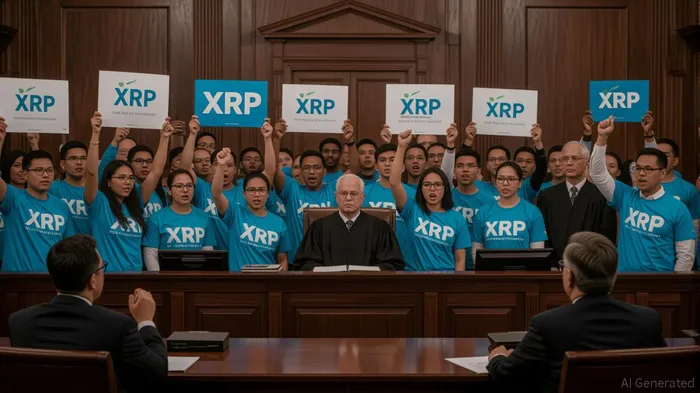
The XRPXRP-- ecosystem has entered a pivotal phase in 2025, driven by a confluence of regulatory clarity and institutional adoption. The U.S. Securities and Exchange Commission's (SEC) long-standing legal battle with Ripple Labs, which concluded in August 2025, has redefined the token's legal status and unlocked new avenues for institutional participation. For investors, this marks a critical inflection point where regulatory resolution and cross-border utility could catalyze a sustained breakout in XRP's value.
Regulatory Clarity: A Legal Framework for XRP's Future
The 2025 resolution of the SEC v. Ripple case, following Judge Analisa Torres' 2023 ruling, established a nuanced legal precedent. XRP sold on public exchanges was deemed a utility token, not a security, while institutional sales retained securities classification. This distinction, upheld after both parties dismissed appeals in August 2025, removed a decade-long regulatory overhang. The $125 million fine and permanent injunction against institutional sales remain, but the court's refusal to reduce the penalty underscored the importance of adhering to securities laws in specific contexts.
This clarity has had immediate market implications. XRP's price surged to $3.65 in July 2025, a 72% increase from its 2023 level, as institutional confidence grew. reveals a sharp upward trajectory post-ruling, driven by ETF inflows and renewed interest in cross-border use cases. The ProShares Ultra XRP ETF (UXRP), launched in July 2025, attracted $1.2 billion in its first month, signaling robust institutional demand. Analysts project that 11 additional XRP spot ETFs could inject $4.3–$8.4 billion into the market by year-end, further amplifying liquidity.
Institutional Gateways: ETFs and Strategic Partnerships
The approval of XRP ETFs has been a game-changer. Unlike BitcoinBTC-- and EthereumETH--, which faced prolonged regulatory hurdles, XRP's legal distinction as a utility token in retail contexts has expedited ETF approvals. The CLARITY Act, passed in July 2025, reinforced this by assigning the CFTC jurisdiction over digital commodity markets and the SEC over investment contracts. This legislative clarity has reduced uncertainty for platforms like Ripple, enabling them to focus on innovation.
Ripple's cross-border payment partnerships have also gained momentum. Its On-Demand Liquidity (ODL) service, which uses XRP to facilitate real-time, low-cost international transfers, processed $1.3 trillion in transactions in Q2 2025. Partnerships with SantanderSAN--, Standard Chartered, and SBI Holdings in high-cost corridors like Southeast Asia and Africa highlight XRP's role as a bridge currency. illustrates the institutional capital flowing into XRP, driven by its utility in financial infrastructure.
Strategic Implications for Investors
For crypto investors, the 2025 developments present a compelling case for XRP. The token's legal clarity has positioned it as a high-conviction asset, particularly in cross-border payments and real-world asset (RWA) tokenization. Ripple's RLUSD stablecoin, custodied by BNY Mellon, further legitimizes XRP's role in institutional finance by providing a regulated on-ramp for capital.
However, risks remain. The SEC's continued enforcement actions against other exchanges, such as CoinbaseCOIN-- and Binance, indicate that regulatory scrutiny is not entirely abating. Delays in passing the Senate's Responsible Financial Innovation Act could prolong uncertainty. Investors should also monitor the pace of ETF approvals and the broader adoption of XRP-based solutions in emerging markets.
A Call to Action: Positioning for a Catalyst-Driven Breakout
The XRP ecosystem is now primed for a catalyst-driven breakout. With regulatory clarity, institutional adoption, and cross-border utility converging, XRP has the potential to outperform other digital assets in the near term. Investors should consider allocating to XRP-based ETFs and monitoring key metrics such as transaction volume on Ripple's ODL network.
highlights XRP's outperformance, driven by its unique regulatory positioning and utility. For those seeking exposure to the next phase of crypto adoption, XRP offers a compelling blend of legal resilience, institutional momentum, and real-world application.
In conclusion, the 2025 regulatory developments and institutional adoption have redefined XRP's trajectory. As the U.S. pivots toward a pro-crypto framework and global cross-border payment demand grows, XRP is well-positioned to capitalize on its strategic advantages. For investors, the next 12–18 months will be critical in determining whether this optimism translates into sustained growth.

Blending traditional trading wisdom with cutting-edge cryptocurrency insights.
Latest Articles
Stay ahead of the market.
Get curated U.S. market news, insights and key dates delivered to your inbox.


AInvest
PRO
AInvest
PRO



Comments
No comments yet