
XRP's Regulatory Clarity and Institutional Embrace: A New Dawn for Digital Asset Investment


 Aime Summary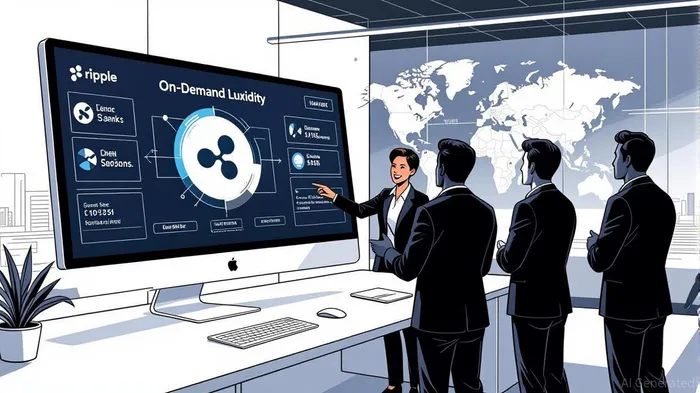
The cryptocurrency market has long been a theater of regulatory uncertainty, where legal ambiguity has stifled institutional participation and distorted price discovery. XRPXRP--, the native token of Ripple's blockchain network, has been no exception. For years, its future hung in the balance due to the U.S. Securities and Exchange Commission's (SEC) lawsuit against Ripple Labs. But in August 2025, a pivotal ruling by the U.S. Court of Appeals for the Second Circuit reshaped the narrative. By reclassifying XRP as a commodity in secondary markets, the court not only ended a four-year legal saga but also unlocked a new era of institutional adoption and market legitimacy.
Regulatory Clarity: A Catalyst for Market Confidence
The dismissal of the SEC's case—coupled with the reclassification of XRP—has resolved a critical overhang. The ruling affirmed that XRP transactions on public exchanges are not subject to securities law, aligning it with BitcoinBTC-- and EthereumETH-- under the CLARITY Act's framework. This shift transferred regulatory oversight to the Commodity Futures Trading Commission (CFTC), a body more attuned to market dynamics than the SEC's rigid securities framework.
The practical implications are profound. Ripple's $50 million fine, while a financial concession, pales against the strategic victory of lifting the injunction that barred institutional sales of XRP. This has enabled the company to resume selling XRP to institutional investors under clear legal parameters, a move that has already spurred a 200% surge in the token's price since early 2025. The ProShares Ultra XRP ETF (UXRP), which saw a $1.2 billion inflow, is a testament to the renewed appetite for XRP among institutional investors.
Institutional Adoption: From Niche to Mainstream
The regulatory clarity has acted as a catalyst for institutional validation. Ripple's On-Demand Liquidity (ODL) service, which uses XRP to facilitate cross-border payments, reported $1.3 trillion in transaction volume in Q2 2025 alone. This growth is underpinned by partnerships with financial giants such as SantanderSAN--, PNC Bank, and Standard Chartered, all leveraging XRP for real-time, low-cost international settlements.
The U.S. government's inclusion of XRP in its newly announced Crypto Reserve Initiative—a strategic fund to position the U.S. as the “Crypto Capital of the World”—further underscores the token's institutional credibility. This initiative, which pairs XRP with SolanaSOL-- and CardanoADA--, signals a broader recognition of its utility in global finance.
Ripple's acquisition of Hidden Road, a prime brokerage firm, is another milestone. By integrating post-trade clearing and FX services onto the XRP Ledger, Ripple is transforming the token from a payment rail into a foundational asset for institutional financial infrastructure. Meanwhile, BNY Mellon's role as custodian for Ripple's USD-pegged stablecoin, RLUSD, highlights the growing trust in XRP-based ecosystems.
Expanding Use Cases: Beyond Payments
XRP's utility is no longer confined to cross-border transactions. Ripple's collaboration with Dubai's Land Department to tokenize real estate on the XRP Ledger exemplifies its potential in asset tokenization. Fractional ownership and blockchain-based property transfers could democratize access to real estate, a sector historically resistant to digital disruption.
In Japan, where XRP adoption has surged, major banks like MUFG are exploring tokenized real estate and consumer platforms like Mercari's Mercoin are enabling retail users to buy XRP. These developments illustrate XRP's versatility as a bridge between traditional finance and decentralized innovation.
Investment Implications: A Case for Strategic Allocation
For investors, the confluence of regulatory clarity and institutional adoption presents a compelling case. XRP's reclassification as a commodity has aligned it with a regulatory framework that prioritizes market efficiency over stifling innovation. The token's role in cross-border payments, stablecoin issuance, and asset tokenization positions it as a multi-use asset with defensible demand.
The pending approval of 11 spot XRP ETFs—projected to inject $4.3–$8.4 billion into the market by October 2025—further amplifies its investment appeal. Analysts project a 5x to 25x growth potential over the next few years, driven by institutional inflows, DeFi integration, and expanding real-world applications.
However, investors must remain cognizantCTSH-- of risks. While the SEC's case is effectively closed, the ruling's non-prejudicial nature leaves room for future legal challenges. Additionally, XRP's price volatility, though tempered by institutional demand, remains a factor in a market prone to speculative swings.
Conclusion: A New Paradigm for XRP
The 2025 court ruling and subsequent institutional embrace have redefined XRP's trajectory. No longer a token mired in legal limbo, it now stands as a commodity with tangible utility in global finance. For investors seeking exposure to a digital asset with regulatory clarity, institutional backing, and expanding use cases, XRP offers a unique opportunity.
As the crypto market evolves, XRP's journey underscores a broader lesson: regulatory frameworks that balance innovation with investor protection can unlock value for all stakeholders. In this new paradigm, XRP is not just a token—it is a bridge to the future of finance.

Blending traditional trading wisdom with cutting-edge cryptocurrency insights.
Latest Articles
Stay ahead of the market.
Get curated U.S. market news, insights and key dates delivered to your inbox.


AInvest
PRO
AInvest
PRO



Comments
No comments yet