
XRP's Regulatory Clarity and Institutional Adoption: Catalysts for 2025 Price Momentum
 Aime Summary
Regulatory Clarity: A Foundation for Institutional Confidence
The court's decision removed a critical barrier to institutional adoption. By distinguishing between retail and institutional XRP transactions, the ruling provided a framework that aligns with the SEC's Howey Test while preserving XRP's utility as a payment asset according to Capital.com. This nuance is crucial. As stated by a report from Capital.com, the outcome "marked a turning point for the broader crypto industry, offering a clearer framework for classifying and trading digital assets in the United States" according to Capital.com.
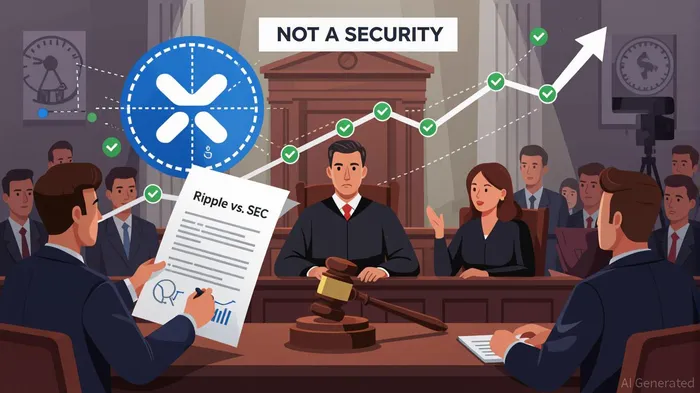 The settlement also included a permanent injunction prohibiting Ripple from conducting direct institutional sales in the U.S., effectively curbing speculative practices while reinforcing compliance according to Capital.com. This regulatory resolution has already triggered market reactions. On the day of the ruling, XRP surged 11%, signaling investor optimism about the asset's newfound legitimacy according to 247 Wall Street.
Institutional Adoption: From ETFs to Prime Brokerage
Regulatory clarity has been the catalyst for a wave of institutional infrastructure developments. The launch of spot XRP ETFs in late 2025, approved by the SEC, has provided a regulated vehicle for institutional and retail investors to gain exposure without the complexities of self-custody according to MEXC. These ETFs, now managed by nine asset managers, are projected to attract $5–$7 billion in inflows by 2026 according to Yahoo Finance, a figure that underscores growing institutional confidence.
Ripple's strategic acquisitions have further solidified its institutional appeal. The $1.25 billion purchase of Hidden Road, rebranded as Ripple Prime, has established the first crypto-owned global prime brokerage according to Yahoo Finance. This entity offers cross-margining, financing, and OTC trading services, addressing institutional demands for liquidity and compliance according to Ki-Ecke. Analysts note that Ripple Prime's infrastructure could deepen XRP pair liquidity and stabilize price volatility according to Ki-Ecke.
Meanwhile, Ripple's RLUSD stablecoin has crossed $1 billion in market cap, serving as a bridge between XRP and traditional financial systems according to Ki-Ecke. A collaboration with Mastercard, WebBank, and Gemini has demonstrated XRP's utility in real-world applications, enabling on-chain settlement of credit card payments according to Yahoo Finance. Such use cases highlight XRP's efficiency-settlement in seconds, low fees, and interoperability-positioning it as a viable alternative to legacy systems like SWIFT according to XBTFX.
Price Momentum and Market Dynamics
The confluence of regulatory clarity and institutional adoption has driven near-term price momentum. Data from Ki-ecke.com indicates that XRP's futures open interest has surged, reflecting increased institutional demand according to Ki-Ecke. Large wallet accumulation and strategic partnerships, such as XRP Tundra's December 15th public launch according to Global Newswire, further signal a shift from speculative trading to utility-driven adoption.
Moreover, the approval of spot ETFs has normalized XRP's inclusion in diversified portfolios. As noted by MEXC, these ETFs align with institutional preferences for security and compliance, reducing counterparty risks according to MEXC. With Ripple's focus now on product development and ecosystem expansion, the asset's fundamentals are increasingly aligned with long-term value creation according to Capital.com.
Conclusion: A New Era for XRP
The Ripple vs. SEC ruling and subsequent institutional infrastructure developments have transformed XRP from a speculative asset into a regulated, utility-driven digital asset. Regulatory clarity has mitigated legal risks, while ETFs, prime brokerage services, and real-world partnerships have expanded its institutional footprint. For investors, the combination of these factors presents a compelling case for near-term price appreciation. As the crypto market continues to mature, XRP's role in cross-border payments and institutional finance is poised to grow-backed by a regulatory framework and infrastructure that now support its legitimacy.

Stay ahead of the market.
Get curated U.S. market news, insights and key dates delivered to your inbox.


AInvest
PRO
AInvest
PRO



Comments
No comments yet