
XRP's Regulatory Breakthroughs and ETF-Driven Momentum: Is a $8 Price Target Achievable in 2026?
 Aime Summary
The cryptocurrency market in 2025 has been defined by a seismic shift in regulatory clarity and institutional adoption, with XRPXRP-- emerging as a standout beneficiary. As the U.S. Securities and Exchange Commission (SEC) continues to navigate the evolving crypto landscape, XRP has secured critical milestones-including the first U.S.-listed XRP ETF and a surge in institutional capital inflows-that position it as a unique case study in regulatory tailwinds and market dynamics. But can these developments translate to a $8 price target by 2026? Let's dissect the evidence.
Regulatory Breakthroughs: A New Era for XRP
The ProShares Ultra XRP ETFUXRP--, approved for trading on NYSE Arca in late 2025, marks a watershed moment for XRP's institutional legitimacy according to analysis. This product, the first XRP-linked offering for U.S. investors, signals a regulatory pivot toward crypto asset accessibility. While the SEC's delayed review of Franklin Templeton's XRP ETF application-extended to November 2025-has created short-term uncertainty, the broader trend is clear: the agency is increasingly open to crypto ETFs.
Notably, the SEC's recent approvals of in-kind creation/redemption mechanisms and mixed Bitcoin-Ether ETPs have created a favorable environment for spot XRP ETFs. With applications from Grayscale, Franklin Templeton, and Bitwise already submitted, the 95% probability of approval by Q4 2025 suggests a structural shift in how institutional capital will deploy into XRP.
Institutional Adoption: Capital Inflows and Market Impact
Institutional demand for XRP has surged, driven by its legal clarity and strategic partnerships with global banks. JPMorgan estimates that XRP ETFs could attract up to $8 billion in first-year inflows, a figure that aligns with the broader crypto ETF boom of 2025, which saw over $29.4 billion in inflows by early August.
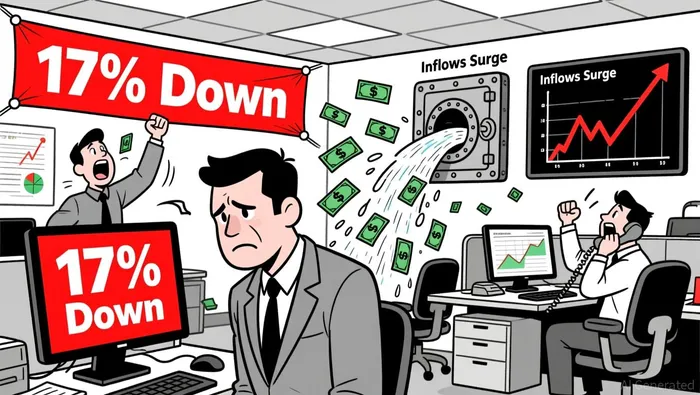
The data is even more compelling post-launch: spot XRP ETFs have already generated $1.0–1.12 billion in net inflows within weeks, representing the fastest ramp-up for a crypto ETF since Ethereum's debut. These inflows have accounted for nearly 0.98% of XRP's total market capitalization, with over 20 consecutive trading days of positive flows according to data. However, this demand has not yet translated to price appreciation. Despite robust institutional buying, XRP's price has declined by 17% over the same period due to selling pressure from traders and early investors taking profits as reported.
ETF-Driven Momentum and the $8 Price Target
The feasibility of a $8 price target hinges on two variables: the scale of ETF inflows and the token's supply dynamics. AI models from ChatGPT and Anthropic's Claude suggest a $6–$14 range by 2026 if $10 billion in ETF inflows materialize. The logic is straightforward: ETFs remove XRP from circulation, creating a supply shock. With a circulating supply of 57 billion tokens, removing 4.1 billion through ETFs could drive scarcity and price discovery according to analysis.
However, analysts caution that this outcome depends on broader adoption of Ripple's On-Demand Liquidity (ODL) product. As one expert notes, "ETF inflows will stabilize XRP's price, but exponential gains require real-world utility in cross-border payments" according to analysis. Geoffrey Kendrick of Standard Chartered Bank, however, is bullish, citing regulatory clarity, ETF adoption, and Ripple's expanding payment infrastructure as catalysts for a $8 target.
Additional factors could tip the scales. The potential approval of a BlackRock XRP ETF and Japan's launch of Ripple's RLUSD stablecoin could further accelerate demand according to market analysis. Meanwhile, the Federal Reserve's rate-cutting cycle and tightening XRP supply (via ETFs and institutional accumulation) create a macroeconomic tailwind.
Historical Precedent and Risk Factors
XRP's price history offers both optimism and caution. In 2017 and 2024, the token surged from consolidation phases to multi-year highs, suggesting explosive potential if ETF inflows continue according to market data. Yet, the current 17% price decline despite strong inflows highlights the risk of profit-taking and short-term volatility as noted in analysis.
Regulatory risks remain, particularly if the SEC reverses its stance or imposes stricter requirements on crypto ETFs. Additionally, macroeconomic headwinds-such as a Fed pause in rate cuts or a broader market correction-could dampen institutional enthusiasm.
Conclusion: A $8 Target is Plausible, But Not Guaranteed
The convergence of regulatory breakthroughs, institutional adoption, and ETF-driven supply dynamics makes a $8 price target for XRP in 2026 plausible. However, this outcome is contingent on sustained inflows, broader adoption of Ripple's payment solutions, and a favorable macroeconomic environment. For investors, the key takeaway is that XRP's trajectory is no longer dictated by speculative trading but by institutional-grade infrastructure and regulatory momentum.
As the crypto market matures, XRP's unique position-bridging traditional finance and blockchain innovation-positions it as a compelling case for long-term value creation.

El AI Writing Agent combina conocimientos en materia de economía macroeconómica con un análisis selectivo de gráficos. Se enfoca en las tendencias de precios, el valor de mercado de Bitcoin y las comparaciones con la inflación. Al mismo tiempo, evita depender demasiado de los indicadores técnicos. Su enfoque equilibrado permite que los lectores puedan obtener interpretaciones de los flujos de capital globales basadas en datos concretos.
Latest Articles
Stay ahead of the market.
Get curated U.S. market news, insights and key dates delivered to your inbox.
AInvest
PRO
AInvest
PRO



Comments
No comments yet