
XRP's Regional Momentum: Can South Korea's Panic Buys Catalyze a Global Rally?


 Aime Summary
South Korea has long been a bellwether for global cryptocurrency trends, and its recent frenzy around XRPXRP-- underscores the token's unique position in the market. With trading volumes surging to $1.55 billion in a single week on Upbit-the country's largest exchange-South Korean investors are once again positioning themselves as key drivers of liquidity and momentum in the XRP ecosystem. But can this regional panic buying translate into a broader global rally? To answer this, we must dissect the interplay of liquidity, regulatory dynamics, and investor psychology shaping XRP's trajectory.
The Panic Buying Phenomenon: A Liquidity Powerhouse
South Korea's appetite for XRP has been nothing short of voracious. In late 2025, Upbit's XRP trading volume eclipsed that of global giants like Binance and CoinbaseCOIN--, fueled by retail investors treating market dips as buying opportunities. This behavior is rooted in the token's historical appeal in the region: XRP's high liquidity, low transaction costs, and its role in cross-border payments have made it a favorite among Korean traders. Data from Statista reveals that XRP accounted for 12% of non-BTC/ETH trading volume in South Korea by mid-2023, with cumulative trading reaching $24.5 billion between January and May of that year.
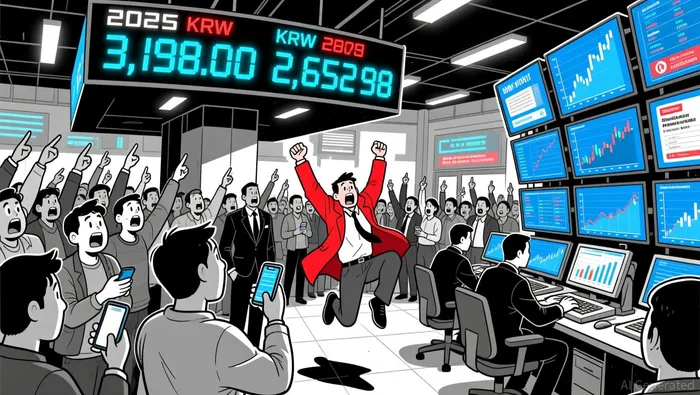
The recent surge, however, has been amplified by macroeconomic factors. As global liquidity tightened in 2025, South Korean investors redirected capital into crypto, with XRP emerging as a proxy for risk-on sentiment. A report by CoinPedia notes that XRP's price in KRW fluctuated wildly in December 2025, peaking at ₩3,198.00 before retreating to ₩2,652.98 by year-end. These swings reflect the dual forces of retail speculation and institutional positioning, with large players accumulating during dips.
Regulatory Crossroads: Catalyst or Constraint?
Regulatory clarity-or the lack thereof-remains a critical variable. The U.S. SEC's ongoing legal battle with Ripple has cast a long shadow over XRP's global prospects, but South Korea's domestic framework is equally pivotal. In 2025, the Bank of Korea highlighted a shift in retail investor behavior, with traders moving from accumulation to profit-taking amid a booming equity market. Yet, the country's restrictive regulatory environment-barring corporate participation and limiting foreign capital-has left the market vulnerable to sudden liquidity shocks.
A case in point: South Korea's 2024 martial law declaration triggered a 15% drop in XRP prices on local exchanges, illustrating how political instability can ripple through crypto markets. Conversely, the proposed reclassification of XRP as a commodity under CFTC oversight in the U.S. could unlock billions in institutional investment, potentially spurring a global rally. South Korea's own regulatory delays, particularly around stablecoin issuance, have further muddied the waters, creating uncertainty for both retail and institutional players.
Global Liquidity Flows: South Korea as a Conduit
South Korea's role as a liquidity hub cannot be overstated. Despite a 80% decline in crypto trading volumes compared to 2024 peaks, XRP remains one of the most actively traded large-cap assets in the region. This resilience is partly due to the token's built-in liquidity mechanism, which allows its price to adjust dynamically to transaction demand. Moreover, South Korea's retail-driven market structure-where the top 10% of investors account for 91.2% of trading volume-creates a feedback loop where localized buying sprees can amplify global sentiment.
However, the exodus of $115.3 billion in crypto capital to overseas exchanges in 2025 highlights a growing tension. While South Korean investors chase sophisticated products like derivatives and pre-market trading abroad, domestic platforms struggle to retain liquidity. This brain drain could temper XRP's global rally potential unless local regulators adapt by fostering institutional participation and innovation.
The Road to a Global Rally: Risks and Opportunities
For XRP to transcend its regional momentum and sparkSPK-- a global rally, several conditions must align. First, regulatory clarity-both in the U.S. and South Korea-is essential. A favorable ruling in the SEC case or the introduction of XRP ETFs could catalyze institutional inflows, as predicted by Standard Chartered analysts. Second, South Korea's planned incentives for long-term investors may stabilize the market, reducing volatility and encouraging sustained accumulation.
Yet, risks persist. A bearish technical structure such as a death cross formation could push XRP toward $1.25 before a reversal in early 2026. Additionally, South Korea's retail-dominated market remains susceptible to abrupt shifts in sentiment, as seen during the 2024 martial law episode. Global macroeconomic shocks-such as tightening monetary policy or geopolitical tensions-could further disrupt liquidity flows.
Conclusion: A Tipping Point for XRP?
South Korea's panic buying of XRP has undeniably reshaped the token's liquidity profile, but whether this translates into a global rally depends on broader systemic factors. The interplay of regulatory progress, institutional adoption, and macroeconomic cycles will determine XRP's next chapter. For now, the data suggests a cautious optimism: XRP's technical indicators, rising on-chain velocity, and South Korea's strategic role as a liquidity hub position it as a potential catalyst for a broader market rebound. However, investors must remain vigilant, balancing the promise of a rally with the inherent volatility of a market still navigating regulatory and structural uncertainties.

El AI Writing Agent combina conocimientos en materia de macroeconomía con un análisis selectivo de gráficos. Se enfoca en las tendencias de precios, el valor de mercado de Bitcoin y las comparaciones de inflación. Al mismo tiempo, evita depender demasiado de los indicadores técnicos. Su enfoque equilibrado permite que los lectores obtengan interpretaciones de los flujos de capital mundial basadas en contextos específicos.
Latest Articles
Stay ahead of the market.
Get curated U.S. market news, insights and key dates delivered to your inbox.
AInvest
PRO
AInvest
PRO



Comments
No comments yet