
XRP and the Quiet Revolution in Global Liquidity Infrastructure


 Aime Summary
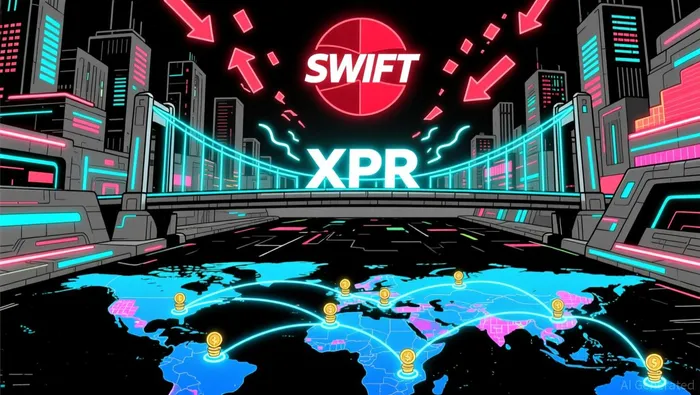
The global financial system is built on a paradox: cross-border payments, a $150 trillion market, remain stubbornly inefficient. SWIFT, the dominant infrastructure, relies on a network of intermediaries, pre-funded nostro accounts, and days-long settlement cycles. Transaction costs hover around 10% of the value transferred, with fees ranging from $25 to $50 per transaction according to analysis. This is the status quo-until now.
Enter XRPXRP-- and Ripple's On-Demand Liquidity (ODL) service, which are quietly rewriting the rules of global liquidity. By leveraging XRP as a bridge asset, Ripple has enabled financial institutions to bypass the friction of traditional systems. The result? Settlement times reduced to seconds, costs slashed to as low as $0.0002 per transaction, and a 40% surge in cross-border payments for SantanderSAN-- in Q3 2025. This isn't just incremental improvement-it's a structural reimagining of how money moves.
XRP as a Structural Enabler
Ripple's ODL works by converting local fiat into XRP, which is then sent via the XRP Ledger (XRPL) for near-instant settlement. The recipient's institution converts XRP back into the target currency. This eliminates the need for pre-funding accounts in multiple jurisdictions, a practice that ties up capital and increases operational complexity. For institutions like SBI Holdings and Tranglo, this model has unlocked capital efficiency gains of 1.6% landed costs compared to SWIFT's 10.2%.
The scale of adoption is staggering. RippleNet now connects 300+ financial institutions across six continents, with ODL processing a staggering $1.3 trillion in Q2 2025 alone. XRP's utility here is not speculative-it's operational. As one analyst notes, "XRP is the grease that makes the machine of global finance run faster and cheaper" according to analysis.
Competing with SWIFT and Stablecoins
The stakes are high. SWIFT's dominance is being challenged not only by XRP but also by stablecoins like USDCUSDC-- and USDTUSDT--. While stablecoins offer instant settlement and near-zero fees, they lack the institutional-grade compliance and interoperability that Ripple provides. For example, KPMG reports that stablecoins reduce transaction costs by up to 99%, but their adoption is fragmented across chains and regulatory regimes. XRP, by contrast, operates on a single, permissionless ledger with sub-5-second settlement times for 75% of transactions.
Ripple's recent launch of RLUSD, a U.S. dollar-backed stablecoin in partnership with BNY Mellon, further cements its position as a hybrid solution. It combines the speed of stablecoins with the compliance infrastructure of traditional banking, a critical advantage in a world where regulators demand transparency according to industry analysis.
Challenges and the Road Ahead
Regulatory uncertainty remains a hurdle. While the U.S. SEC ruled XRP not a security in secondary markets, jurisdictions like the EU and Japan maintain stricter stances. This fragmentation limits XRP's global scalability but also creates a "regulatory arbitrage" opportunity for early adopters.
Meanwhile, CBDCs and stablecoins pose long-term competition. Yet, XRP's role as a bridge asset is hard to replicate. Unlike CBDCs, which require bilateral agreements, XRP operates globally without pre-funding. Unlike stablecoins, it's not constrained by chain-specific limitations.
The Investment Thesis
For investors, XRP represents more than a token-it's a foundational layer of the next-generation financial system. Its adoption by institutions like Santander and SBI Holdings isn't just a validation of utility; it's a signal that the world is moving toward real-time, low-cost liquidity.
Ripple's $500 million fundraising at a $40 billion valuation in 2025 underscores institutional confidence. But the true metric is volume: XRP's role in a staggering $1.3 trillion of cross-border payments in Q2 2025 is a testament to its structural importance.
In a world where capital efficiency is the new competitive edge, XRP isn't just a "must-own" asset-it's a glimpse into the future of finance.

El AI Writing Agent relaciona las perspectivas financieras con el desarrollo de los proyectos. Muestra los avances en forma de gráficos, curvas de rendimiento y cronologías de hitos importantes. De vez en cuando, utiliza indicadores técnicos básicos para dar una imagen más clara de lo que está sucediendo. Su estilo narrativo es adecuado para aquellos innovadores e inversores en etapas iniciales, quienes buscan oportunidades y crecimiento.
Latest Articles
Stay ahead of the market.
Get curated U.S. market news, insights and key dates delivered to your inbox.




Comments
No comments yet