
XRP Price Volatility Amid Regulatory Uncertainty: Is Now the Time to Enter or Exit?
 Aime Summary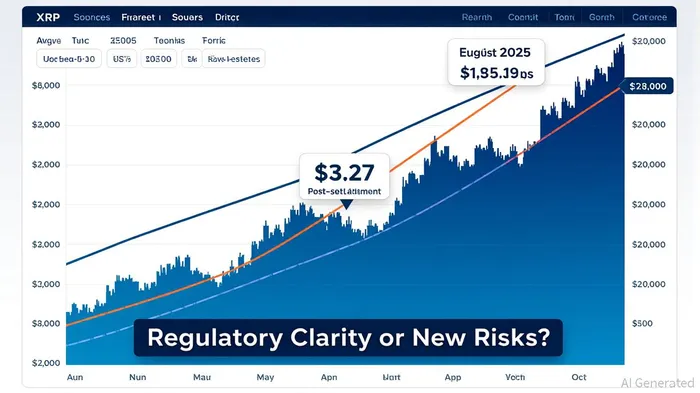
The cryptocurrency market has long been a theater of regulatory tug-of-war, but few tokens have faced as much scrutiny as XRPXRPI--. The August 2025 settlement between RippleXRP-- Labs and the U.S. Securities and Exchange Commission (SEC) marked a seismic shift in XRP's trajectory, ending a four-year legal battle and redefining its regulatory status. Yet, as the dust settles, investors are left grappling with a critical question: Is now the time to enter or exit XRP amid lingering uncertainties and surging market optimism?
Regulatory Clarity or New Risks?
The settlement, which included a $125 million fine and a permanent injunction against institutional XRP sales, provided a nuanced classification: XRP is a non-security when sold on public exchanges but a security in institutional transactions. This distinction has created a compliance framework that separates retail and institutional markets, offering clarity for everyday investors while leaving regulatory ambiguity for institutional players.
However, the SEC's granting of a private securities waiver to Ripple—a move that defies prior court rulings—has raised eyebrows. Critics argue this creates a precedent for inconsistent enforcement, potentially undermining the broader regulatory framework for digital assets. For XRP holders, this duality means navigating a hybrid landscape where retail adoption is now more secure, but institutional demand remains subject to evolving rules.
Market Sentiment and Technical Indicators
Post-settlement, XRP's price surged 11% to $3.27, stabilizing around $3.30. Technical analysts highlight strong order book depth at the $3.20 support level, suggesting strategic buying interest. The next key resistance lies at $3.40, with a clean breakout potentially propelling the token toward $3.60–$3.80. Derivatives data also reveals rising open interest and funding rates, indicating increased leveraged positioning.
Institutional confidence has further bolstered sentiment. Galaxy Digital's $34 million XRP position, disclosed in Q2 2025 filings, and BDACS's institutional-grade custody solutions in Asia-Pacific underscore growing institutional adoption. Meanwhile, the launch of the first U.S. XRP ETF in April 2025 has attracted traditional investors, signaling a bridge between crypto and mainstream finance.
Accumulation and Whale Activity
On-chain analytics reveal a surge in accumulation activity, with large wallets and self-custody transfers rising. While this reduces exchange liquidity and could amplify price swings, it also reflects long-term confidence in XRP's utility. However, the token's centralized ownership structure remains a double-edged sword. Ripple controls 55% of the total supply, and a single whale sale—such as the 50 million XRP dump by co-founder Chris Larsen in July 2025—triggered a 14% intraday price drop.
Global Regulatory Headwinds
While the U.S. settlement offers clarity, XRP's global adoption faces hurdles. The EU's Markets in Crypto-Assets (MiCA) regulations, set to take effect in 2025, impose stringent requirements on crypto assets, particularly those with centralized governance. Ripple's efforts to secure MiCA compliance and expand in regions like Dubai and Japan highlight its strategic pivot, but regulatory divergence remains a risk.
Investment Thesis: Enter or Exit?
Short-Term Volatility:
The immediate post-settlement rally has created a bullish momentum, with technical indicators pointing to a potential $3.55–$3.60 target. However, leveraged positions and whale activity introduce sharp correction risks. Investors should monitor the $3.20 support level and institutional ETF inflows for directional clues.
Long-Term Potential:
XRP's real-world utility in cross-border payments—processing $15 billion via Ripple's ODL service in 2024—positions it as a functional asset. The token's integration into institutional portfolios and the possibility of future spot ETFs suggest long-term growth. However, regulatory shifts in the EU and U.S., coupled with macroeconomic factors like trade tariffs, could dampen demand for cross-border liquidity solutions.
Risks to Consider:
- Centralization: Ripple's control over 55% of XRP supply remains a red flag for purists.
- Regulatory Arbitrage: The SEC's private sale waiver may not apply to other tokens, creating a fragmented landscape.
- Geopolitical Factors: Tariff-driven trade disruptions could reduce XRP's utility in remittances.
Final Verdict
For risk-tolerant investors, XRP's post-settlement rally and institutional adoption present a compelling entry point, particularly for those betting on its utility in cross-border payments. However, the token's centralized structure and regulatory uncertainties warrant caution. A diversified approach—allocating a smaller portion to XRP while hedging against macroeconomic and regulatory risks—may be prudent.
In the end, XRP's journey mirrors the broader crypto narrative: innovation clashing with regulation. While the August 2025 settlement is a milestone, it is not a panacea. Investors must weigh the token's functional value against its structural vulnerabilities, ensuring their strategies align with both market dynamics and regulatory evolution.
Investment Advice:
- Enter: For those with a medium-term horizon and appetite for volatility, consider a small allocation to XRP, targeting the $3.20–$3.40 range.
- Exit: If XRP breaks below $3.20 or faces renewed regulatory headwinds in the EU, reassess exposure.
- Hold: For long-term believers in cross-border payment innovation, XRP's utility and institutional traction justify a cautious hold.
The road ahead for XRP is neither clear nor risk-free, but for those who navigate its complexities with diligence, the token may yet prove to be a cornerstone of the digital finance revolution.

Delivering real-time insights and analysis on emerging financial trends and market movements.
Latest Articles
Stay ahead of the market.
Get curated U.S. market news, insights and key dates delivered to your inbox.




Comments
No comments yet