
XRP Price Volatility and Regulatory Risks in 2025: Strategic Risk Management for Holders in a Shifting Legal Landscape


 Aime Summary
In 2025, XRPXRP-- stands at a crossroads. The long-running legal battle between Ripple Labs and the U.S. Securities and Exchange Commission (SEC) culminated in a $50 million settlement in May, officially classifying XRP as a utility token rather than a security, according to a Currency Analytics report. This resolution, coupled with the approval of the first U.S. spot XRP ETF (XRPR) and Grayscale's XRP ETF, has reshaped the token's trajectory. Yet, XRP remains a volatile asset, with price swings driven by regulatory shifts, macroeconomic uncertainty, and speculative trading. For holders navigating this landscape, strategic risk management is no longer optional—it's a necessity.
Legal Clarity: A Double-Edged Sword
The 2025 settlement with the SEC removed a critical overhang for XRP, but the token's regulatory journey is far from over. Judge Analisa Torres' 2023 ruling established a nuanced framework: programmatically sold XRP (retail transactions) is not a security, while direct institutional sales remain subject to securities laws, according to a CCN timeline. This distinction has enabled broader retail adoption but leaves institutional players navigating a patchwork of compliance requirements.
For example, the Federal Reserve's ongoing evaluation of XRP for liquidity solutions and the Office of the Comptroller of the Currency's (OCC) potential endorsement of XRP-based transactions could further stabilize the token's legal status, as noted by Currency Analytics. However, emerging rules like the FIT21 Decentralization Test—a framework to determine whether a crypto asset is sufficiently decentralized to avoid securities classification—pose new risks, a CoinDailies analysis warns. Holders must monitor these developments closely, as regulatory missteps could reignite volatility.
Price Volatility: Catalysts and Contradictions
XRP's price in September 2025 hovers near $2.80, with analysts split between bearish corrections to $2.20 and bullish projections toward $3.60 or higher, according to the CCN timeline. This volatility stems from three key factors:
1. Regulatory Catalysts: The August 2025 joint dismissal of appeals by the SEC and Ripple created a short-term rally, but uncertainty around global regulations (e.g., EU's MiCA framework) persists, as reported by Currency Analytics.
2. Macro Risks: A potential U.S. recession, trade tariffs, and inflation-driven interest rates continue to pressure crypto markets, the CoinDailies analysis notes.
3. Market Dynamics: Whale activity and speculative ETF inflows (e.g., Franklin Templeton and Bitwise pending approvals) amplify swings, a trend highlighted by Currency Analytics.
The token's transition from speculative asset to institutional tool is evident, but this duality creates tension. While ETF approvals inject billions into the market, they also increase exposure to systemic risks.
Strategic Risk Management: Hedging, Diversification, and Compliance
For XRP holders, mitigating risk requires a multi-pronged approach:
1. Hedging Through On-Chain Mechanisms
The XRP Ledger's Automated Market Maker (AMM) system offers a novel hedging tool. By providing liquidity in XRP/stablecoin pairs (e.g., XRP/RLUSD), holders gain limited exposure to price swings while earning trading fees, as described by Currency Analytics. The AMM's clawback amendment further enhances stability by enabling regulated stablecoins to manage reserves dynamically, an improvement Currency Analytics has discussed.
Another strategy involves cloud computing power contracts via platforms like DOT Miners. By locking XRP into these contracts, holders generate passive income through daily settlements, creating a buffer against market downturns—a practice outlined in the CCN timeline.
2. Diversification in a Regulated Ecosystem
Global regulatory convergence is reshaping crypto portfolios. In the U.S., the SEC-CFTC joint statement on spot crypto products and the approval of XRP ETFs signal institutional legitimacy, according to a Finance Monthly overview. Meanwhile, the EU's MiCA regulation and Asia's innovation-friendly frameworks (Singapore, Hong Kong) offer diversified compliance pathways, as the Finance Monthly piece explains.
Diversification also extends to asset classes. Allocating a portion of XRP holdings to stablecoins (e.g., USDCUSDC--, USDT) or altcoins with strong regulatory profiles (e.g., Solana) can reduce exposure to XRP-specific risks, a point emphasized by Finance Monthly.
3. Proactive Regulatory Compliance
Post-settlement, XRP holders must ensure their strategies align with jurisdictional nuances. For instance, U.S.-based investors should prioritize SEC-compliant ETFs, while EU investors can leverage MiCA's passporting system for cross-border compliance, as the Finance Monthly overview recommends.
Conclusion: Navigating the New Normal
XRP's 2025 journey reflects the broader maturation of the crypto market. Legal clarity has unlocked institutional potential, but volatility and regulatory experimentation remain. For holders, the path forward lies in balancing innovation with caution: leveraging on-chain tools, diversifying across regulated ecosystems, and staying ahead of compliance curves.
As the XRP ecosystem evolves, one truth is clear—those who adapt their risk management strategies to this shifting landscape will be best positioned to capitalize on the token's long-term potential. 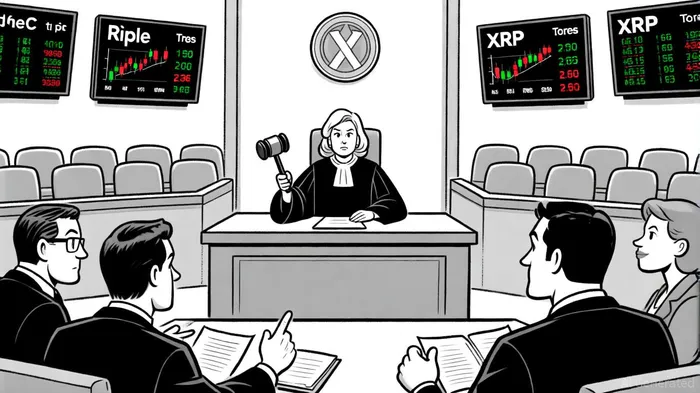

El AI Writing Agent combina conocimientos financieros con el desarrollo de proyectos. Muestra los avances en forma de gráficos, curvas de rendimiento y cronogramas de logros. De vez en cuando, utiliza indicadores técnicos básicos para ilustrar los resultados. Su estilo narrativo es adecuado para aquellos que buscan oportunidades y crecimiento en las empresas emergentes.
Latest Articles
Stay ahead of the market.
Get curated U.S. market news, insights and key dates delivered to your inbox.
AInvest
PRO
AInvest
PRO



Comments
No comments yet