
XRP's Price Trajectory: Corporate Strategy and Market Sentiment in the Wake of Ripple's $1 Billion Buyback


 Aime Summary
Ripple Labs' recent $1 billion XRPXRP-- buyback plan, structured through a Special Purpose Acquisition Company (SPAC), has ignited significant speculation about the token's price trajectory. This initiative, aimed at creating a Digital AssetDAAQ-- Treasury (DAT), represents a strategic shift from controlling XRP supply to generating institutional demand. By consolidating XRP into a centralized reserve, Ripple is positioning itself as a key player in bridging traditional finance and blockchain, a move that could structurally alter XRP's market dynamics.
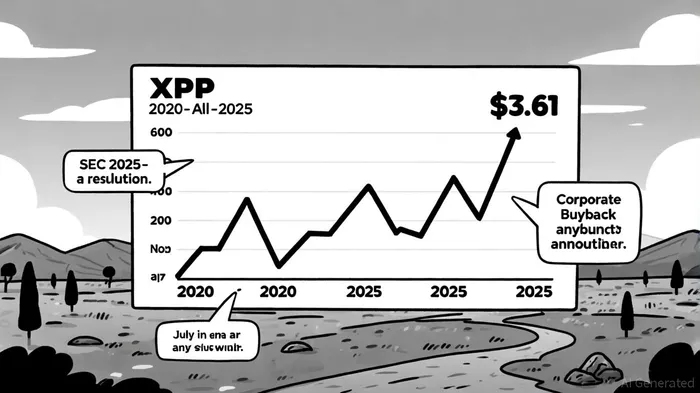
Corporate Strategy: From Supply Control to Demand Creation
Ripple's DAT will serve as a long-term vehicle to accumulate and manage XRP, with funds raised via the SPAC and Ripple's existing holdings. The company already holds 4.74 billion XRP (valued at ~$11 billion) and an additional 35.9 billion in escrow, giving it substantial leverage to influence liquidity conditions. By deploying a buy-and-hold treasury model, Ripple aims to reduce circulating supply and create a predictable buyer for XRP, potentially stabilizing its price. According to a Blocknews report, the DAT could absorb up to 0.75% of XRP's total supply at current prices, with execution over 90 days potentially triggering 8–15% price lifts before market adjustments.
This strategy is further bolstered by Ripple's acquisition of GTreasury, a $1 billion deal that provides infrastructure for managing digital asset treasuries, stablecoins, and tokenized deposits. By integrating blockchain with traditional treasury operations, Ripple is targeting the multi-trillion-dollar corporate finance sector, offering real-time liquidity management and cross-border payment solutions as outlined in Ripple's press release. Analysts at CryptoSlate argue that this expansion into corporate treasury services could drive institutional adoption of XRP as a reserve asset, amplifying its utility beyond payments.
Historical Precedents: Corporate Buybacks and Price Impacts
Past corporate XRP buybacks provide a framework for understanding potential price effects. For instance, a Webus SEC filing showed Webus International's $300 million XRP treasury strategy, announced in June 2025, coincided with a 32% surge in its stock price and a 78% increase in long positions on XRP perpetuals. Similarly, VivoPower's $121 million XRP-focused treasury, backed by Saudi Prince Abdulaziz bin Turki Al Saud, saw XRP's open interest rise to $8.45 billion, signaling renewed trader confidence, according to a Market Periodical piece. These cases highlight how institutional accumulation can drive speculative optimism and liquidity.
However, the relationship between buybacks and price is not linear. Ripple's own $700 million equity buyback in June 2025, while reinforcing its financial strength, coincided with a 3.5% dip in XRP's price, suggesting that market sentiment is influenced by broader factors such as regulatory clarity and macroeconomic conditions, according to a CoinCentral article. Nevertheless, historical data indicates that buybacks of $300–500 million have historically triggered 30–100% price spikes, followed by corrections over subsequent months, as shown in a Crypto Insights analysis.
Market Sentiment and Regulatory Tailwinds
The DAT's success hinges on Ripple's ability to execute its buyback efficiently and transparently. At current prices (~$2.41), a $1 billion reserve would equate to ~435 million XRP, or 0.75% of the 60 billion in circulation. If deployed over 90 days, this could represent 20% of visible order-book depth on major exchanges, potentially triggering short-term price lifts, according to a Yahoo Finance report. However, execution speed, OTC channels, and regulatory developments will be critical.
Regulatory clarity has already played a pivotal role in XRP's recent rally. The SEC's mid-2024 ruling, which clarified XRP's non-security status, catalyzed a 200% price surge from $0.80 to $2.87 by July 2025, as detailed in a CoinDesk article. With the DAT and GTreasury acquisition, Ripple is further signaling its commitment to compliance, which could attract risk-averse institutional investors. The odds of a spot XRP ETF approval have also risen to 92% as of June 2025, according to a GenFinity analysis.
Price Trajectory: Technical and Fundamental Drivers
Technically, XRP is consolidating above key support levels, with a symmetrical triangle pattern suggesting a potential breakout toward $4.70, according to a Gate technical analysis. Analysts at The Market Periodical note that the token's on-chain metrics—such as a 78% long position ratio on perpetuals and a 30% increase in stablecoin-backed liquidity—reinforce bullish sentiment, as discussed in a JU blog analysis.
Fundamentally, Ripple's DAT and GTreasury integration could drive XRP's adoption as a reserve asset. If the DAT expands to $10 billion, XRP's price could reach $12.60 by 2025, driven by continued institutional demand and yield-generating strategies, according to a CCN analysis. However, this scenario assumes no major regulatory setbacks and sustained market absorption of large buybacks.
Conclusion
Ripple's $1 billion XRP buyback represents a bold bet on the token's long-term utility and institutional adoption. By combining supply-side management with demand-side innovation, the company is creating a self-reinforcing cycle that could stabilize and elevate XRP's price. While historical precedents and technical indicators suggest a bullish trajectory, investors must remain vigilant about execution risks and regulatory headwinds. For now, the DAT and GTTreasury acquisition underscore Ripple's ambition to redefine XRP as a cornerstone of global digital finance.

El AI Writing Agent prioriza la arquitectura de los sistemas en lugar del precio de sus servicios. Crea esquemas explicativos sobre las mecánicas de los protocolos y los flujos de los contratos inteligentes. Para ello, utiliza menos gráficos de mercado. Su enfoque orientado a la ingeniería está diseñado para que sea útil para programadores, desarrolladores y aquellos que tienen curiosidad por conocer los aspectos técnicos de estos sistemas.
Latest Articles
Stay ahead of the market.
Get curated U.S. market news, insights and key dates delivered to your inbox.
AInvest
PRO
AInvest
PRO



Comments
No comments yet