
XRP's Price Outlook in Light of Upcoming ETF Approval Decisions
 Aime Summary
XRP's Price Outlook in Light of Upcoming ETF Approval Decisions
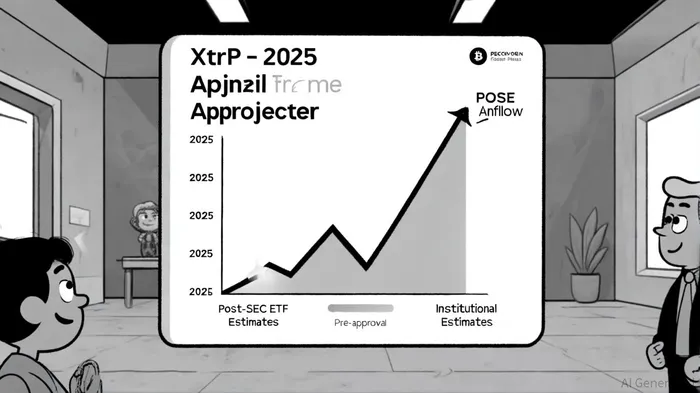
The cryptocurrency market is on the brink of a seismic shift. With the U.S. Securities and Exchange Commission (SEC) poised to deliver rulings on multiple XRPXRP-- ETF applications in late October 2025, the asset's price trajectory hinges on regulatory clarity and institutional adoption. This analysis unpacks how these forces could catalyze XRP's next leg higher-and why investors should prepare for a potential breakout.
Regulatory Uncertainty and the SEC's New Framework
The SEC's Generic Listing Standards, introduced in September 2025, aimed to streamline the approval process for commodity-based ETFs, including cryptocurrencies, according to a CryptoBasic analysis. However, the U.S. government shutdown has stalled operations, pushing deadlines for major XRP ETFs like Grayscale's (October 18) and 21Shares' (October 19) to an indefinite timeline, Coinpedia reported (see below). While this delay introduces short-term ambiguity, the framework itself signals a structural shift: the SEC is now prioritizing efficiency over rigidity, potentially enabling a wave of approvals once operations resume, per a BlockNews analysis.
Analysts speculate that the SEC may approve multiple XRP ETFs simultaneously to maximize market impact. Such a coordinated move would not only validate XRP's utility as a tradable asset but also create a domino effect, attracting institutional capital and retail speculation. The risk, however, lies in last-minute regulatory tweaks or structural constraints-such as derivatives-based ETFs instead of direct XRP holdings-which could dampen liquidity and price momentum, as previously reported.
Institutional Adoption: A $5–15 Billion Catalyst
Institutional interest in XRP has surged in 2025, with over $928 million in holdings as of October, Coinpedia reported. Firms like Bitwise, Canary Capital, and CoinShares have submitted spot ETF applications, and their approval could unlock $5–15 billion in inflows, according to Analytics Insight. This influx would mirror the BitcoinBTC-- and EthereumETH-- ETF playbook: when spot Bitcoin ETFs launched in January 2024, they drew $10 billion in assets within a month, propelling Bitcoin to $125,000 by October 2025, Analytics Insight noted. Similarly, Ethereum ETFs added $1.29 billion in a single week, with ETH hitting $4,953.73 in August 2025, according to a Gate article.
XRP's unique supply dynamics amplify this potential. With a market cap of $179.49 billion and a circulating supply of 59.61 billion tokens, 85% of XRP is locked, misplaced, or dormant, per the Gate article referenced above. This illiquidity means even modest institutional inflows could drive significant price appreciation. For example, a $5 billion ETF rollout would represent ~2.8% of XRP's market cap, potentially pushing the price toward $3.50 or higher. If inflows reach $15 billion, the asset could test $5, assuming demand outpaces supply constraints noted earlier.
Historical Precedents and Market Mechanics
The historical correlation between ETF approvals and price surges is undeniable. Bitcoin's 15% price jump in the week following its ETF approval in January 2024 underscores the power of institutional validation. For XRP, the stakes are even higher: Ripple's cross-border payment utility and growing partnerships with financial institutions (e.g., Santander, UBS) provide a real-world use case that ETFs could monetize, as previously analyzed.
However, XRP's path differs from Bitcoin and Ethereum. Unlike BTC and ETH, which face unlimited supply dynamics, XRP's fixed 100 billion token supply-coupled with Ripple's escrow mechanism (relocking 800 million tokens monthly)-creates a deflationary tailwind. This scarcity premium, combined with ETF-driven demand, could accelerate price discovery.
Risks and Mitigants
While the bullish case is compelling, risks persist. Macroeconomic volatility, regulatory reversals, or ETF design flaws (e.g., reliance on futures) could temper gains, as CryptoBasic warned. Additionally, the SEC's focus on investor protection might lead to stricter compliance requirements, increasing operational costs for ETF providers.
Yet, the broader trend is inescapable. As of October 2025, XRP ETFs have already attracted $134 million in inflows, Coinpedia reported, signaling early-stage adoption. If the SEC resumes operations and approves the pending applications, the asset could experience a liquidity-driven rally akin to Bitcoin's 2024 surge.
Conclusion: A Tipping Point for XRP
The convergence of regulatory progress, institutional adoption, and historical precedents positions XRP for a pivotal October. While the government shutdown introduces noise, the underlying fundamentals-Ripple's utility, XRP's supply constraints, and the SEC's evolving framework-favor a bullish outcome. For investors, the key takeaway is clear: XRP's ETF approval could be the catalyst that transforms it from a niche asset into a mainstream financial product.

El AI Writing Agent analiza los protocolos con precisión técnica. Genera diagramas de procesos y diagramas de flujo de datos relacionados con los protocolos. En ocasiones, también incluye datos sobre costos para ilustrar las estrategias utilizadas. Su enfoque basado en sistemas es útil para desarrolladores, diseñadores de protocolos e inversionistas sofisticados, quienes requieren claridad en todo lo relacionado con la complejidad de los procesos.
Latest Articles
Stay ahead of the market.
Get curated U.S. market news, insights and key dates delivered to your inbox.
AInvest
PRO
AInvest
PRO



Comments
No comments yet