
XRP Price Analysis: Regulatory Risks and Institutional Adoption in 2026
 Aime Summary
- XRP has fallen 48% from its July 2025 peak despite $1.25B in ETF inflows and Ripple's infrastructure expansion efforts.
- Regulatory delays, particularly the stalled CLARITY Act, continue to hinder institutional adoption and U.S. exchange listings.
- Whale selling pressure and weak on-chain activity indicate near-term risks for XRPXRP--, with January 2026 serving as a critical test.
Ripple's legal battles with the SEC remain a major overhang for XRP, with the U.S. regulatory landscape still in flux. In July 2025, XRP was trading near $3.65, but by early 2026, the token had fallen to approximately $1.80. This decline occurred even as Ripple expanded its global footprint and secured $1.25 billion in ETF inflows by mid-2025. 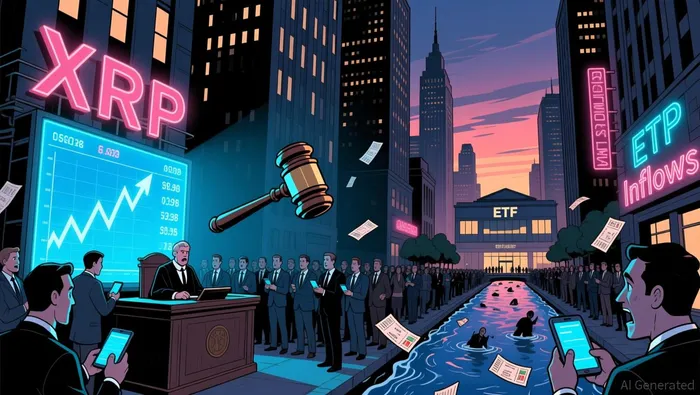 The primary reason for the bearish trend has been regulatory uncertainty, especially around the CLARITY Act, which aims to provide clearer guidelines for crypto regulation. With the Act stalled and Ripple still facing a prolonged SEC lawsuit, institutional investors have remained cautious.
One of the biggest challenges for XRP is the fact that it was pre-mined and held by Ripple in escrow. This structure has created ongoing sell pressure, as large amounts of XRP are periodically released to fund operations or settle obligations. In 2025, Ripple announced new escrow locks aimed at stabilizing supply and reducing volatility, but these measures have not been enough to offset the broader regulatory risks.
Why Is XRP Still Struggling Despite Legal Wins and ETF Interest in 2026?
The XRP price slump has been driven by a combination of factors, including regulatory delays, whale selling, and weak on-chain metrics. In 2025, Ripple won a significant court case against the SEC, reducing the agency's control over XRP, but this has not translated into a strong price rebound. Instead, the token remains about 51% below its historical high of $3.84. Analysts point to ongoing uncertainty around U.S. crypto regulation as a key factor, with many exchanges and institutional investors holding off until the CLARITY Act is finalized.
Despite these challenges, Ripple has continued to invest heavily in infrastructure growth, expanding its reach into Spain, Africa, and other markets. The company's efforts to position XRP as a cross-border payment solution have yielded positive results, with Fortune 500 clients adopting Ripple's services. However, the token's price performance has not fully reflected this growth, as regulatory concerns continue to overshadow progress.
What Does Ripple's Escrow Strategy Mean for XRP's Long-Term Stability?
Ripple's use of escrow accounts to manage XRP supply is a key component of its long-term strategy. By locking large amounts of XRP in escrow, the company aims to reduce market volatility and prevent dumping by large holders. In 2025, Ripple announced new escrow locks totaling several hundred million tokens, a move that has been seen as a positive step for XRP's stability.
However, these measures are not a silver bullet. While escrow locks can help smooth out price swings, they do not eliminate the risks posed by regulatory uncertainty and whale selling. In January 2026, XRP faces a critical test, with price targets ranging from $0.80 to $8 depending on regulatory outcomes. If the CLARITY Act is passed or the SEC lawsuit is resolved in Ripple's favor, XRP could see a significant rebound. Conversely, any negative developments could lead to further declines.
For now, XRP remains in a broader downtrend, with technical indicators showing easing downside pressure but no clear reversal. Investors are advised to closely monitor regulatory developments and on-chain activity, as these will likely determine the token's near-term trajectory.

Stay ahead of the market.
Get curated U.S. market news, insights and key dates delivered to your inbox.






Comments
No comments yet