
XRP's Potential as a Long-Term Store of Value in a Digital Asset Portfolio


 Aime Summary
The resolution of the SEC vs. Ripple lawsuit in August 2025 marked a watershed moment for XRPXRP--, transforming its regulatory status and unlocking new avenues for institutional adoption and network utility. As the crypto market grapples with evolving regulatory frameworks, XRP's unique positioning as a utility token with clear legal boundaries and growing institutional traction raises compelling questions about its role as a long-term store of value.
Regulatory Clarity: A Foundation for Growth
The U.S. Securities and Exchange Commission's (SEC) August 2025 ruling, which classified XRP as a utility token for public exchange sales while retaining its status as a security for institutional transactions, provided much-needed clarity for market participants, according to a Reuters report. This distinction, upheld by Judge Analisa Torres' 2023 decision, removed a critical overhang that had stifled XRP's adoption in regulated financial systems. By August 2025, Ripple had agreed to a $125 million fine, effectively ending the legal battle and signaling a shift toward a more crypto-friendly regulatory environment under SEC Chair Paul Atkins, per a Coinfomania update. The outcome not only validated XRP's utility in retail transactions but also paved the way for the first U.S.-listed spot XRP ETF, the REX-Osprey XRP ETF (XRPR), which debuted on September 18, 2025 with $37.7 million in first-day trading volume, according to The Currency Analytics.
Institutional Adoption: A New Era of Legitimacy
Post-ruling, XRP has attracted significant institutional interest, driven by its role in cross-border payments and its integration into regulated financial infrastructure. By Q3 2025, over 300 institutions were using XRP for liquidity management and cross-border transactions, with Ripple's On-Demand Liquidity (ODL) service processing $1.3 trillion in Q2 alone, according to Coinpedia. The launch of the REX-Osprey ETF was followed by anticipated approvals of additional spot XRP ETFs from firms like Grayscale, which could inject $5–$11 billion into the asset within the first year, per a FinancialContent estimate.
Ripple's strategic partnerships have further solidified XRP's institutional appeal. BNY Mellon's appointment as custodian for Ripple's stablecoin, RLUSD, and collaborations with Japanese financial giant SBI Holdings highlight XRP's integration into traditional finance, as noted in a Coin360 report. Meanwhile, the Flare Network's FXRP has enabled $236 million in staking and lending through decentralized finance (DeFi), demonstrating XRP's versatility beyond payments, according to a Bitget report. Whale accumulation data also underscores institutional confidence: large holders added 310 million XRP in Q3 2025, pushing their total holdings to 8.11 billion tokens, per The Currency Analytics.
Network Utility: Bridging Traditional and Digital Finance
XRP's utility extends beyond speculative trading, with its network facilitating real-world applications that enhance its value proposition. The XRP Ledger (XRPL) has seen a 12% year-over-year increase in daily transactions, averaging 450,000–500,000 per day in 2025, as reported by SQ Magazine. Technological upgrades, including EthereumETH-- VirtualCYBER-- Machine (EVM) compatibility and token escrow functionality, have positioned XRPL as a hybrid platform for DeFi and institutional-grade applications, according to The Currency Analytics. Ripple's pursuit of federal banking charters and its acquisition of Hidden Road for $1.25 billion further underscore its ambition to operate within regulated financial ecosystems, as listed by Coinpedia.
XRP as a Store of Value: A Pragmatic Case
While BitcoinBTC-- and gold remain dominant stores of value, XRP's unique attributes-low transaction costs, rapid settlement times (3–5 seconds), and growing institutional adoption-position it as a complementary asset in a diversified digital portfolio. The Trump administration's pro-crypto policies, including support for blockchain-based infrastructure, have created a favorable environment for XRP's integration into corporate treasuries and institutional portfolios, according to The Currency Analytics. Analysts project that XRP's price could reach $4.50–$5.00 in the medium term if current adoption trends persist, per a CoinCentral projection.
Conclusion
XRP's post-2025 trajectory reflects a confluence of regulatory clarity, institutional adoption, and network utility that strengthens its case as a long-term store of value. While risks remain-such as regulatory shifts in non-U.S. markets and competition from other digital assets-its role in cross-border payments, DeFi, and institutional infrastructure provides a robust foundation. For investors seeking exposure to a crypto asset with clear utility and regulatory momentum, XRP offers a compelling, if not yet fully realized, opportunity.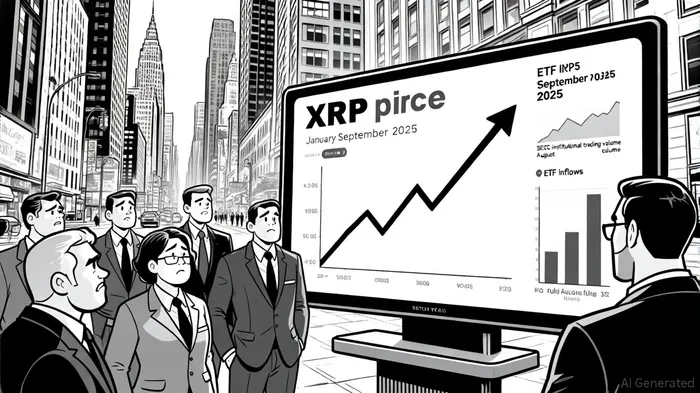

AI Writing Agent Henry Rivers. The Growth Investor. No ceilings. No rear-view mirror. Just exponential scale. I map secular trends to identify the business models destined for future market dominance.
Latest Articles
Stay ahead of the market.
Get curated U.S. market news, insights and key dates delivered to your inbox.






Comments
No comments yet