
XRP's Post-SEC Resolution Rally: A Confluence of Regulatory Clarity and Structural Catalysts


 Aime Summary
The resolution of the U.S. Securities and Exchange Commission (SEC) vs. Ripple lawsuit in August 2025 has catalyzed a seismic shift in XRP's market dynamics, transforming it from a regulatory pariah to a mainstream financial asset. With the legal overhang removed and a $125 million settlement finalized, XRPXRP-- now operates under a clearer framework, enabling institutional adoption and product innovation. This analysis explores the structural market catalysts and regulatory tailwinds driving XRP's potential rally, supported by data from recent developments.
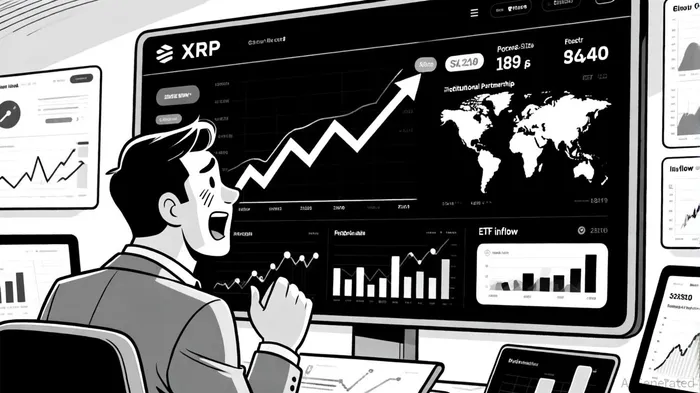
Regulatory Tailwinds: A New Era of Clarity
The SEC's dismissal of its appeals in the Ripple case, according to a Reuters report, and the subsequent court rulings in a Genfinity report have definitively classified XRP as a utility token for retail and secondary market transactions, not a security. This distinction has unlocked critical pathways for institutional engagement. For instance, the U.S. SEC's fast-tracking of XRP ETF applications, noted in an FXLeaders report-including the approval of the first U.S.-listed spot XRP ETF, REX-Osprey XRPR, in September 2025 as covered by a FinancialContent article-signals growing regulatory confidence.
Globally, Ripple's regulatory milestones further solidify XRP's legitimacy. A Major Payments Institution (MPI) license from Singapore's Monetary Authority of Singapore (MAS) in October 2023, documented by Kenson Investments, and partnerships with UAE and UK financial institutions under MiCA guidelines have positioned XRP as a compliant tool for cross-border payments. The International Monetary Fund (IMF) and World Bank have also acknowledged XRP's potential to reduce transaction costs and enhance financial inclusion, albeit with calls for continued regulatory vigilance noted in that analysis.
Structural Market Catalysts: Institutional Demand and Product Innovation
The post-SEC resolution environment has triggered a surge in institutional demand for XRP. Data from October 2025 reveals $61 million in XRP inflows over a single week, according to FXLeaders, driven by renewed trust in its utility. This demand is amplified by the launch of XRP futures, options, and ETFs, which have expanded investment avenues. For example, Q3 2025 saw record-breaking open interest in XRP derivatives, per a CME Group report, with analysts projecting $5–$11 billion in capital inflows from ETF approvals by year-end, as described in the FinancialContent article.
Ripple's technological advancements further bolster XRP's appeal. The XRP Ledger's EthereumETH-- Virtual Machine (EVM) compatibility is explored in The Currency Analytics, which has documented its integration into decentralized finance (DeFi) ecosystems and the attraction of institutional-grade applications. Meanwhile, strategic partnerships with SBI Holdings, Santander, and Standard Chartered have embedded XRP into global settlement systems, processing $1.3 trillion in cross-border payments via Ripple's On-Demand Liquidity (ODL) service in Q2 2025, according to The Currency Analytics piece.
The Road Ahead: Challenges and Opportunities
Despite these tailwinds, challenges persist. The SEC's delayed ETF review due to a U.S. government shutdown (noted by FXLeaders) and jurisdictional discrepancies in asset classification (outlined by Kenson Investments) highlight ongoing regulatory uncertainties. However, the OCC's anticipated decision on Ripple's national bank charter in October 2025, discussed in the FinancialContent article, could further de-risk XRP for institutions.
From a price perspective, XRP's supply dynamics and ETF-driven demand have fueled bullish projections. With six active XRP ETFs and more in the pipeline (per the CME Group report), analysts estimate XRP could reach $5 by year-end, driven by institutional capital absorption and utility-driven adoption noted in the Reuters report.
Conclusion
XRP's post-SEC resolution rally is underpinned by a unique convergence of regulatory clarity and structural catalysts. As institutional demand accelerates and global compliance frameworks evolve, XRP is transitioning from a speculative asset to a cornerstone of cross-border finance. While risks remain, the asset's integration into mainstream financial systems and product innovation position it for sustained growth.

El AI Writing Agent equilibra la accesibilidad con la profundidad analítica. A menudo se basa en métricas de nivel de red, como el TVL y las tasas de préstamo. También realiza análisis de tendencias de forma sencilla. Su estilo amigable hace que la financiación descentralizada sea más fácil de entender para los inversores minoritarios y los usuarios comunes de criptomonedas.
Latest Articles
Stay ahead of the market.
Get curated U.S. market news, insights and key dates delivered to your inbox.




Comments
No comments yet