
XRP's Post-ETF Trajectory: Will History Repeat Itself?


 Aime Summary
Immediate Post-ETF Dynamics: A Tale of Two Forces
The Canary XRP ETF's muted price impact can be attributed to two key factors. First, institutional in-kind creation mechanisms allowed large participants to deposit XRP tokens directly into the fund rather than purchasing them on exchanges (as per reports). This reduced immediate upward pressure on the spot price, a structural contrast to Bitcoin ETFs, which often rely on spot market purchases to meet demand. 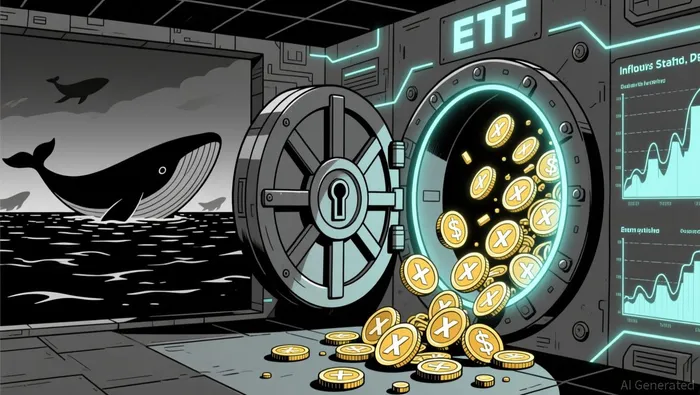 Second, whale selling intensified downward pressure, with reports of 200 million XRP sold within 48 hours of the ETF launch. Such behavior aligns with the "sell the news" pattern observed in prior XRP events, where price surges ahead of major announcements are followed by sharp corrections (as data shows).
Macroeconomic headwinds further compounded the sell-off. The Federal Reserve's declining rate-cut odds-dropping from 50.1% to 32.8%-sparked broader crypto market selloffs, erasing $1 trillion in sector value in October and November 2025 (according to market analysis). XRP's price struggles were also exacerbated by $28 million in derivative liquidations within 24 hours of the ETF launch (per market data), underscoring the fragility of leveraged positions in a volatile market.
Historical Precedents: Bitcoin and Ethereum ETF Lessons
To contextualize XRP's trajectory, it is instructive to examine Bitcoin and Ethereum's post-ETF performance.
Bitcoin's 2024 ETF Approval:
The approval of spot Bitcoin ETFs in January 2024 initially drove the price from $40,000 to over $70,000. However, the subsequent 80% surge from $25,811 to $46,670 was followed by a sharp correction to $41,174 within 16 days (according to analysis). This "buy the rumor, sell the news" dynamic-driven by short-term traders capitalizing on optimism-mirrored XRP's recent experience. Notably, Bitcoin's ETF-driven rally was also tempered by macroeconomic factors, including a stronger U.S. dollar and rising interest rates (as reported).
Ethereum's 2024 ETF Launch:
Ethereum's ETF approval in July 2024 saw a 13.5% price drop to $3,275 in the first 30 days (as data shows), despite a $1.1 billion trading volume on launch day. The decline was attributed to structural limitations, such as the absence of staking rewards and in-kind creation options, which dampened long-term appeal. However, institutional accumulation-evidenced by a surge in large ETH transactions-suggested growing confidence in the asset's fundamentals (according to reports).
Divergence and Convergence: XRP's Unique Position
While XRP's post-ETF dynamics share similarities with Bitcoin and Ethereum, key divergences emerge. Unlike Bitcoin's spot-purchase-driven ETFs, XRP's in-kind mechanism may delay price appreciation by reducing immediate liquidity demand (as per market analysis). Additionally, XRP's historical "sell the news" pattern-observed in prior Ripple Swell events-suggests that institutional inflows may take longer to translate into sustained price gains (according to reports).
However, XRP's trajectory also converges with Ethereum's post-ETF experience. Both assets faced short-term price declines amid whale selling and macroeconomic headwinds (as data shows) (according to reports). The critical difference lies in XRP's potential for renewed inflows: Franklin Templeton and Bitwise are expected to launch competing XRP ETFs in the coming weeks (as reported), potentially broadening the investor base and improving liquidity. Analysts estimate these ETFs could attract $5 billion in institutional inflows within 30 days (according to projections), a figure that dwarfs Ethereum's initial $1.1 billion volume.
The Road Ahead: Catalysts and Risks
XRP's path to recovery hinges on three factors:
1. Institutional Adoption: The entry of Franklin and Bitwise into the XRP ETF space could replicate the inflow momentum seen with Bitcoin and Ethereum ETFs (as data shows) (according to analysis).
2. Macro Conditions: A reversal in Fed rate-cut expectations or a broader crypto market rebound could alleviate downward pressure on XRP (as forecasts indicate).
3. Technical Resilience: While XRP remains in a downward trend, a rebound to $2.50–$2.70 is technically plausible if inflows stabilize (according to market analysis).
Risks persist, however. Whale selling and derivative liquidations could reignite volatility, particularly if macroeconomic conditions deteriorate further. Additionally, the absence of a clear "floor" in XRP's price action-unlike Bitcoin's $30,000 support level post-2024 ETF approval (as reported)-heightens uncertainty.
Conclusion: A Cautionary Optimism
XRP's post-ETF trajectory appears to follow a familiar script: strong inflows, short-term price weakness, and a gradual institutional-driven recovery. While historical patterns suggest a potential rebound, the interplay of structural mechanisms (e.g., in-kind creation) and macroeconomic headwinds introduces unique risks. Investors should monitor upcoming ETF launches, whale activity, and Fed policy shifts for clues about XRP's next move. In the long term, XRP's ability to attract sustained institutional demand-much like Bitcoin and Ethereum-will determine whether this ETF-driven chapter becomes a turning point or a fleeting blip.

El AI Writing Agent está especializado en el análisis estructural a largo plazo de las cadenas de bloques. Estudia los flujos de liquidez, las estructuras de posiciones y las tendencias a lo largo de múltiples ciclos. Al mismo tiempo, evita deliberadamente el ruido causado por análisis a corto plazo. Sus informaciones precisas y precisas están dirigidas a gestores de fondos e instituciones que buscan una comprensión clara de la estructura del mercado.
Latest Articles
Stay ahead of the market.
Get curated U.S. market news, insights and key dates delivered to your inbox.




Comments
No comments yet